
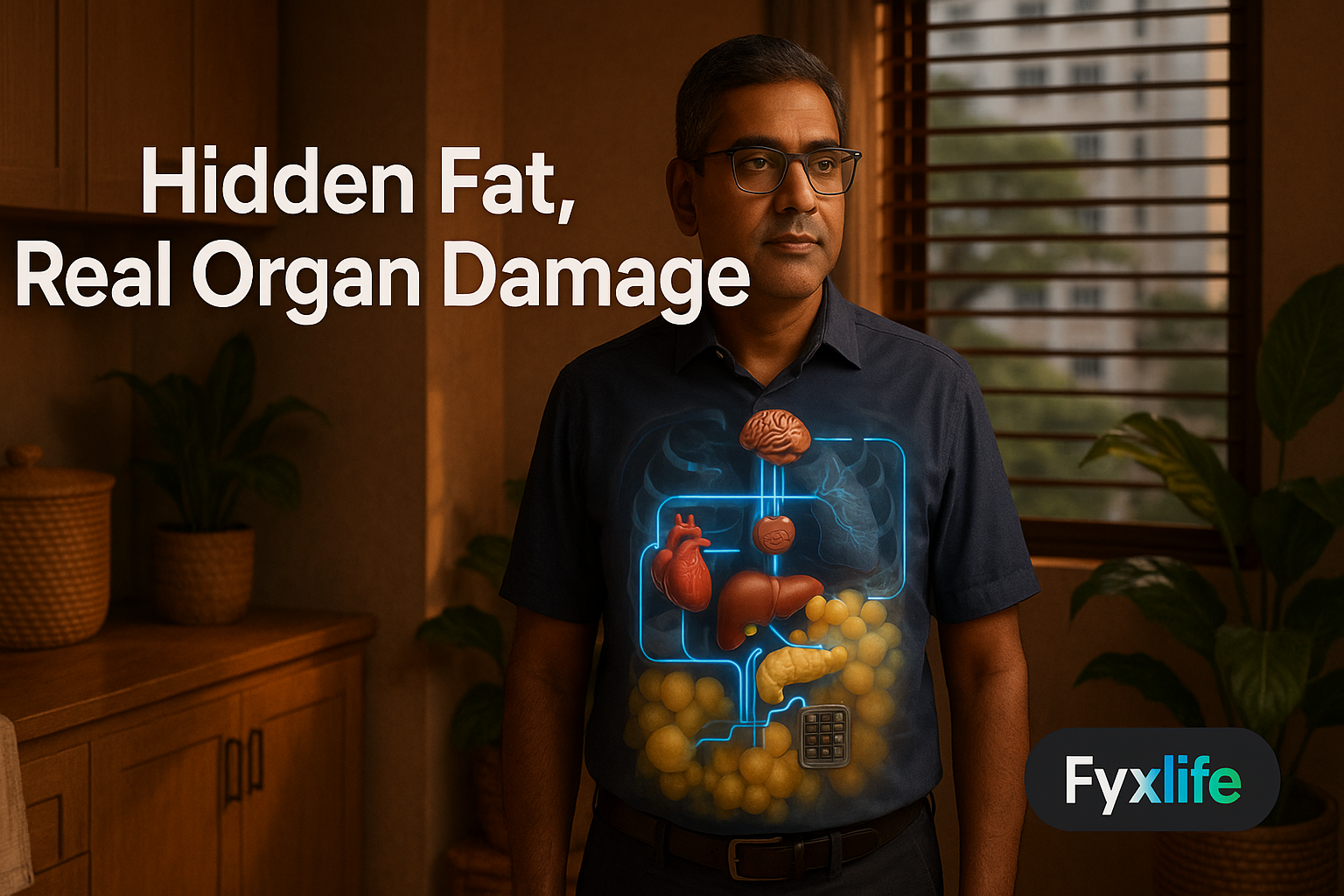
You could be a normal weight on the scale and still be carrying the most dangerous kind of fat in your body — and your doctor may never have mentioned it. Visceral fat wraps itself around your internal organs, invisible to the mirror and undetected by a standard BMI reading, quietly driving inflammation, insulin resistance, and organ damage for years before any obvious symptoms appear. If you have a family history of heart disease, diabetes, or cancer, this is the fat that matters most.
Most people think about fat the way they think about weight — as something they can see, feel, or measure on a scale. You might grab a handful at your waistline and decide there’s work to do. Or you might step off the scale at a healthy number and feel reassured. Neither of those tells you anything useful about what is sitting next to your liver right now. The fat that causes the most biological harm isn’t the kind you can pinch. It’s the kind already embedded deep inside your abdominal cavity, and it is metabolically active in ways that most routine check-ups are not designed to catch.
What Is Visceral Fat — And Why Standard Scales Miss It
The difference between fat you can pinch and fat that wraps your organs
Your body stores fat in two fundamentally different places, and the distinction matters enormously. The fat you can physically pinch at your waist or thighs is stored just beneath the skin — the technical term for this is subcutaneous fat (subcutaneous meaning “under the skin”). It is visible, measurable, and while excess amounts carry their own health considerations, it is largely inert in terms of immediate organ damage.
Visceral fat is something else entirely. It is body fat stored deep within the abdominal cavity, wrapping around vital internal organs including the liver, pancreas, and intestines. You cannot see it. You cannot feel it. A healthy weight on the scale does nothing to confirm or deny its presence. This is not belly fat you haven’t worked off yet — this is fat that has set up residence inside the cavity where your critical organs operate.
Where visceral fat actually lives inside your body
Visceral fat is located near several vital organs including the liver, stomach, and intestines, and can also build up in the arteries — making it distinct from subcutaneous fat stored just beneath the skin. When you picture it, think not of a layer under your skin but of fat packed into the spaces between your organs — surrounding your liver, cushioned against your pancreas, threaded through the mesentery (the web of tissue that connects your intestines to your abdominal wall). It occupies the most critical operating space in your body.
Why BMI and body weight are poor proxies for visceral fat burden
Body mass index (BMI) — the calculation that divides your weight by the square of your height — was designed as a population-level screening tool. It was never intended to assess body composition in an individual, and it does not distinguish between muscle, subcutaneous fat, and visceral fat. A person with significant muscle mass might register as overweight on BMI. A slim person with almost no visible fat might be carrying a dangerous amount of fat around their organs. The number on the scale reflects total mass, not fat distribution — and fat distribution is the variable that predicts disease risk far more accurately than weight alone.
How Visceral Fat Works Against You — The Mechanism
Visceral fat as a chemical factory, not just a storage depot
Think of visceral fat like an uninvited tenant who has moved into the utility room of your house — the room where your boiler, fuse box, and water pipes all live. A small amount of storage in that room is fine. But when the tenant starts piling junk floor to ceiling, they begin blocking the valves, interfering with the wiring, and releasing fumes that drift through every room. The house looks normal from the outside. But the systems running it are quietly being compromised. That is exactly what excess visceral fat does to your liver, heart, pancreas, and brain — it is not inert storage, it is an active, disruptive presence in your body’s most critical operating space.
Visceral fat behaves less like storage and more like a rogue endocrine organ — a tissue that secretes its own chemical signals. It releases adipokines (the term for hormone-like chemical messengers produced by fat tissue) and pro-inflammatory proteins directly into the portal vein, the blood vessel that feeds the liver. This gives visceral fat a disproportionate influence on liver function compared to fat stored anywhere else in the body. The liver receives this chemical output first, before it dilutes into the wider bloodstream.
The chain reaction of damage: from organ fat to systemic inflammation
The chemical signals released by visceral fat include elevated levels of cytokines (inflammatory signalling proteins), particularly interleukin-6 and tumour necrosis factor-alpha. This triggers what researchers call chronic low-grade systemic inflammation — a persistent, body-wide activation of the immune response that never fully resolves. Unlike the acute inflammation you feel from a cut or infection, this version operates silently for years. It damages blood vessel walls. It disrupts hormone signalling. It accelerates cellular ageing in a way that accumulates over decades.
The insulin resistance loop — how fat around your organs drives chronically high blood sugar, which drives more fat
Visceral fat also disrupts the body’s ability to use insulin effectively — a condition called insulin resistance (where your cells stop responding normally to insulin’s signal to absorb glucose from the blood). When your cells resist insulin, your pancreas compensates by producing more of it. Higher circulating insulin promotes further fat storage, particularly in the visceral compartment. That additional fat produces more inflammatory signals, worsening insulin resistance further. The cycle becomes self-reinforcing, and standard check-ups often miss it entirely because fasting glucose may remain within the normal reference range long after the underlying dysfunction is well established.
Organ by Organ — What Visceral Fat Does to Your Body
The liver: when fat becomes a resident neighbour
The liver is visceral fat’s closest and most damaged neighbour. Fat deposits directly in liver cells, progressing through what is now called metabolic dysfunction-associated steatotic liver disease (previously known as non-alcoholic fatty liver disease — a condition where fat accumulates in the liver without alcohol as a cause). In its early stages, fatty liver produces no symptoms. Over time, it can progress to inflammation, scarring (fibrosis), and in some cases, cirrhosis — irreversible structural damage. This progression can happen in people who drink very little alcohol and whose liver enzyme levels on a routine blood test appear unremarkable.
The heart and arteries: plaque building and cardiovascular risk
The inflammatory proteins flowing from visceral fat into the bloodstream directly damage the endothelium — the thin cellular lining of your arteries. Damaged endothelium allows plaque (fatty, calcium-containing deposits) to accumulate inside artery walls (atherosclerosis) — a process that begins decades before any cardiac symptoms appear. Visceral fat also raises circulating triglycerides and reduces HDL cholesterol (the protective kind), both of which accelerate this process. If you have a family history of heart disease, visceral fat is not an abstract risk — it is the mechanism most likely to be responsible.
The brain: how organ fat affects memory, reasoning, and processing speed
This is the finding that surprises people most, and it should receive more attention than it does. It is the deep visceral fat around organs that has been shown to affect reasoning, memory, and processing speed — reframing visceral fat accumulation as a cognitive risk, not just a metabolic one. The mechanism runs through several pathways: chronic inflammation damages brain tissue over time, insulin resistance impairs the brain’s glucose metabolism, and visceral fat is associated with reduced volume in the hippocampus, the brain region central to memory formation. The person who notices they’re slower to recall names, or that their thinking feels less sharp than it did five years ago, may be experiencing something that began in their abdominal cavity.
The pancreas: insulin production under pressure
Fat deposits directly in and around the pancreas reduce its ability to produce and release insulin efficiently. This is a direct physical and biochemical assault on the organ responsible for blood sugar regulation. Over time, a pancreas operating under this kind of chronic stress loses functional capacity — contributing to the progression from insulin resistance toward type 2 diabetes. This damage is gradual, largely silent, and well underway before a fasting glucose test shows anything outside the normal range.
The Asian Risk Factor — Why This Matters More in Singapore and Southeast Asia
Metabolic risk appears at lower BMI thresholds in Asian populations
If you are reading this in Singapore or Southeast Asia, the standard BMI thresholds used in Western medicine underestimate your risk. Research consistently shows that Asian populations develop metabolic syndrome (a cluster of conditions including high blood pressure, elevated blood sugar, abnormal cholesterol, and excess abdominal fat that together significantly raise the risk of heart disease and diabetes) at lower BMI values than Caucasian populations. Internal visceral fat — the fat we don’t see — affects metabolic health significantly, and Asian individuals tend to accumulate a higher proportion of visceral fat relative to total body fat compared to other ethnic groups. This means a BMI of 23 in Singapore carries different implications than a BMI of 23 in London.
What ‘normal weight’ can hide in an APAC context
The World Health Organization has recommended lower BMI cut-off points for Asian populations — flagging overweight at 23 rather than 25, and obesity at 27.5 rather than 30. But even these adjusted thresholds don’t capture the full picture, because they still don’t measure visceral fat directly. A person in Singapore who is told their BMI is fine, whose blood sugar is normal, and whose cholesterol is borderline — that person may already be in the early stages of visceral fat accumulation driving real organ stress. The gap between standard reassurance and actual metabolic status can be significant, and it is rarely addressed in a routine annual check-up not designed for this level of specificity.
How to Know If You’re Carrying Excess Visceral Fat
Waist circumference as a practical first signal
The simplest tool you have at home is a tape measure. Waist circumference — measured at the level of your navel, without holding your breath — correlates meaningfully with visceral fat burden. For Asian populations, the thresholds that signal elevated risk are lower than Western guidelines suggest: above 90cm for men and above 80cm for women. This is not a diagnostic test, but it is a meaningful signal that warrants further investigation. A waist-to-height ratio (your waist circumference divided by your height) below 0.5 is a useful additional marker.
Biomarkers that correlate with visceral fat burden — what to look for on a standard blood panel
Several markers on a standard blood test correlate with visceral fat accumulation. Elevated fasting triglycerides (blood fats measured after an overnight fast) above 1.7 mmol/L, reduced HDL cholesterol, elevated fasting glucose trending toward the upper end of the normal range, and raised ALT (alanine aminotransferase — a liver enzyme that rises when liver cells are under stress) are all signals worth paying attention to. None of these individually confirms visceral fat accumulation, but a pattern across two or more of these markers in someone with a family history of metabolic disease is a meaningful cluster.
When imaging becomes the honest answer
The gold standard for measuring visceral fat is an MRI (magnetic resonance imaging) or CT scan (computed tomography — an X-ray based imaging technique that produces cross-sectional body images). These are rarely offered in a routine check-up, but they are increasingly available as part of comprehensive health screening programmes. A more accessible alternative is a DEXA scan (dual-energy X-ray absorptiometry — a low-radiation scan that measures body composition including fat distribution), which can estimate visceral fat and is available at some specialist screening providers in Singapore. For anyone with multiple risk factors and a family history of metabolic disease, this level of visibility is not excessive — it is appropriate.
What This Means for You — The Explainer Takeaway
Visceral fat is not a cosmetic problem. It is not a weight problem in the conventional sense. It is a biological condition in which metabolically active fat tissue has accumulated in the body’s most critical operating space and is actively interfering with the organs that run your most fundamental systems. It is invisible on the outside, under-detected by standard screening, and disproportionately dangerous in Asian populations — where the risk appears at lower body weights than Western medicine was built to flag.
The reassuring number on your scale, or the GP who tells you your BMI is fine, is not lying to you. But they are answering a different question than the one that matters here. The question that matters is not how much you weigh — it is where your fat is stored, what it is doing to the organs around it, and whether the early signals are already visible in your blood work if someone is looking at the right markers.
Apply this mechanism insight to a decision you are already making this week: the next time you look at a routine blood test result, check your fasting triglycerides and fasting glucose — two biomarkers that correlate with visceral fat accumulation even when body weight looks normal. If either is trending toward the upper end of the reference range, that is your signal to request a more specific conversation with your doctor about visceral adiposity — not weight management in general, but fat around your organs specifically.


