
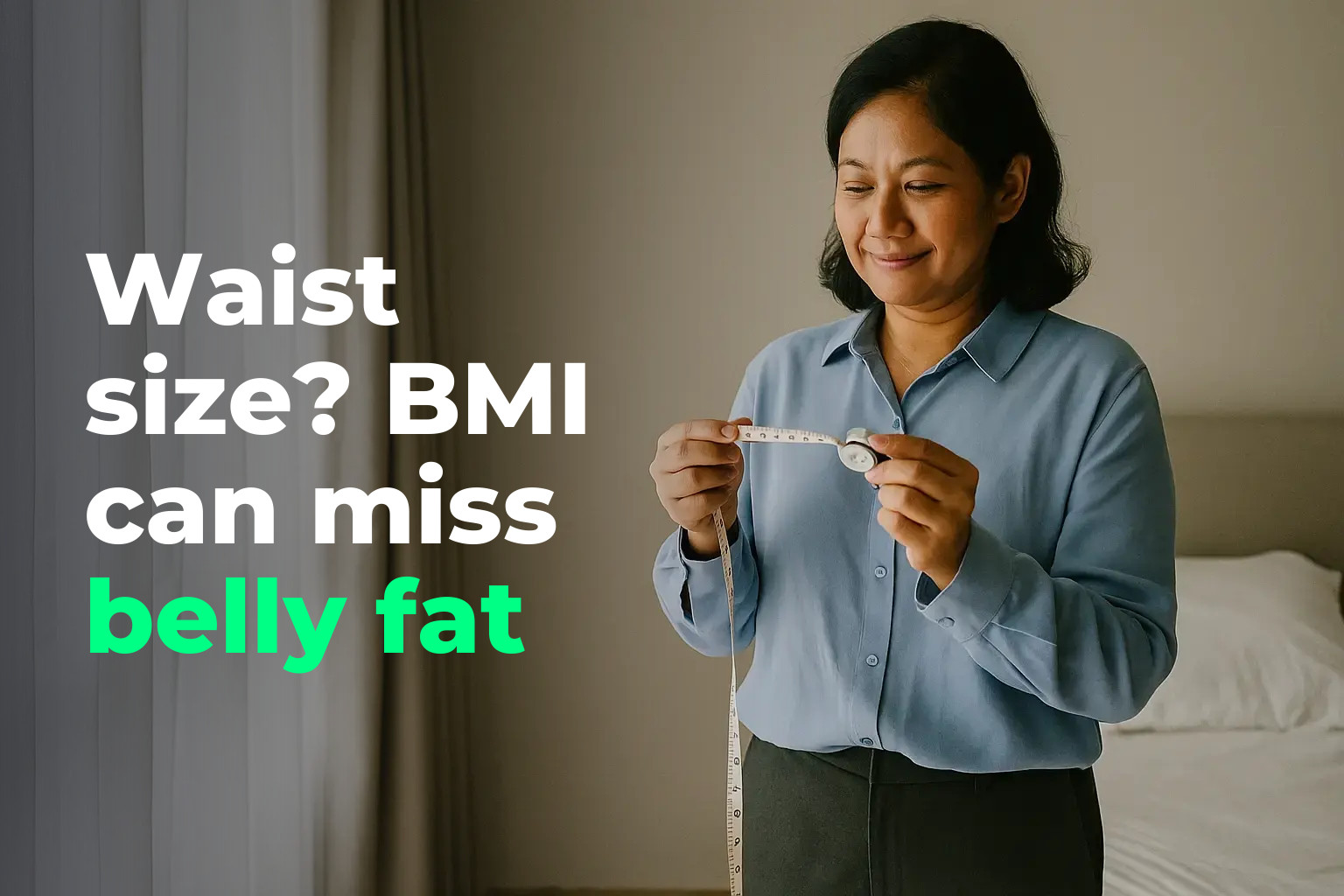
QUICK ANSWER
A healthy waist size for Asian adults is under 90 cm (35.5 in) for men and under 80 cm (31.5 in) for women, says Singapore’s HealthHub. Above that, belly fat may be raising your risk, even with a normal BMI. Measure between your lower ribs and navel, after breathing out.
Key takeaways
- Asian cut-offs sit lower than US ones, so use the Asian numbers.
- Belly fat can be high even when BMI looks normal, so check the tape as well as the scale.
- Measure between lower ribs and navel, after breathing out.
- You can’t spot-reduce belly fat, but regular aerobic activity can shrink your waist.
At a glance
Waist size chart: Asian cut-offs in cm and inches, with waist-to-hip and waist-to-height checks
| Measure | Men | Women | What it means |
|---|---|---|---|
| Waist, Asian cut-off | Under 90 cm (35.5 in) | Under 80 cm (31.5 in) | Above this counts as abdominal obesity |
| Waist-to-hip ratio (WHO) | 0.9 or less | 0.85 or less | Above this points to higher heart risk |
| Waist-to-height ratio | Waist ÷ height | Waist ÷ height | Example: 80 cm ÷ 170 cm = 0.47 |
| US waist threshold | 40 in (about 102 cm) | 35 in (about 89 cm) | Higher than the Asian cut-offs |
What is a healthy waist size for men and women?
For Asian adults, HealthHub advises under 90 cm (35.5 in) for men and under 80 cm (31.5 in) for women [1] [2]. Above that, it calls it abdominal obesity [3].
In Singapore’s National Population Health Survey, obesity was highest, at 15%, among adults aged 40 to 49 [3]. That figure uses BMI, not waist size.
Men under 90 cm, women under 80 cm: that is the Asian waist line.
How do I measure my waist correctly?
Place the tape between your lower ribs and navel, level all the way round, and read it after breathing out [3] [2].
- Stand relaxed, with your belly unclenched.
- Use a soft tape on skin or thin clothing.
- Measure under the same conditions each time, such as first thing in the morning.
Keeping a soft tape in a bathroom drawer makes this easy to repeat.
Why Asian waist cut-offs differ from UK or US ones
Many Asians have a high risk of type 2 diabetes and heart disease at lower body weight than Europeans, so Asian cut-offs are lower [4]. US thresholds are 35 inches for women and 40 inches for men [5].
Why this varies from person to person
The right cut-off depends on your sex and the guideline used. Your own risk also depends on your health and family history, so a number is a starting point.
Does waist size predict heart disease and diabetes better than BMI?
For screening metabolic syndrome, waist size and waist-to-height ratio performed better than BMI-based measures [6]. Metabolic syndrome is a cluster of heart and diabetes risk factors. BMI estimates total body fat but ignores where it sits [1].
Waist-to-height ratio
This is your waist divided by your height, in the same units. For example, 80 cm divided by 170 cm is 0.47. The sources used here give no guideline target, so ask your doctor which cut-off they use.
Waist-to-hip ratio
A ratio above 0.9 in men or 0.85 in women points to higher heart risk [1]. At 1.0 or more, heart disease risk rises in both sexes [7].
What changes your waist size?
Aerobic activity can help shrink your waist [8]. Sit-ups alone do not help [8].
- Activity: 150 minutes a week of moderate to vigorous aerobic exercise gave clinically important waist reductions [9].
- Strength: men who lifted weights gained about half as much belly fat over 12 years as cardio-only men [8].
- Sleep and stress: stress raises cortisol, a hormone that increases how much deep belly fat your body stores [1]. Poor sleep can spike cortisol too [8].
- Screen time: US adults who watched 2 hours or more of TV a day were more likely to have a large waist [10].
- Food: people who ate the most ultra-processed food were more likely to have a large waist. This is an association, not proof of cause [11].
- Alcohol: your liver burns alcohol before fat, so drinks can slow fat burning [5].
On your plate
- Swap: ask for less rice with your chicken rice and add a side of vegetables.
- Swap: at a yong tau foo stall, pick clear soup over laksa gravy.
- Swap: teh tarik for teh-O kosong.
- Trade: packaged ultra-processed snacks for fresh fruit or nuts [11].
Fitting it into a 40-something work week
After a late client call, the sofa and a screen are tempting. Try a 10-minute walk after lunch at the food court and a fixed lights-out time. Fiya can fit your weekly activity around meetings and trips.
When to see a doctor
- Your waist is above the cut-off, even with a normal BMI. Book a routine appointment to discuss your overall risk and whether any checks are appropriate.
- Your waist-to-hip ratio is 1.0 or higher.
- Your waist keeps growing despite changes to food, activity and sleep.
- You already have diabetes, high blood pressure or fatty liver and your waist is above the cut-off.
- If you are pregnant, different advice applies: ask your antenatal clinic how to read changes in your waist.
HOW FIYA HELPS
Sticking with it
Shrinking a waist takes time, which makes it easy to lose interest. Fiya is Fyxlife’s personal health manager. She works over WhatsApp, reads the lab reports you share and tells you the next right thing to do.
Frequently asked questions
It is your waist divided by your height, in the same units. For example, 80 cm divided by 170 cm is 0.47. We have no guideline source for a target here, so ask your doctor which number they use.
Yes. BMI estimates total body fat but ignores where it sits. HealthHub notes that excess belly fat can happen even when your BMI is in the healthy range.
No. Fat can’t be burned from one spot, so sit-ups alone won’t shrink your belly. Brisk walking, cycling or other aerobic activity done regularly is what can help over time.
The WHO range is 0.9 or less for men and 0.85 or less for women. Divide your waist by your hip measurement. A ratio of 1.0 or higher raises heart disease risk in both sexes.
A 32 inch waist is about 81 cm, under the male cut-off and just above the female one. 28 inches is about 71 cm. Trouser labels vary by brand, so trust a tape measure, not the size tag.
A 34-inch waist is not reliably M or L, because brand size charts differ. Measure your body with a tape, then check that brand’s own chart before buying.
Related reading
- NEAT Explained: Why Everyday Movement Matters
- HIIT Protocol for Longevity Athletes: The Right Way
- Strength Training for Women: The Evidence-Based Protocol
- Mobility & Stability Training: What the Evidence Says
References
- Do You Know All There Is To Know About Your Belly Fat?, HealthHub (Health Promotion Board / MOH Singapore), 2022
- Daily Habits To Help Fight The Belly Bulge, HealthHub, 2025
- Obesity in Singapore: It’s Not a Small World, HealthHub (Health Promotion Board), 2022
- Appropriate body-mass index for Asian populations and its implications for policy and intervention strategies, WHO Expert Consultation, The Lancet, 2004
- How To Get Rid of a Beer Belly, Cleveland Clinic, 2024
- Effectiveness of body roundness index in predicting metabolic syndrome, Obesity Reviews, 2020
- What is a Healthy Weight?, HealthHub, 2026
- Strategies to Reduce Abdominal Fat Effectively, HealthHub, 2025
- Aerobic Exercise and Weight Loss in Adults: A Systematic Review and Dose-Response Meta-Analysis, JAMA Network Open, 2024
- Factors Affecting Obesity and Waist Circumference Among US Adults, Preventing Chronic Disease (CDC), 2019
- Consumption of ultra-processed foods and health status, British Journal of Nutrition, 2021
Sources checked on 2026-10-16.
This article is general information, not medical advice. Talk to your doctor about your own results and before changing any medicine.


