
The Study At A Glance — What Researchers Actually Found
You already optimise your sleep, your VO2 max, your glucose. But inside your body right now, a different kind of threat is accumulating — cells that refuse to die and are slowly poisoning everything around them. Here is what the latest science on cellular senescence actually found, what it means for your healthspan, and where the evidence still has gaps.
The science of aging has produced a lot of promising headlines that quietly evaporated under scrutiny. Senescence research is different — not because it has delivered human clinical proof yet, but because the mechanism is unusually well-characterised, the animal data is striking, and the translation effort is now serious. This is not fringe biology. It is one of the most actively funded areas in longevity science right now. What it is not, yet, is something you should be self-medicating for. That distinction matters, and this article will hold it throughout.
The Core Finding: Clearing Zombie Cells Extended Lifespan By Up To 35% In Mice
The study most cited in this field came out of the Mayo Clinic and produced results that stopped researchers mid-sentence. When scientists cleared senescent cells from aging mice, the animals lived 25 to 35% longer, showed stronger cardiac function, and maintained better physical performance than controls. To put that in human terms: if the same effect scaled proportionally, it would represent more than a decade of additional healthy life. That is the number that made senolytic research a priority. It is also a mouse number, and that distinction carries real weight — which we will get to.
What Senolytics Are And Why Scientists Are Excited
A senolytic is a compound designed to selectively clear senescent cells from tissue — the “lytic” part meaning to break apart or destroy. The concept sounds straightforward. The execution is not. Senolytic therapy is now described as a potential revolution in aging science, with the field actively moving from animal models toward human clinical investigation. Several trials are underway. None have yet produced the kind of large-scale, long-term human data that would justify widespread clinical use. But the excitement in the research community is based on something real: a mechanism that is biologically coherent, measurable, and — in animals — clearly modifiable.
What Are Zombie Cells — And Why Do They Matter To You
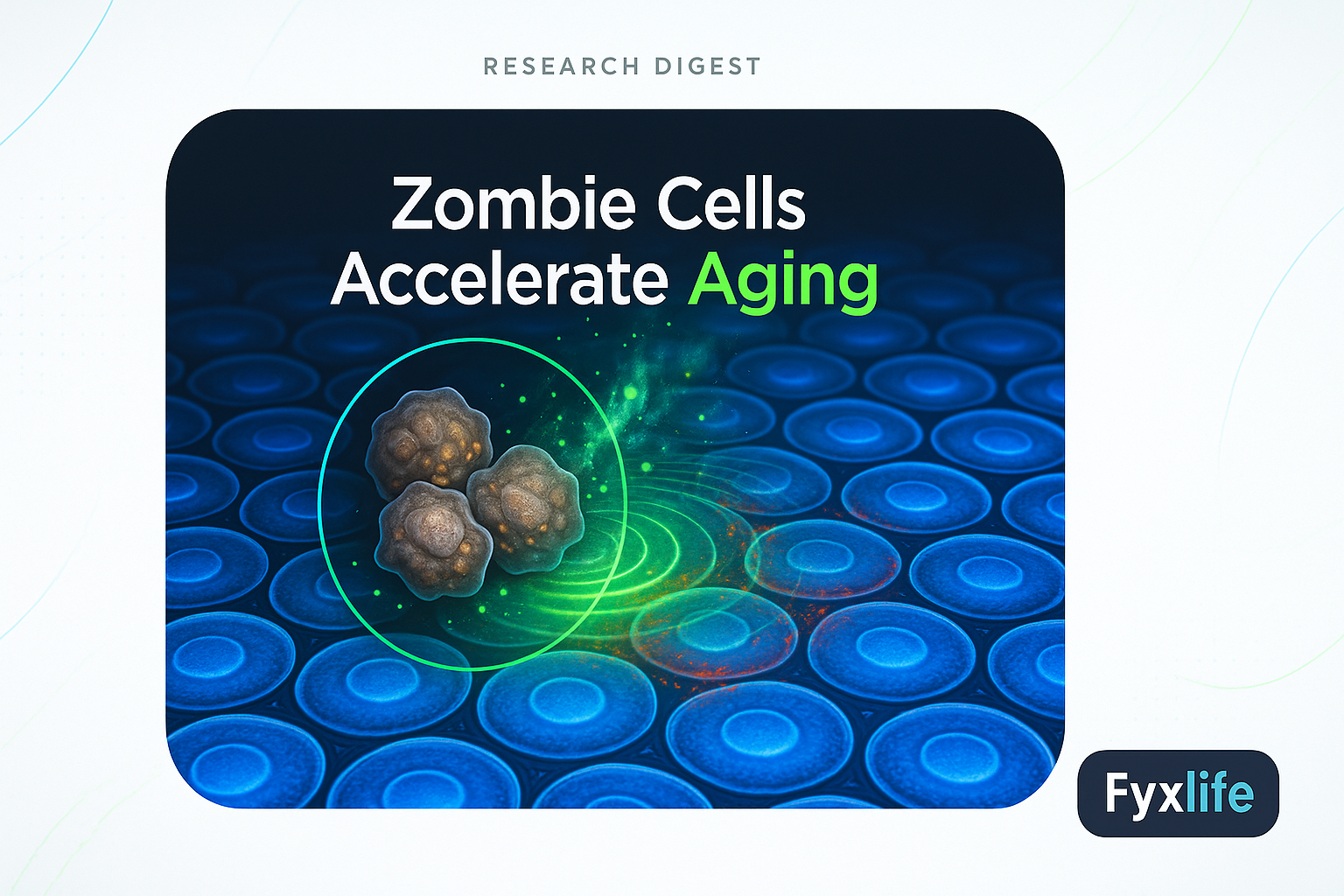
Think of your body’s tissues as a garden. Healthy cells are productive plants — they grow, do their job, and eventually die off to make room for new growth. Senescent zombie cells are like plants that have stopped producing but refuse to be pulled out. Worse, they leak a chemical signal that slowly wilts the healthy plants around them. A gardener’s instinct is to yank every dead plant immediately — but researchers have discovered some of those dead plants are actually sheltering beneficial insects underneath. That is the senolytic challenge in one image: selective weeding without destroying the ecosystem.
The Mechanism: How A Cell Becomes A Zombie
Every cell in your body carries a set of internal stress sensors. Under normal conditions, when a cell is too damaged to function properly, it either repairs itself or triggers a controlled self-destruction process (the technical term for this is apoptosis). Senescence is what happens when that self-destruction pathway fails — or is deliberately bypassed. When a cell is subjected to extreme stress, severe DNA damage, or critically shortened protective caps at the ends of chromosomes (telomeres), it enters a senescent state — stopping division but persisting in tissue rather than undergoing normal programmed cell death. The cell is stuck. It cannot replicate and it will not die. And it is not quiet about it.
The SASP Problem: Why These Cells Don’t Just Sit There — They Poison Their Neighbours
Cellular senescence describes a state where cells stop dividing but continue releasing inflammatory and tissue-degrading signals, actively damaging surrounding healthy tissue rather than simply going dormant. This toxic output has a formal name: the senescence-associated secretory phenotype, or SASP. Think of it as a distress broadcast that never switches off — a constant low-level chemical alarm that drives a chain reaction of damage throughout surrounding tissue (what researchers call systemic inflammation). Over years, this is not a local problem. The systemic cascade from zombie cell accumulation connects senescence biology to cardiovascular disease, metabolic dysfunction, and cognitive decline — not just wrinkles and stiff joints. This is why researchers argue that senescence is not a footnote in the aging story. It may be a central chapter.
The Nuance: Some Zombie Cells Are Actually Useful
Here is where the popular narrative oversimplifies dangerously. Scientists have reappraised the role of zombie cells, finding that some senescent cells are embedded in young, healthy tissue and actively promote normal repair from damage — making blanket clearance more complicated than it sounds. Senescence appears to be an evolutionarily conserved mechanism, not a pure malfunction. In wound healing, in embryonic development, and in tumour suppression, controlled senescence plays a constructive role. The problem is accumulation over time — when the immune system loses its ability to clear these cells efficiently, they pile up, and their SASP output shifts from temporary signal to chronic noise. The garden metaphor holds: a few dormant plants sheltering useful insects are fine. A garden overrun by them is a problem.
What This Research Can And Cannot Prove
The Mouse-To-Human Gap: Why You Should Not Buy Senolytics Off The Internet Yet
The 35% lifespan extension in mice is genuinely exciting. It is also the product of a controlled experiment in genetically similar animals, living in sterile conditions, with precisely timed interventions. Mice are not small humans. Their immune systems differ. Their telomere biology differs dramatically from ours. And the interventions that cleared zombie cells in those experiments were not the over-the-counter compounds circulating in longevity forums. The mechanism is translatable in principle. The dose, timing, safety profile, and net effect in a genetically diverse human population with decades of accumulated lifestyle variation are entirely separate questions — ones that have not yet been answered.
Where Human Trials Stand Right Now
Several human trials are now underway investigating senolytic compounds — most prominently combinations of dasatinib (a cancer drug) and quercetin (a plant flavonoid), as well as navitoclax and fisetin. The field is actively moving from animal models toward human clinical investigation, but most current trials are small, short-duration, and focused on safety rather than longevity endpoints. Early signals are cautiously encouraging in specific conditions like idiopathic pulmonary fibrosis and diabetic kidney disease. Broad healthy-aging applications in humans remain unproven. The honest framing is this: the science is real, the direction is compelling, and the human evidence is not yet there. That gap is closing, but it has not closed.
This is exactly the kind of frontier where the standard health system was not designed to help you navigate. A GP working within a 15-minute consultation is unlikely to have reviewed the senolytic trial pipeline or to know how your specific biomarker pattern maps onto the emerging senescence research. That is not a criticism — it is an accurate description of what routine care was built to do, and what it was not.
What Accelerates Zombie Cell Accumulation — And What You Can Do About It
Known Accelerators: DNA Damage, Chronic Inflammation, Shortened Telomeres
The inputs that push cells into senescence are, largely, the same inputs that accelerate aging across every other system you already track. Ultraviolet radiation causes DNA damage directly. Chronic low-grade inflammation — driven by poor sleep, processed food, visceral fat, and chronic stress — creates the cellular environment in which senescence accumulates fastest. Shortened telomeres, the protective caps on your chromosomes that erode with each cell division, are both a trigger for senescence and a measurable signal of accumulated biological stress. The SASP output from existing zombie cells also creates a feedback loop — the inflammation it generates damages nearby cells, pushing more of them into senescence. The fire spreads. This is why managing the inputs is not just general health advice. In the context of senescence biology, it is mechanistically specific.
Natural Compounds Under Investigation: Spermidine And Others
While clinical senolytics mature in human trials, a natural compound called spermidine — found in high concentrations in wheat germ, aged cheese, mushrooms, and soybeans — has attracted genuine research attention. Spermidine has been shown to reduce cellular senescence and extend lifespan in different organisms in study conditions, partly through its role in promoting a cellular self-cleaning process (the technical term is autophagy) that clears damaged components before they accumulate. Quercetin, fisetin, and resveratrol are also under investigation, with varying levels of evidence. None of these are proven senolytics in humans at dietary doses. But they represent the current dietary bridge between the mouse data and whatever comes next in clinical trials.
What To Watch — The Biomarker And Research Signals Worth Tracking
How Biological Age Metrics And Routine Biomarkers Connect To Senescence
You cannot yet measure your senescent cell burden with a standard blood test. What you can measure are the downstream signals it produces. Eighteen routine biomarkers have been identified that can estimate biological age at scale, with senescence-driven systemic breakdown identified as a key mechanism connecting those biomarker patterns to accelerated aging. CRP (C-reactive protein) — a standard marker for systemic inflammation — is one of the most accessible proxies for the kind of chronic inflammatory environment that both accelerates zombie cell accumulation and is amplified by SASP output. Biological age clocks based on DNA methylation patterns (the epigenetic clock, most famously the Horvath clock) are moving toward clinical availability and represent a more direct window into how fast your cells are aging. Interleukin-6 and other specific inflammatory signalling proteins are also used in research settings as SASP markers. The field is moving toward routine senescence monitoring. It is not there yet for most people.
The Bottom Line — One Decision You Can Make Today
The science of zombie cells is not science fiction. The mechanism is real, the animal data is striking, and the human research is accelerating. What the evidence does not yet support is treating yourself with experimental senolytic compounds sourced from supplement marketplaces. What it does support is taking the inflammatory inputs that drive senescent cell accumulation seriously — and understanding how to read the proxies you already have access to.
Pull your most recent full blood count and CRP (C-reactive protein) result. Chronically elevated CRP is one of the clearest accessible signals of the kind of systemic low-grade inflammation that both accelerates senescent cell accumulation and is amplified by SASP. If your CRP is above 1.0 mg/L without an obvious acute cause, that is a concrete data point worth bringing to your doctor alongside the question: “Is it worth adding a high-sensitivity CRP and biological age panel to my next annual screen, given the emerging senescence research?”


