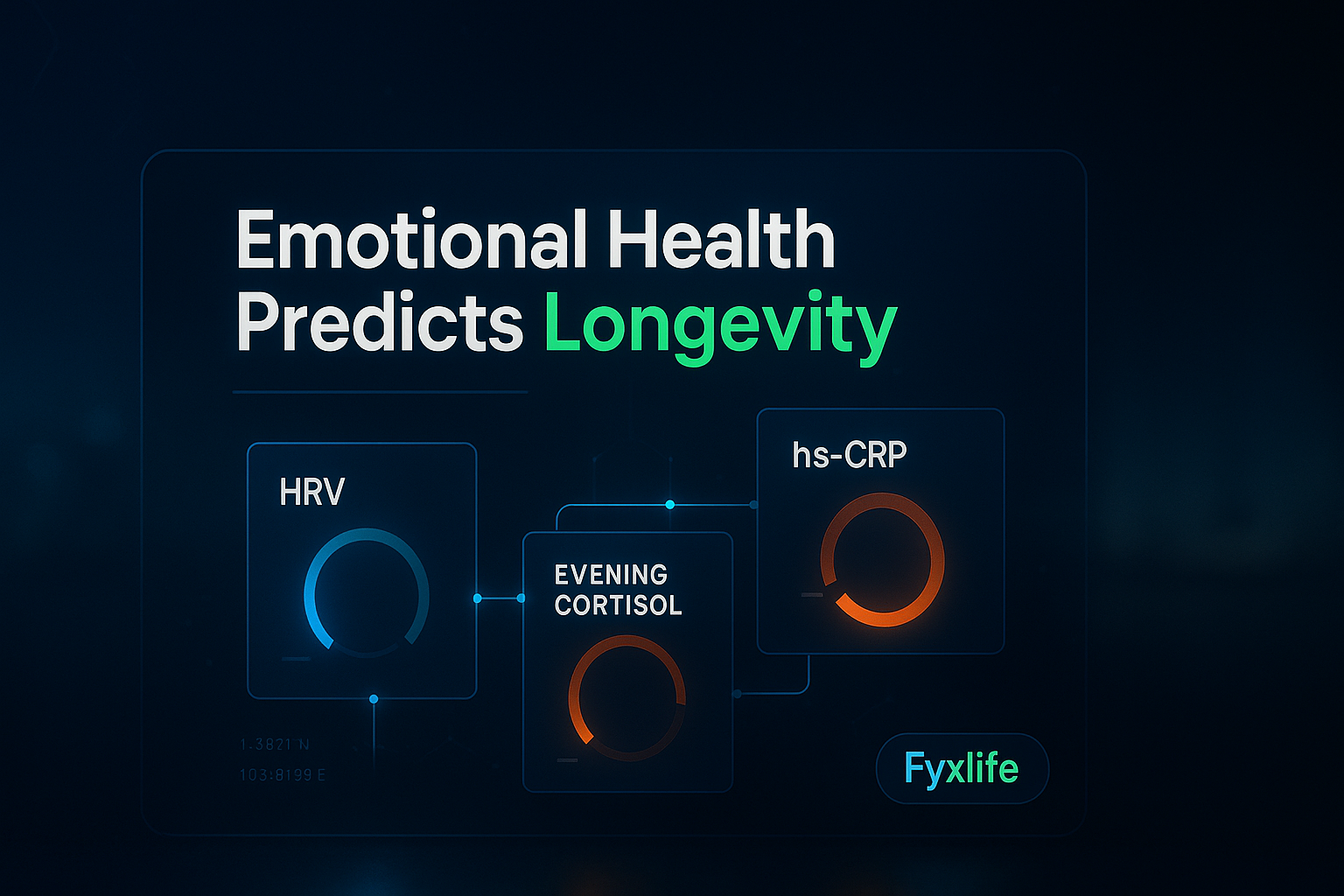
You track your LDL, your HRV, maybe even your VO2 max — but when did you last measure the thing that predicts how long you’ll live as reliably as any blood panel? Emotional health has quantifiable biomarkers, and ignoring them is the longevity blind spot most optimisers don’t know they have. You’ve built the spreadsheet, run the tests, optimised the sleep. And yet the chronic low-grade stress of a demanding career, a caregiving role, a mind that won’t fully switch off — that part stays in the “too soft to measure” column. It shouldn’t. It never should have been there.
Why Emotional Health Has a Lab Report (And You Should Be Reading It)
The biology beneath the feeling — how chronic stress and emotional load show up in blood markers
Stress is not just a feeling. It is a biological event. When you carry a heavy emotional load — chronic work pressure, unresolved conflict, persistent low-level anxiety — your body responds with measurable physiological changes. The stress response system releases hormones. The immune system activates. Inflammation rises. Proteins in your bloodstream shift their pattern. None of this is invisible. All of it is testable.
The mechanism works like this: your brain perceives a threat, real or psychological, and activates the hypothalamic-pituitary-adrenal axis — the body’s central stress command system — which floods the bloodstream with cortisol and other stress hormones. In short bursts, this is protective. Sustained over months or years, it becomes corrosive. Inflammatory proteins accumulate. Cellular repair slows. The proteomic composition of blood — the pattern of proteins circulating at any given time — is a complex signal of biological age, and chronic psychological stress is known to alter this composition in ways that accelerate aging trajectories. That acceleration is not theoretical. It shows up in your results.
What ’emotional health biomarkers’ actually means — and what it doesn’t
Let’s be precise. An emotional health biomarker is not a test that measures happiness or stress directly. No blood draw can quantify how you feel. What it can do is measure the downstream biological consequences of how you’ve been feeling — for weeks, months, years. Think of the distinction this way: the biomarker isn’t the emotion, it’s the footprint the emotion leaves in your physiology.
Biomarkers of aging are biological parameters that can predict functional capacity at a later age better than chronological age — meaning two people of the same age can have vastly different biological trajectories depending on their lifestyle and psychological load. This is not a peripheral finding. It reframes emotional health entirely: from a wellbeing concern into a clinical longevity variable.
The Core Tests: What to Measure and Why
Heart Rate Variability (HRV) — your autonomic nervous system’s daily report card
Heart rate variability is the variation in time between consecutive heartbeats, and it is one of the most sensitive real-time indicators of stress load your body produces. A higher HRV generally signals that your autonomic nervous system — the part of your nervous system that regulates involuntary functions like heart rate, digestion, and immune response — is flexible and well-regulated. A chronically suppressed HRV signals that you are operating in a prolonged state of physiological stress, even when you feel like you’re coping fine.
You don’t need a lab for this one. A wearable device — Garmin, Polar, Whoop, or an Oura ring — captures HRV during sleep. What matters is not your single reading but your 30-day rolling trend. A week of poor sleep before a big presentation will dip your HRV. Six months of that same pattern without recovery is the signal worth acting on.
Cortisol rhythm — the difference between a morning reading and the full diurnal curve
Cortisol is your primary stress hormone, and it is supposed to follow a predictable arc: high in the morning — which is healthy and helps you wake — declining through the day, and low by evening. A single morning cortisol reading tells you almost nothing clinically useful about stress load. What matters is the full daily pattern, called the diurnal cortisol curve.
A four-point salivary cortisol test — taken at waking, midday, late afternoon, and evening — is the minimum meaningful snapshot. Elevated evening cortisol in particular is a reliable marker of chronic stress load, poor sleep onset, and suppressed immune repair. This test is available through functional medicine practitioners and most longevity-focused clinics in Singapore. It is not a standard request at a GP appointment, but it is a reasonable one to make.
Inflammatory markers — CRP and IL-6 as downstream signals of chronic emotional stress
High-sensitivity C-reactive protein (hs-CRP) is a protein your liver produces in response to inflammation anywhere in the body. Interleukin-6 (IL-6) is a chemical signalling molecule — what researchers call a cytokine — that drives that inflammatory response. Together they represent the downstream biological consequence of sustained stress activation.
Objectively measurable biomarkers of positive health include immunity level, endorphin proxies, and handgrip strength — but CRP and IL-6 tell the other side of that story. They reveal what’s being silently consumed by stress that hasn’t been metabolised. An hs-CRP consistently above 1.0 mg/L without an acute infection, injury, or obvious physical cause deserves attention. Above 3.0 mg/L moves you into a risk category that the cardiovascular and oncology literature takes seriously.
Handgrip strength — a surprisingly reliable proxy for emotional and physical resilience
This one surprises people. Handgrip strength, measured with a simple handheld dynamometer device, is one of the most robust predictors of all-cause mortality in the epidemiological literature — more predictive, in some studies, than resting blood pressure. Biomarkers of aging can monitor and analyse biological changes associated with aging and anticipate the progression of organ aging to disease — and grip strength sits at the intersection of physical and psychological resilience in a way that is still being fully characterised by researchers.
What it reflects, practically, is the accumulated effect of sleep quality, anabolic hormone status, nutritional adequacy, and the degree to which chronic stress has eroded physiological reserve. A physiotherapist, sports medicine clinic, or most longevity assessments in Singapore can test this in under two minutes. Test both hands. Track it every six months.
Biological age estimations — what proteomics and epigenetic clocks can reveal
Epigenetic clocks are tools that estimate your biological age based on chemical modifications to your DNA — specifically, patterns of methylation (the addition of chemical tags to DNA that alter gene expression without changing the underlying sequence). They are arguably the most direct measure of how fast you are aging at the cellular level. Proteomic age testing uses the circulating protein signature in your blood to make the same estimate via a different biological pathway.
These tests are not yet standard clinical tools. They are available through specialised longevity clinics and direct-to-consumer services, with costs ranging from a few hundred to several thousand dollars depending on the depth of the panel. A biomarker of aging should be responsive to both accelerated and decelerated aging — meaning that positive emotional interventions, including stress reduction, social connection, and structured psychological support, should in theory shift these markers measurably. That is the scientific case for taking emotional health seriously as a biological intervention, not just a lifestyle choice.
The Tests You Don’t Need to Obsess Over
Applying Attia’s framework: what lab tests cannot tell you about emotional health
Peter Attia emphasises a framework where lab tests must be understood for what they can and cannot prove — a critical caution for emotional health biomarker interpretation, where correlation with outcomes is strong but causation is complex. A high hs-CRP could reflect unresolved grief, chronic overwork, or a low-grade infection you’ve been ignoring. The marker does not diagnose the cause. It signals that something needs investigating, not that you’ve found the answer.
Applied to emotional health, this means resisting the urge to over-interpret any single result. An HRV dip during a tough quarter at work is information. Running a full inflammatory cytokine panel every month in response to a stressful week is not useful — it generates noise, not insight, and costs money that would be better spent on the intervention itself.
When more testing creates anxiety, not insight
There is a real phenomenon, observed consistently in health-engaged populations, where the act of testing — and the uncertainty of waiting for results — becomes its own source of physiological stress. If you find yourself checking your HRV the moment you wake up and letting the number determine how you feel about your day, the tool has stopped serving you. The biomarker has become the stressor. Notice that. The goal of emotional health testing is to inform decisions, not to create a new source of vigilance.
When to Test and How Often
Setting your baseline: the first measurement is the most important
Before you think about trajectories, interventions, or optimal ranges, you need a starting point. In longevity medicine, testing is performed iteratively: the initial measurement sets the baseline, and subsequent regular tests help to assess whether interventions are slowing, halting, or reversing aging markers. The same logic applies directly here. Your first hs-CRP, your first 30-day HRV average, your first grip strength reading — these numbers are not judgements. They are coordinates. You cannot map a trajectory without them.
Do your baseline testing during a representative period. Not during a family crisis, not immediately post-holiday when everything looks artificially good. Aim for a reasonably typical week in your life. That’s your true north.
Frequency guide by marker type — what to track monthly, quarterly, annually
HRV is best monitored continuously via wearable, with monthly trend reviews rather than daily fixation. Salivary cortisol curve testing is most useful quarterly when you’re actively investigating a problem, or twice yearly as a maintenance check. Hs-CRP and IL-6 fit naturally into quarterly or biannual blood panels. Grip strength is a simple six-monthly physical check. Epigenetic or proteomic age testing, given cost and the time lag needed for meaningful biological change, is most useful annually or every eighteen months — enough time for interventions to produce a detectable shift.
Trigger-based retesting — when a life event warrants an unscheduled check-in
Schedules are not the whole picture. Significant life events — bereavement, job loss, a relationship ending, a major health diagnosis in someone close to you — create acute biological stress that can accelerate aging markers over a compressed timeframe. These events warrant an unscheduled check-in: a salivary cortisol test six to eight weeks after the acute phase, an hs-CRP draw at your next available opportunity. Strong relationships, stress reduction, and a positive mindset are identified as supporting both emotional health and longevity outcomes — and the inverse is equally true. Major disruptions to social connection and psychological safety leave biological traces worth monitoring.
How to Interpret Your Results Without Spiralling
Reference ranges vs. optimal ranges — why ‘normal’ is not the goal
This distinction matters more than most people realise. A laboratory reference range is typically built from population data — it tells you what is statistically common, not what is biologically optimal. An hs-CRP of 2.8 mg/L might be reported as “within normal limits” because much of the population carries low-grade inflammation. That does not make it a number to accept without investigation. Blood markers important for health and longevity, including those reflecting metabolic, inflammatory, and hormonal status, all intersect with chronic emotional stress and psychological resilience — and the targets worth aiming for are consistently more demanding than what a reference range considers unremarkable.
The challenge here is that this is exactly the kind of question a routine annual check-up was not designed to answer — not because doctors don’t care, but because population-level reference ranges were never built to account for your specific risk profile, your family history, or the cumulative biological cost of the decade you’ve just lived through.
Trajectory over time matters more than a single snapshot
A single measurement is a photograph. What you need is a film. One elevated hs-CRP result after a stressful December is unremarkable. An hs-CRP that has risen from 0.6 to 2.4 mg/L over three years of consecutive testing, without any acute illness to explain it, is a meaningful signal that deserves a serious clinical conversation. The number itself is less important than the direction it is travelling and the rate at which it is moving.
The combination signal: when multiple markers trend together
Think of your emotional health biomarkers like the dashboard warning lights in a car. A single amber light — say, mildly elevated CRP — means watch and wait. But when HRV drops, cortisol stays high by evening, and CRP climbs together, that’s not one warning light; that’s the dashboard lighting up. The car is still moving, but something upstream is failing. Catching the pattern early is the difference between a service appointment and an engine replacement. No single marker justifies alarm on its own. The convergence of multiple markers trending in the same direction, over the same time period, is the signal worth acting on with urgency.
What to Say to Your Doctor
The exact conversation to start — framing emotional health as a clinical priority
Most GP appointments are not designed for this conversation. You have limited time, and your doctor is operating within a system built primarily for diagnosing acute illness and managing chronic disease once it’s established. That means the framing is your responsibility. Don’t lead with “I’ve been stressed.” Lead with your numbers. “My hs-CRP has been trending up over the last two blood tests, and I’d like to understand whether that’s consistent with chronic stress load or whether there’s something else we should be ruling out.” That is a clinical question. It gets a clinical answer.
If you want a diurnal cortisol test or an IL-6 measurement added to your panel, ask specifically. Bring the names of the tests written down. Know in advance that some of these are not standard and may need to be requested through a private laboratory or a functional medicine practitioner rather than a public health system referral.
Specialists worth knowing about in Singapore: psychiatrists, functional medicine practitioners, and longevity clinics
In Singapore, longevity-focused clinics — including several operating within private hospital networks and independent specialist practices — now offer comprehensive panels that include cortisol curves, advanced inflammatory markers, grip strength assessment, and in some cases epigenetic age testing. Functional medicine practitioners are trained to interpret biomarkers within the context of lifestyle, stress load, and individual history rather than solely against population reference ranges. A psychiatrist with an interest in psychoneuroimmunology — the study of how psychological states affect immune and inflammatory function — can bridge the clinical and psychological dimensions in a way that neither a GP nor a psychologist typically does alone. These specialists exist in Singapore. Finding the right one is worth the effort.
Your Emotional Health Testing Checklist — Organised by Test Type and Frequency
- Continuous / Monthly review: Heart Rate Variability (HRV) via wearable — 30-day rolling average trend
- Quarterly: High-sensitivity CRP (hs-CRP) — add to standard blood panel; Diurnal salivary cortisol curve (4-point) — especially if evening cortisol or sleep onset is a concern; IL-6 (interleukin-6) — if chronic inflammation is suspected or confirmed
- Every 6 months: Handgrip strength — both hands, measured with dynamometer; Fasting metabolic and hormonal panel — includes glucose, insulin, testosterone or oestradiol, thyroid function; all intersect with stress physiology
- Annually: Comprehensive blood panel including hs-CRP trend review; Social connection quality — validated self-report tools such as the UCLA Loneliness Scale or the PROMIS Social Isolation scale, used alongside biological markers
- Every 12–18 months: Epigenetic or proteomic biological age estimation — where accessible and affordable, as a long-interval check on overall aging trajectory
- Trigger-based (unscheduled): Salivary cortisol and hs-CRP following major life stressors — bereavement, significant career disruption, major relational change — retested 6–8 weeks after the acute phase
At your next routine blood test, ask your doctor to add high-sensitivity CRP (hs-CRP) to the panel and request a printed copy of your results. If your hs-CRP is above 1.0 mg/L without an obvious physical cause — no recent infection, injury, or illness — bring that number back to this guide and use it as your baseline emotional-stress inflammatory marker to track over the next 12 months.