You’ve been told cortisol is the villain — the reason you can’t sleep, can’t lose weight, and can’t recover. But the real story is more complicated, and believing the myth may actually be sabotaging your health more than the hormone itself.
If you’ve spent any time trying to optimise your health, you’ve almost certainly absorbed the cortisol narrative. It shows up in podcast segments, supplement marketing, and wellness content with remarkable consistency: cortisol is the stress hormone, stress is bad, therefore cortisol is bad, therefore the goal is to lower it. That logic feels intuitive. It is also wrong in ways that matter — and acting on it can quietly make things worse.
The Myth That Is Keeping You Stuck
Why ‘cortisol is bad’ became the default explanation for everything
There is something seductive about a single-villain explanation, especially when you are exhausted, not recovering well, and doing everything you think you should be doing. Cortisol filled that role because the basic science is real enough to sound credible: yes, stress triggers cortisol release. Yes, prolonged stress is damaging. The leap — from “cortisol rises with stress” to “cortisol is the cause of everything wrong with you” — is where the oversimplification becomes a problem.
The pattern plays out in a predictable loop. You learn that cortisol causes fat storage, disrupted sleep, and poor recovery. You start tracking it, worrying about it, adding protocols to suppress it. The anxiety about optimising your cortisol becomes its own source of physiological stress — which, with some irony, triggers more cortisol release. The myth creates the very condition it claims to explain. That is not a hypothetical. It is a pattern that shows up repeatedly among people who are genuinely trying to do the right things.
Myth 1 — Cortisol Is Harmful By Nature
The verdict: false. Cortisol is essential — you cannot survive without it
It is a widespread misconception to associate cortisol only with stress and its negative aspects — in reality, cortisol is essential for survival and serves multiple critical functions. People with conditions that destroy the adrenal glands, leaving them unable to produce cortisol, require lifelong hormone replacement therapy or they will die. That is not a theoretical point. It is the baseline against which the entire “cortisol is bad” narrative has to be measured.
What cortisol actually does when it is working correctly
Cortisol is a glucocorticoid hormone — a signalling molecule that regulates your metabolism, immune function, blood pressure, and the sleep-wake cycle you depend on to feel human in the morning. A healthy cortisol pattern looks like a pronounced surge in the first hour after waking — the cortisol awakening response — followed by a gradual decline through the day, reaching its lowest point at night. That rhythm is not incidental. It is the mechanism your body uses to coordinate energy availability, immune readiness, and cognitive function across the day. The goal was never zero cortisol. The goal is cortisol at the right level, at the right time.
Myth 2 — More Cortisol Always Means Worse Outcomes
The verdict: false. Acute cortisol spikes can be mood-protective
Here is where the evidence gets genuinely counterintuitive. Research found that a greater cortisol response to acute stress is actually associated with smaller increases in negative affect — meaning an acute cortisol spike can buffer you against feeling worse, not the other way around. A robust response to a real stressor is a sign of a well-functioning system, not a broken one. Blunting that response in a healthy person is not obviously a good idea.
The difference between an acute stress response and a chronic one
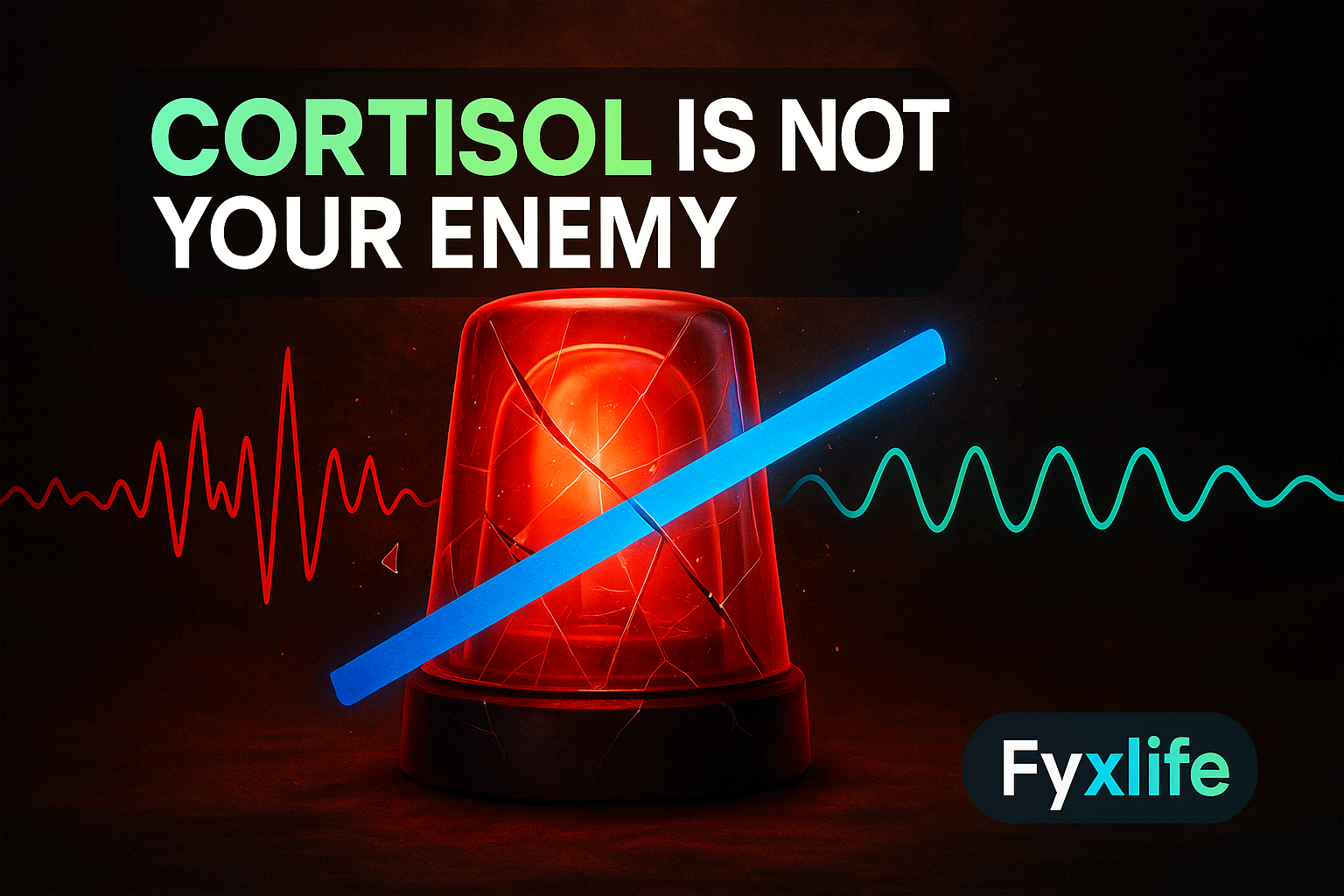
Think of cortisol like a car alarm. A working car alarm is valuable — it fires when there is a real threat, then shuts off. The problem is not the alarm itself. The problem is when the alarm gets stuck going off all night, every night, for months. Eventually the alarm system breaks down — not into a permanent loud blare, but into an erratic, unreliable state where it fires at the wrong times and fails when you actually need it. That is what chronic stress does to your body’s cortisol system. The goal is not to silence the alarm. It is to restore the rhythm.
An acute cortisol spike during a hard workout, a difficult conversation, or a genuine deadline is the alarm working correctly. It mobilises energy, sharpens focus, and resolves. The harm comes from the alarm that never resets — and that is a different biological problem entirely.
Myth 3 — Chronic Stress Means Chronically High Cortisol
The verdict: misleading. Long-term chronic stress can actually flatten cortisol output
This is the myth that does the most damage to people who are genuinely burned out. The popular image of chronic stress is someone with sky-high cortisol, wired and anxious, unable to sit still. But that is only part of the picture, and often the earlier part. Adaptation to chronic stress and potential overexposure to glucocorticoids — the class of hormones cortisol belongs to — may paradoxically result in lower cortisol levels over time. Burned-out individuals frequently show depleted, not elevated, cortisol output. The alarm is not blaring. The alarm is barely working.
This matters practically because the interventions appropriate for high cortisol and low cortisol are not the same. If you are in a depleted state and aggressively trying to “lower your cortisol” through restriction, fasting, or high-intensity protocols, you may be pushing a system that is already under-resourced in entirely the wrong direction.
Why ‘adrenal fatigue’ as popularly described does not map to the science
Adrenal fatigue — the idea that your adrenal glands become physically exhausted and stop producing cortisol after prolonged stress — is not a recognised clinical diagnosis and does not accurately describe what the research shows. What does happen is subtler and more interesting: the regulatory system that controls cortisol release, not the glands themselves, loses its precision. The adrenal glands are generally capable of producing cortisol. The problem is upstream, in the feedback loops that tell them when and how much to produce.
Myth 4 — Stress Only Hurts Your Mind
The verdict: false. Chronic stress rewires neurological, immune, and hormonal systems simultaneously
Chronic stress influences disease progression through neurological, immune, hormonal, and genetic pathways simultaneously — it is not limited to mental health outcomes. The downstream effects include measurable changes in immune cell behaviour, inflammatory signalling, hormonal feedback loops, and even gene expression. Chronic stress now poses a documented major threat to health and economic wellbeing globally, with compounding effects that extend well beyond mood and motivation. Framing stress as primarily a mental health issue underestimates its reach — and often leads people to dismiss their physical symptoms as psychological when they are, in fact, physiological.
What Is Actually Happening When You Feel Burned Out But Wired
HPA axis dysregulation explained in plain English
The system that governs cortisol release is called the HPA axis — the hypothalamic-pituitary-adrenal axis, which is the brain-to-body signalling chain that detects stress and calibrates your cortisol response. Under normal conditions, this system operates like a thermostat: it senses stress, raises cortisol, then detects the cortisol in your bloodstream and dials back production once the threat has passed. Chronic stress causes this system to become dysregulated rather than simply overactive — a slow breakdown of the body’s stress control mechanism, not a simple spike-and-recover cycle. The HPA axis is a complex regulatory loop, not a simple on/off switch, and its dysregulation has implications for multiple disease states including neurodegeneration, immune dysfunction, and metabolic disruption.
Why the real problem is loss of cortisol rhythm, not cortisol level
The feeling many people describe as burnout — tired but unable to switch off, exhausted in the morning but alert at midnight, unable to recover from exercise that used to feel manageable — is consistent with what dysregulated HPA axis function actually looks like. The morning surge is blunted. The evening decline fails to arrive. The rhythm that should coordinate your entire physiology has become unreliable. This is why a single cortisol test, taken at one point in time, tells you very little. The level matters less than the pattern.
The challenge is that this is exactly the kind of question a routine annual check-up was not designed to answer — not because doctors don’t care, but because a single fasting blood draw and a population-level reference range were never built to capture the rhythmic, time-dependent nature of cortisol function in a specific individual.
What the Evidence Actually Supports You Doing
Drop the myth, adopt the accurate mental model
The evidence does not support “lower your cortisol” as a health goal. It supports restoring the precision and rhythm of your cortisol system. Those are different targets, and they require different approaches. Sleep consistency — not just duration, but going to bed and waking at the same time — is one of the most reliable inputs for restoring HPA axis rhythm. Chronic sleep irregularity is itself a significant driver of HPA dysregulation. Exercise matters too, but the type and timing matter: high-intensity training added on top of an already depleted system can extend the recovery deficit rather than resolve it. Light exposure in the morning and darkness in the evening are among the most underused and evidence-consistent tools for anchoring the cortisol awakening response back to a functional pattern.
The single most useful next step for a busy professional
Drop this one belief — “my cortisol is high and that is why I feel terrible” — and replace it with the evidence-based alternative: “my cortisol rhythm may be dysregulated, which is a different problem requiring a different response.” The next time you reach for a supplement, a fast, or another protocol to “lower cortisol,” ask instead whether what you are adding is restoring rhythm or adding another stressor to an already overloaded system.