
You are training for Hyrox or your third marathon, tracking every metric your wearable throws at you, and yet you are getting slower, sleeping worse, and feeling like you are running on fumes. The instinct is to push harder. The evidence says that is exactly the wrong call — and the tools you are using to guide that decision may be less reliable than you think.
The problem is not that you are not paying attention. The problem is that you are paying attention to the wrong signals, or misreading the right ones. Recovery monitoring has become a serious field, and the technology has genuinely advanced. But the gap between what your wearable measures and what your body actually needs remains wider than most product marketing acknowledges. This article is a clear-eyed look at what the evidence supports, what it does not, and how to make smarter decisions with the data you already have.
The Verdict Up Front — What Works, What Doesn’t, and What to Stop Paying For
Heart rate variability tracking earns its place as the most evidence-supported wearable metric for recovery monitoring — but only when you understand how to interpret it correctly. Subjective well-being scores and perceived effort ratings are underrated, surprisingly accurate, and free. Blood biomarkers have real value when tracked as trends, not snapshots. And a meaningful slice of the recovery product industry — compression boots, cryotherapy chambers, certain recovery supplements — is running well ahead of its evidence base. The rest of this article unpacks why.
What Overtraining Syndrome Actually Is (And Why It Is Easy to Miss)
Think of your training load and recovery capacity as a bank account. Every hard session is a withdrawal. Sleep, nutrition, and rest days are deposits. Overtraining syndrome is not about one big overdraft — it is what happens when you make small withdrawals every single day for months without ever checking the balance. By the time the account hits zero, the nervous system, hormonal system, immune system, and sleep architecture are all bouncing cheques simultaneously. The tech tools you use are your bank statement — but only if you know how to read them.
The three-stage progression — acute fatigue, functional overreaching, full OTS
There is a meaningful clinical difference between being tired after a hard week and being genuinely overtrained. Acute fatigue is normal and expected — it resolves within days with rest. Functional overreaching is the next stage: performance drops, mood dips, and recovery takes weeks rather than days, but you come back stronger once you rest. Most serious athletes cycle through this intentionally during peak training blocks. Overtraining syndrome (OTS) is the third stage, and it is categorically different. OTS is defined as a maladapted response to excessive exercise without adequate rest, resulting in measurable disruptions across multiple body systems simultaneously — not just muscular fatigue. Recovery from full OTS is measured in months, not weeks. In a case series of three endurance athletes with confirmed OTS, only two of the three successfully returned to competition — a sobering data point for anyone who thinks they can simply push through.
Why OTS is a whole-system failure, not just tired muscles
This is where most athletes underestimate the condition. A narrative review found that the consequences of OTS extend well beyond physical exhaustion, encompassing psychological, hormonal, and immune system disruption simultaneously. Cortisol rhythms flatten. Testosterone drops. The immune system becomes hyperreactive or suppressed depending on the individual. Sleep architecture degrades. Mood follows. The reason OTS is so easy to miss is that each of these disruptions, looked at in isolation, resembles something else — overwork stress, a virus, a bad week. It is the constellation of simultaneous signals that reveals the pattern.
HRV — The Most Evidence-Supported Signal You Are Probably Misreading
What HRV actually measures and why it matters for recovery
Heart rate variability is the variation in time between consecutive heartbeats — and it is a window into your autonomic nervous system, the system that controls the balance between your stress response (sympathetic, or “fight or flight”) and your recovery response (parasympathetic, or “rest and digest”). A higher HRV generally indicates that your body is in a recovered, adaptive state. A declining HRV trend suggests accumulating physiological stress, regardless of whether that stress comes from training, poor sleep, illness, or psychological load. That is both its strength and its limitation — HRV does not tell you where the stress is coming from, only that it exists.
How heavy training loads change your HRV and what that change means
Heavy training leading to performance decrements produces measurable changes in sub-maximal post-exercise HRV, meaning HRV can flag functional overreaching before subjective exhaustion becomes obvious. This is genuinely useful. Your body is telling you something is wrong before you consciously feel it. The practical implication is that watching your post-exercise HRV recovery curve — how quickly it returns to baseline after a hard session — is more informative than your resting morning HRV number in isolation. A morning HRV that looks acceptable can mask the fact that last night’s session is still being processed.
The RMSSD metric — what long-term trends reveal that single readings miss
The specific metric your wearable uses matters. RMSSD — which stands for the root mean square of successive differences in beat-to-beat intervals, and is the standard measure of short-term heart rate variability — is the metric most commonly tracked by consumer devices. RMSSD appears to increase the longer an athlete engages in structured training, and this increase is more pronounced in some athlete profiles than others, confirming that individual baselines matter far more than population norms. This is critical. Comparing your HRV to an average is almost meaningless. What matters is your trend relative to your own established baseline — and that baseline takes weeks to establish reliably. If you are making daily training decisions based on a wearable you bought two weeks ago, the signal quality is not there yet.
Subjective Tools — Cheaper Than a Wearable, Surprisingly Accurate
Session RPE as an early warning system
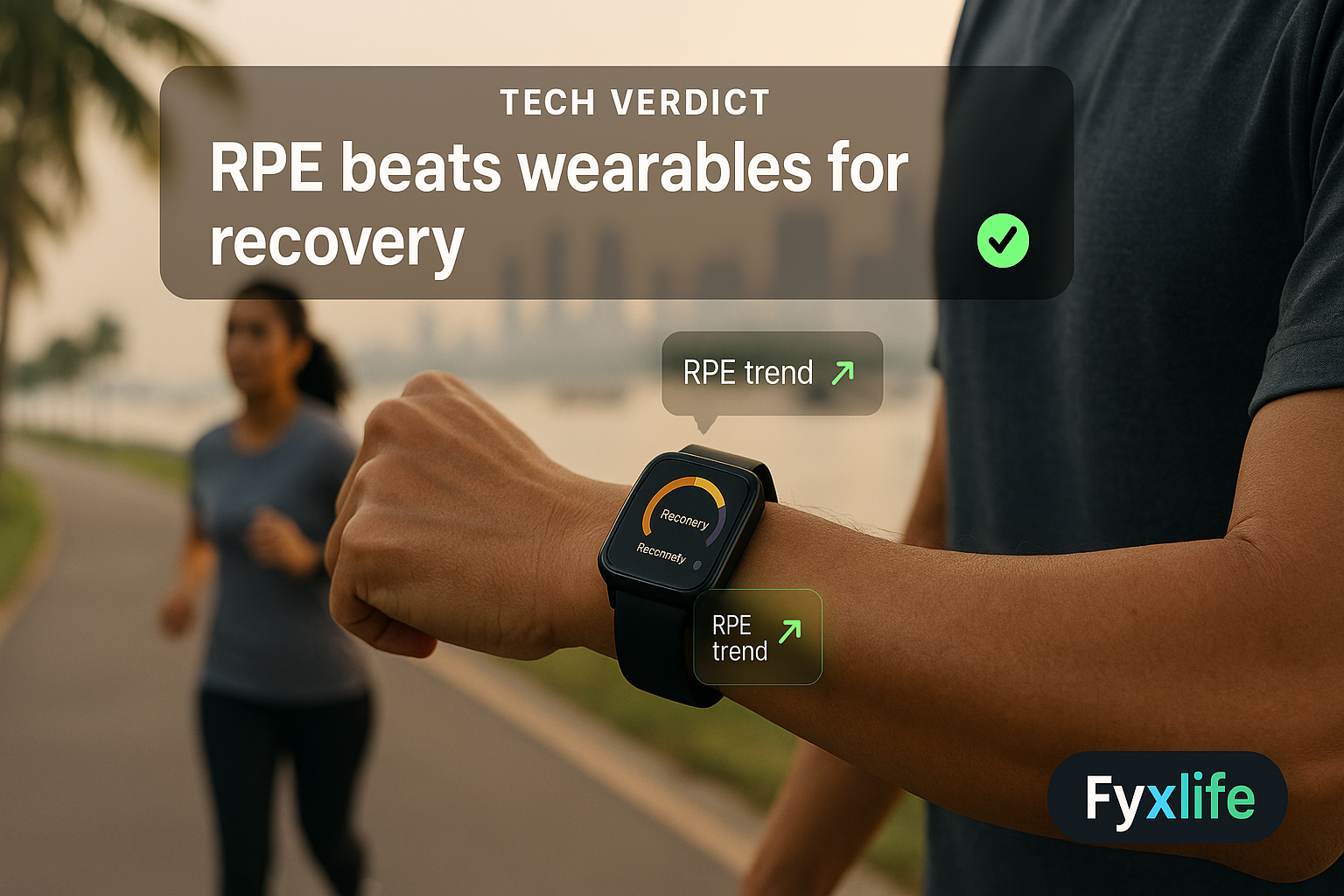
Session RPE — the perceived exertion (how hard an effort feels) rated on a simple 1-to-10 scale after a training session — is one of the most underappreciated monitoring tools available. The evidence behind it is more robust than most athletes realise. Subjective well-being measures typically track similarly to creatine kinase levels across training load changes — meaning cheap self-report tools carry comparable signal value to expensive blood tests for routine monitoring. The specific pattern to watch: if your RPE at a standard training pace or weight is trending upward over two to three weeks without a corresponding increase in load, you are looking at a load-recovery mismatch. This is not a soft signal. It is early warning data.
Mood, motivation, and libido — the psychological markers that show up before blood tests do
Athletes in training communities have described the early signs of overtraining with striking accuracy: going backwards, feeling overly tired, and — importantly — a drop in libido often arriving alongside fatigue well before performance collapses. The clinical literature validates this precisely. Reduced motivation, irritability, loss of interest in training, and diminished libido are neurological and hormonal signals that precede objective performance decrements. They are not psychological weakness. They are early biomarkers. A structured three-week strength training study tracking both biochemical and psychological fatigue markers found that temporal changes in these markers diverged — meaning a single-marker approach to monitoring recovery missed what a multi-marker approach detected. The implication: your mood is data. Log it as such.
Blood Biomarkers — Worth Testing, Not Worth Over-Relying On
Creatine kinase, CRP, ferritin — what they can and cannot tell you
Creatine kinase (CK) is an enzyme released by muscle cells when they sustain damage during exercise. Elevated CK after a hard session is normal. Chronically elevated CK at rest suggests inadequate recovery between sessions. C-reactive protein (CRP) is a marker of systemic inflammation — a chain reaction of physiological stress responses throughout the body — and rises in both acute and chronic overload states. Ferritin, the body’s primary iron storage protein, is particularly relevant for endurance athletes, where iron depletion from high training volume is common and contributes directly to fatigue and reduced oxygen-carrying capacity. Each of these markers has a role. None of them, in isolation, diagnoses overtraining.
The case for tracking trends, not single readings
The challenge is that routine annual check-ups were not designed to give you what you actually need here. A single CK or CRP reading outside the training context tells you almost nothing useful. What matters is directional change over time — whether values are creeping upward across a training block, and whether they are recovering adequately in taper weeks. CK levels increase and decrease predictably with acute training load, which means their value comes from repeated measurement, not isolated snapshots. This is exactly the kind of question that needs someone interpreting your specific numbers in context — not a population reference range.
Sleep as Both Signal and Recovery Tool
How overreaching degrades sleep quality — and why that makes everything worse
Sleep is where the majority of physiological recovery occurs — growth hormone release, tissue repair, nervous system recalibration. Overreaching is consistently linked to deterioration in sleep quality, and a systematic review has now specifically examined this relationship. The mechanism creates a compounding problem: training stress degrades sleep architecture, poor sleep impairs the hormonal and neurological recovery that hard training demands, which deepens the overreaching state, which further disrupts sleep. You cannot out-supplement or out-gadget this cycle. The only exit is reduced training load. Wearable sleep staging data — particularly changes in the proportion of deep sleep and rapid eye movement sleep — can be an early signal that this cycle has started, even before performance metrics decline.
Active Recovery Interventions — Separating Signal from Noise
What the systematic review evidence supports
Active recovery — low-intensity movement between hard sessions, designed to promote circulation and metabolic clearance without adding training stress — has a reasonable evidence base for reducing perceived soreness and restoring short-term readiness. Light swimming, easy cycling, and deliberate walking all qualify. Cold water immersion has demonstrated some short-term benefit for reducing muscle soreness and perceived fatigue after high-intensity sessions, though its long-term effects on training adaptation remain contested. Sleep extension — simply sleeping more during high training load periods — has perhaps the strongest evidence-to-cost ratio of any recovery intervention available.
What to drop from your recovery stack
A systematic review on the effectiveness of active recovery interventions found mixed results across professional, collegiate, and competitive adult athletes — signalling that not all recovery modalities are equally supported by evidence. Pneumatic compression devices show modest short-term soreness reduction but limited evidence for meaningful performance restoration. Cryotherapy chambers are expensive, increasingly popular, and substantially ahead of their evidence base for anything beyond acute soreness. Certain amino acid and antioxidant supplement protocols marketed specifically for recovery often show benefit in deficient populations only — if your nutrition is already adequate, the marginal return is low. The honest answer is that the most effective recovery interventions are consistently the least glamorous ones: sleep, easy movement, and adequate caloric intake.
The Tech Verdict — A Tiered Guide to Recovery Monitoring Tools
Tier 1 — Strong evidence, worth using
Daily HRV monitoring using RMSSD, tracked as a personal trend over a minimum of four to six weeks, earns its place in any serious athlete’s toolkit. Session RPE logging — a number you write down after every session — is free, validated, and more predictive of load-recovery mismatch than most people give it credit for. Subjective well-being tracking, including mood, motivation, sleep quality, and energy levels rated daily on a simple scale, rounds out a monitoring approach that covers the physiological, psychological, and neurological dimensions of recovery simultaneously.
Tier 2 — Promising but context-dependent
Wearable sleep staging data is genuinely useful for identifying trend changes in deep sleep and REM proportions, but the absolute accuracy of consumer devices remains imperfect — use it for directional signals, not precise measurements. Periodic blood biomarker panels including CK, CRP, ferritin, and full blood count are worth doing two to three times per year during training blocks, interpreted as a series rather than isolated readings. Resting heart rate trend data from any wearable device adds a useful secondary layer alongside HRV.
Tier 3 — Skip or deprioritise
Single-point biomarker testing outside of training context, pneumatic compression devices used as primary recovery tools, cryotherapy for anything beyond acute soreness management, and recovery supplement stacks in athletes with adequate baseline nutrition all fall into this category. Not harmful — just not worth the time, cost, or misplaced confidence in their signal quality.
One Decision to Make This Week
This week, before your next hard session, check whether your perceived effort (RPE) at your standard training pace has trended upward over the past two to three weeks at the same training load. If the same pace or weight that felt like a 7 out of 10 now consistently feels like an 8 or 9, that single data point — free, no wearable required — is a stronger signal of load-recovery mismatch than most metrics your device is selling you. Decide based on that trend: hold load this week, or investigate further before adding volume.