
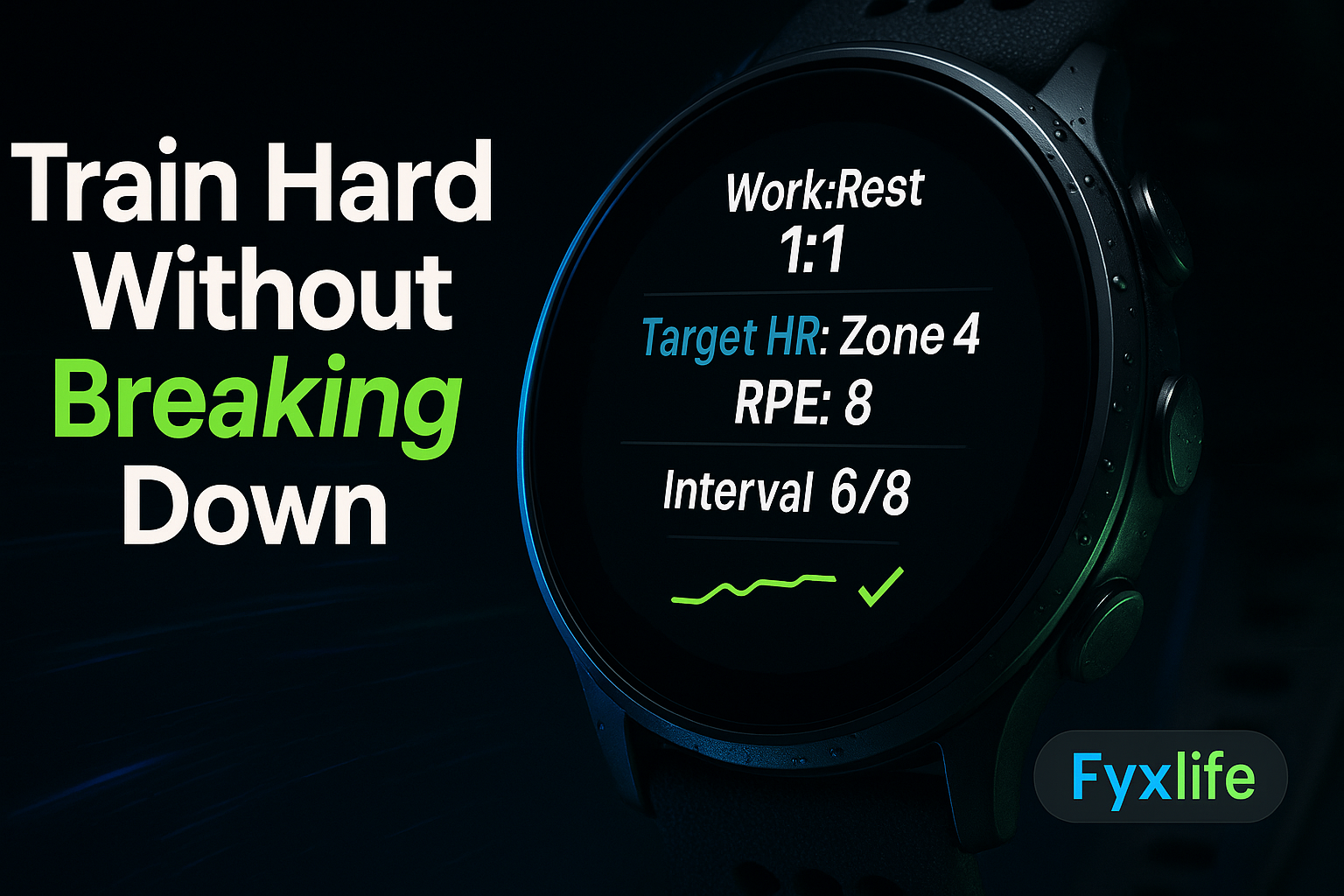
You already know how to push hard — the problem is you’ve been treating HIIT and interval training as the same thing, and that mistake is costing you recovery, performance, and possibly years off your training lifespan. This protocol separates what the evidence actually supports from what group fitness culture has quietly normalised, and gives you a precise framework for using high-intensity work as a longevity tool rather than a slow-burn injury accumulator.
If you’re training for Hyrox, building toward a marathon PB, or somewhere deep in an Ironman block, you’re already doing more than most people will attempt in a lifetime. The issue isn’t effort. It’s precision. Because at the level you’re operating, the difference between structured high-intensity work and unstructured hard work isn’t motivation — it’s physiology. And the physiology does not negotiate.
First, Get the Definition Right — HIIT vs. Interval Training Is Not Semantics
Why the confusion costs you: what each method actually does to your body
The fitness industry has done serious damage by using these two terms interchangeably. Walk into any group fitness class branded as HIIT and you’ll find something that resembles interval training at moderate intensity — which is fine exercise, but not what the research on high-intensity interval training actually studied. The stimulus required for true HIIT is categorically different from the effort required in structured interval training, and conflating them means you’re either training too hard too often, or not hard enough to generate the adaptation you think you’re getting. Both outcomes stall progress. One of them also gets you injured.
Interval training is a broad umbrella. It describes any structured approach where work periods alternate with rest or recovery periods — including lactate threshold runs, tempo intervals, and aerobic power sets. These sessions are designed to be hard, but sustainable. You’re working at an effort level you could theoretically hold for longer if you had to. That’s intentional. The adaptation target is different.
The key difference — true HIIT requires near-maximal effort; interval training does not
True HIIT — the version the cardiovascular and metabolic research is built on — requires near-maximal output. We’re talking about efforts at 90 to 100 percent of your maximum heart rate, or roughly a nine out of ten on a perceived exertion scale where ten means you physically cannot continue. HIIT is frequently misrepresented in group fitness settings, where the label is applied to sessions that never reach the intensity threshold required to generate the documented HIIT adaptation. If you’re chatting between sets, it isn’t HIIT. If you could do it again tomorrow without significant fatigue, it almost certainly wasn’t HIIT.
This distinction matters enormously for programming. Interval training sessions can appear multiple times per week because the recovery demand is moderate. True HIIT sessions — done correctly — require 48 to 72 hours of genuine recovery. Confuse the two and you either under-stimulate or chronically under-recover. Most self-coached athletes in the advanced fitness community quietly discover this the hard way: months of daily “HIIT” followed by a plateau, a niggling injury, or both, before realising they were never hitting the required intensity or never giving their system the time to respond to it.
The Physiology You Need to Understand Before Programming Anything
What high-intensity work does to your aerobic engine (VO2 max) and anaerobic capacity
Think of your aerobic system as a car engine. Zone 2 training — long, steady, low-intensity work — is the process of building a bigger engine. HIIT and interval training are the test drives that push the engine to its redline and force it to become more efficient under stress. But if you redline a small engine before it’s built, you crack the block. Most athletes are redlining before they’ve built the engine — and calling it training smart.
The redline moments, used correctly, drive two specific adaptations. First, they increase your maximum oxygen uptake (the technical term is VO2 max) — the ceiling of how much oxygen your working muscles can extract and use. Second, they expand your anaerobic capacity — your ability to sustain high-output efforts above the point where your aerobic system can fully keep up. Science-backed interval training protocols have demonstrated measurable improvements in running speed, VO2 max, and race times when correctly programmed. The word “correctly” is doing real work in that sentence.
How HIIT preserves lean muscle while driving fat loss — and why this matters after 40
After 40, your body’s default response to a caloric deficit is to shed lean tissue alongside fat — a process called muscle protein breakdown that accelerates with age. Steady-state cardio alone tends to reinforce this pattern. High-intensity interval work does something different. HIIT is an effective method for maintaining muscle mass while reducing body fat simultaneously — a dual outcome that steady-state cardio alone rarely achieves. The mechanism involves the hormonal response to near-maximal effort: growth hormone release, acute testosterone response, and the anabolic signalling that high-intensity muscular recruitment triggers. For masters athletes managing body composition without sacrificing the lean tissue that underpins both performance and long-term metabolic health, this is not a minor distinction.
The recovery debt: why more sessions does not mean more adaptation
Adaptation does not happen during the session. It happens in the 48 to 72 hours after it, when your body repairs the micro-damage, synthesises new mitochondria (the energy-producing structures inside your cells), and recalibrates the cardiovascular and neuromuscular systems that the session stressed. Add another intense session before that process completes and you interrupt it. Do this consistently and you accumulate a recovery debt — a progressive deficit between the stress you’re applying and the adaptation you’re allowing. The result looks like a plateau. It feels like fatigue that doesn’t clear. And it often ends with an overuse injury that a sports doctor will tell you came “out of nowhere.”
The Protocol — How to Structure HIIT and Interval Training in Your Week
Step 1 — Establish your training status and weekly volume baseline before adding intensity
The optimal HIIT protocol depends on multiple individual variables: training status, fitness level, exercise modality, and individual response — meaning no single protocol works universally. Before you add any high-intensity work, establish your honest weekly volume baseline — total hours of structured training across all modalities. If you’re running four to six hours per week with no structured intensity, one interval session is an addition. If you’re already doing ten-plus hours, adding true HIIT without removing something else is a tax your recovery system will eventually refuse to pay.
Step 2 — Choose the right modality for your goal (running, cycling, rowing, stair climbing)
Modality selection matters because the injury risk profile and recovery demand differ significantly between activities. Running produces the highest musculoskeletal load per session. Cycling and rowing allow you to hit the same cardiovascular intensity with substantially lower joint stress — making them valuable HIIT vehicles when you’re in a high-volume running block. Brief, intense stair climbing sessions have been shown to produce meaningful cardiovascular fitness improvements — and for time-constrained professionals in Singapore, where a 20-storey HDB or office building is rarely more than a walk away, this is a genuinely accessible modality that requires no equipment and no travel. Effective HIIT and interval programming emphasises variety and intensity calibration as essential for time-constrained athletes seeking maximum stimulus efficiency.
Step 3 — Set work-to-rest ratios based on the adaptation you are chasing
If your goal is VO2 max development, use longer work intervals — three to five minutes at 90 to 95 percent of maximum heart rate — with equal or slightly shorter rest. This forces your cardiovascular system to sustain output near its ceiling long enough to generate adaptation. If your goal is anaerobic capacity and power, use shorter work periods — 20 to 30 seconds at true near-maximal effort — with full recovery ratios of one to three or one to four. Compressing the rest period before the engine has recovered turns a power session into a mediocre metabolic conditioning session. Neither adaptation gets optimised.
Step 4 — Assign intensity sessions to your week using polarised training logic
Polarised training — the model supported by elite endurance coaches and increasingly by the research literature — means spending roughly 80 percent of your training time at low intensity (Zone 2 and below) and 20 percent at genuinely high intensity. There is very little in between. The middle ground — what athletes call “Zone 3 grey zone” — is hard enough to accumulate fatigue without being intense enough to drive the top-end adaptations you’re after. Structure your week with two hard sessions maximum. Everything else should feel almost too easy. It won’t feel that way, but that’s the point.
Step 5 — Program the session: warm-up, work blocks, cool-down, and what to track
A proper warm-up for high-intensity work is not five minutes of jogging. It’s a progressive activation sequence — ten to fifteen minutes that includes easy aerobic work, dynamic mobility, and two to three build-up efforts at increasing intensity, finishing just below your target work zone. The purpose is to prime your neuromuscular system and raise core temperature before you ask it to perform at near-maximal output. Skipping this step increases both injury risk and the time it takes to reach target intensity in your opening intervals. Track your peak heart rate in each interval, your heart rate at the start of each rest period, and your heart rate recovery — the drop in beats per minute in the 60 seconds after each work block ends. These three numbers tell you whether the session is doing what it’s supposed to do.
What NOT to Do — The Protocol Errors That Derail Longevity Athletes
Daily high-intensity sessions and the chronic under-recovery trap
This is the most common error among self-coached athletes who are motivated, disciplined, and completely derailing their own progress. Common HIIT programming errors — including daily high-intensity sessions, skipping low-intensity base work, and ignoring work-to-rest ratios — directly undermine the adaptation the protocol is supposed to deliver. The athlete who does five intense sessions per week is not five times more adapted than the one who does two. They are often significantly less adapted — and significantly closer to injury or burnout — because the stimulus-recovery cycle never completes.
Skipping Zone 2 base work and why it limits your ceiling
You cannot build a high-performance engine without first making it bigger. Zone 2 training — effort levels where you can hold a conversation but are genuinely working — is the mechanism by which your body grows new energy factories inside your cells (the technical term for this process is mitochondrial biogenesis). It also builds the capillary density that delivers oxygen to those cells and improves your ability to use fat as a fuel source at higher intensities. Athletes who skip Zone 2 in favour of more high-intensity work hit a ceiling because the engine they’re redlining was never fully built. Your HIIT sessions are only as good as the aerobic base they’re stress-testing.
Confusing ‘hard’ with ‘high-intensity’ — effort perception vs. physiological threshold
Hard and high-intensity are not the same thing. A long run that leaves you tired feels hard. A heavy strength session feels hard. Genuinely hard feelings are not reliable indicators of the specific physiological threshold — the point above which your body is working anaerobically and producing the systemic stress required for HIIT adaptation. Use objective markers: heart rate as a percentage of your measured maximum, pace per kilometre at a known lactate threshold, or a power output you’ve established through testing. Effort perception is a useful supplement to these markers. Used alone, it’s a guess dressed up as a training system.
Programming for Your Race Goal — Hyrox, Marathon, and Ironman Variations
Hyrox: power-endurance intervals and how to structure them
Hyrox demands something specific: the ability to sustain power output across repeated functional efforts with incomplete recovery. Your interval programming should reflect this. Use work periods of 60 to 90 seconds at high intensity — rowing, ski erg, sled pushes, or running — with 60 to 90 second recovery periods, building progressively toward shorter rest ratios as your event approaches. The goal isn’t maximum aerobic power. It’s the ability to re-recruit and sustain output when your aerobic system hasn’t fully recovered. That’s a trainable quality, but only if your intervals are programmed to replicate it.
Marathon: lactate threshold intervals vs. VO2 max intervals — which to prioritise and when
For marathon preparation, the most important intensity work is not at VO2 max — it’s at or just below your lactate threshold, the pace at which your muscles begin producing lactic acid faster than your body can clear it. Tempo intervals — 10 to 20 minute efforts at threshold pace — build your ability to sustain marathon race pace without accumulating the metabolic fatigue that forces you to slow in the final 10 kilometres. VO2 max intervals (shorter, faster, at 95 percent of maximum heart rate) have a place in early preparation phases to raise your ceiling. But as race day approaches, threshold work should dominate your intensity prescription. The sequence matters as much as the sessions themselves.
Ironman: why less true HIIT and more structured tempo work usually wins
Ironman is fundamentally an aerobic event. Race pace for most athletes sits well below their lactate threshold for most of the day. This means the marginal return on true HIIT — with its high recovery demand — is lower than in shorter-format racing. What moves the needle in Ironman training is a well-built Zone 2 base, consistent lactate threshold work across all three disciplines, and the capacity to hold power and pace late in the run when glycogen is depleted. One VO2 max session per week during base phase has value for raising your aerobic ceiling. Beyond that, the recovery cost typically exceeds the adaptation benefit for athletes also carrying the cumulative load of swim-bike-run volume.
Tracking Progress — The Biomarkers and Performance Markers That Tell You It’s Working
VO2 max trends, resting heart rate, and heart rate recovery as objective signals
Three markers tell you the most about whether your protocol is working. First, VO2 max — trackable through wearables with reasonable accuracy, or precisely through laboratory or field testing. A rising trend over eight to twelve weeks indicates genuine aerobic development. Second, resting heart rate — measured first thing in the morning before you rise. A downward trend indicates improved cardiovascular efficiency. Third, and most useful in real time, heart rate recovery — how quickly your heart rate drops in the 60 seconds after a maximal effort. A faster drop means your autonomic nervous system (the body’s control system for involuntary functions like heart rate) is becoming more efficient. These are not vanity metrics. They are the objective evidence that the stress you are applying is producing adaptation rather than erosion.
When to back off: the three signs your intensity load has exceeded your recovery capacity
The first sign is elevated resting heart rate — five or more beats above your baseline for two or more consecutive mornings. The second is declining performance in sessions that previously felt manageable: if your threshold pace has slowed, or your heart rate at a given power output is rising, you are not recovering between sessions. The third is disrupted sleep — specifically, waking in the night or sleeping longer than normal without feeling rested. These three signals often appear together. When they do, the answer is not a rest day followed by a return to full intensity. It’s a reduction in high-intensity volume for one to two full weeks, with Zone 2 work maintained.
This is also where the challenge of self-coaching becomes real. Knowing when to back off is straightforward in principle and genuinely difficult in practice — especially for athletes who have built their identity around consistent output. The standard annual health check-up was not designed to answer the question of whether your current training load is generating adaptation or breaking you down. Population-level reference ranges for cardiovascular markers were never built to account for your specific training history, recovery capacity, or race schedule. Getting that question answered precisely requires someone looking at your actual numbers, not the average.
Your First Week on This Protocol — One Concrete Starting Point
This week, before your next high-intensity session, write down your planned work-to-rest ratio and your target intensity marker (heart rate zone, RPE, or pace). If you cannot define either with specificity before you start, you are doing interval training at best — and guessing at worst. Define those two variables, execute the session against them, and compare your heart rate recovery in the final interval to your first. That single data point tells you more about your current adaptation state than any fitness tracker summary.


