The Myth Stack: What Most People Believe About Breathwork
You have tried the four-count box breathing, the app-guided sessions, the five deep breaths before a meeting — and you still feel wired, unrested, and vaguely sceptical. Either breathwork works and you are doing it wrong, or the whole thing is overhyped wellness noise. The truth is more specific, more useful, and more honest than either camp admits.
The problem is not breathwork. The problem is the layer of mythology that has been built on top of it. Before you can use the tool correctly, you need to understand which beliefs about it are actually false — and why the false ones feel so plausible.
Myth 1 — Any deep breathing will calm your nervous system
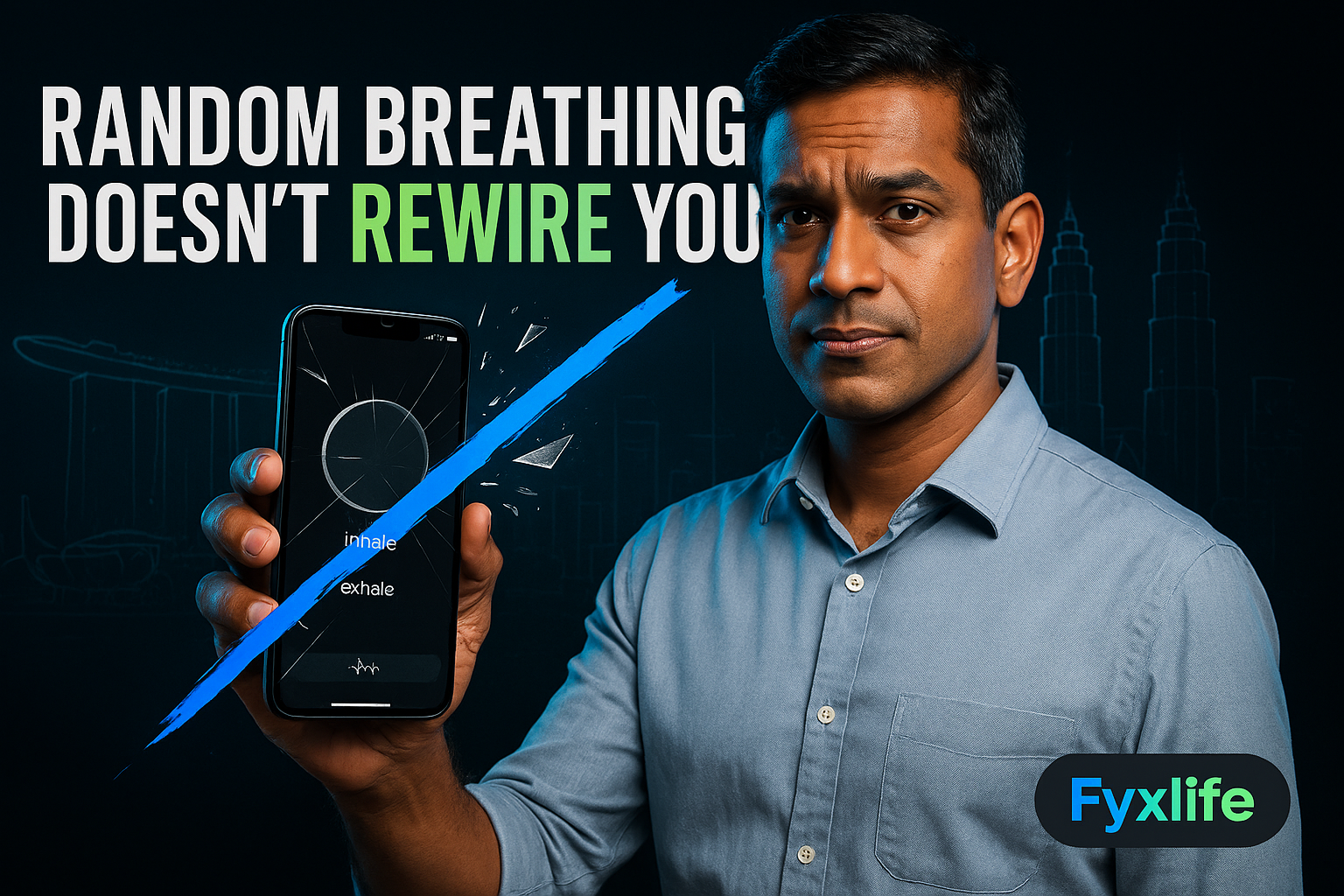
This is the most widely held belief and the most consequential one to get wrong. You take a few deep breaths, nothing much happens, and you conclude either that you are too stressed to be helped or that the whole thing is theatre. Neither conclusion is correct. The reality is that breathing activates a measurable physiological pathway between the two main divisions of your nervous system, but the effect is technique-specific, not universal. Breathing deeply without a specific pattern is not the same as breathing with one. The distinction matters more than most breathwork instruction ever acknowledges.
Myth 2 — The science on breathwork is weak or nonexistent
This is the sceptic’s default position, and it is outdated. A review of 26 randomised controlled trials found breathwork was associated with measurable reductions in stress, anxiety, and depressive symptoms. That is not anecdote. That is controlled trial data across multiple populations. The science exists. What the science does not do is validate every claim made on behalf of breathwork — and that distinction is the entire point of this article.
Myth 3 — Slower breathing will help you live longer
This one gets shared in longevity circles as though it is settled. It is not. Slower breathing has not been proven to directly extend lifespan. It may support health by improving the way your body regulates stress — which is a meaningful finding in its own right — but confusing “may support stress regulation” with “extends your life” is the kind of overclaim that makes serious researchers wince and sceptics dismiss the whole field. The honest version is interesting enough without the embellishment.
Myth 4 — If breathwork does not work for you, you are doing it wrong
This is perhaps the most damaging myth because it is shaming. If you have tried breathwork for anxiety and found it unhelpful, the explanation may not be your technique. For people experiencing high-frequency anxious thoughts, breathwork and meditation can fail to produce relief — and the explanation is neurological: certain anxiety states involve thought-pattern loops that simple breathing cannot interrupt. That is not a personal failing. It is a mismatch between the tool and the specific state you are trying to address. More on this shortly.
The Mechanism: What Breathwork Actually Does To Your Nervous System
The two-lane highway between your breathing and your stress response
Think of your nervous system as a car with two modes: a high-rev drive mode — your stress response — and a low-idle park mode — your recovery state. Most people assume any breathing is like tapping the brakes. It is not. Specific breathing patterns are more like shifting into a lower gear. They engage a direct mechanical link between your lungs and your idle speed. But only if you use the right gear for the right speed. Breathing randomly does not shift gears. The pattern is the mechanism.
The reason this mechanical link exists is anatomical. Breathing serves as a direct connection between the part of your nervous system that runs automatically — controlling heart rate, digestion, and the stress response (the autonomic nervous system) — and the part you consciously control, governing voluntary movement and sensation (the somatic nervous system). This makes breathing one of the very few voluntary actions that can reach into an otherwise automatic system and alter its output. You cannot consciously slow your heart rate. You can consciously change your breathing pattern, and that change pulls heart rate and stress hormones with it — if the pattern is right.
Why pattern, ratio, and context determine whether it works
The key variable is the ratio between your inhale and your exhale. Inhaling activates your sympathetic nervous system — the body’s accelerator. Exhaling activates your parasympathetic nervous system — the body’s brake and recovery mode. When your exhale is longer than your inhale, you spend more time in recovery mode per breath cycle. This is not metaphor. Breathwork activates the parasympathetic nervous system — the body’s rest-and-digest mode — which is the physiological opposite of the fight-or-flight stress state. Box breathing, where inhale and exhale are equal, does not produce this asymmetry. It produces balance, which has its own value. But if your goal is genuine downregulation — shifting into park — you need the exhale to dominate.
Context matters too. Someone who applied breathwork specifically when they felt their symptoms worsening — rather than as a daily background ritual — described around 50% improvement in how they felt. That tracks with what the evidence suggests: breathwork works best as a targeted, pattern-specific intervention rather than a passive habit you run in the background like white noise.
What measurable changes look like in the brain and body
A 2026 study found that specific breathing patterns combined with music induced measurable changes in emotional brain regions — which means the neurological effects are real, but they are conditional on what you are doing, not on the fact that you are breathing with intention. Effort and attention are not enough. The pattern produces the effect. This is the central finding that the wellness industry consistently glosses over in its enthusiasm to make breathwork sound effortlessly accessible.
The Evidence: What 26 Randomised Controlled Trials Actually Show
What breathwork reliably reduces — and what it does not cure
The controlled trial data is clear on a narrow but meaningful set of outcomes. Stress, anxiety, and depressive symptoms respond to breathwork interventions across multiple study populations. These are not trivial outcomes. For someone sleeping badly because their nervous system will not downregulate at the end of the day, a tool that measurably reduces stress is directly relevant. What breathwork does not do — and what popular media has suggested it might do — is boost the immune system, eliminate ill health, or reliably lengthen your life. These claims outpace the evidence by a considerable distance, and accepting them sets you up for the cynicism that follows when breathwork does not deliver on promises it was never positioned to keep.
The honest UCSF finding on aging and the limits of current data
Researchers at UCSF are actively investigating whether different breathing techniques may slow biological aging markers — the kind of cellular-level changes that accumulate over years of chronic stress. This is genuinely interesting science. It is also genuinely preliminary. The signal is promising. The confirmation is not here yet. For a longevity-oriented reader, that distinction matters: you can be interested in this research thread without betting your health strategy on it. The honest position is to watch it develop.
The Verdict: Breathwork Is Real, Specific, And Often Misapplied
Which techniques have the strongest signal for stress and sleep
For the goal most readers here are actually chasing — better sleep quality and faster recovery from the day — the techniques with the strongest evidence share one feature: an exhale that is longer than the inhale. A 4-count inhale with a 6-to-8-count exhale is the basic version. Coherent breathing, which aims for roughly 5 to 6 breath cycles per minute, extends each phase long enough to produce genuine parasympathetic activation. What these techniques have in common is that they are not random. They are applied deliberately, at the right moment — specifically when the nervous system is in high-rev drive mode and needs a mechanical reason to shift down.
Who it is less likely to help — and why that is neurological, not personal
If you experience anxiety characterised by fast-cycling, intrusive thought loops — the kind where your mind cannot stop generating scenarios regardless of what your body is doing — breathwork alone is likely insufficient. This is not a failure of commitment or technique. The thought-pattern loops driving that kind of anxiety operate through neural circuits that a breathing ratio cannot directly access. Knowing this is more useful than spending another six months feeling broken because a tool designed for a different problem did not fix yours. Breathwork is a nervous system tool. Some anxiety states are primarily cognitive architecture problems that require a different type of intervention.
What To Drop, What To Keep, And What To Do Next
The wellness industry has done breathwork a specific kind of harm. Phrases like “nervous system reset” and “emotional release” are not inaccurate in spirit, but they are vague enough to obscure what the evidence actually says — and to set expectations that lead directly to the scepticism you may have arrived here with. The real version is less dramatic and more durable: a specific breathing pattern, applied to a specific physiological state, produces a measurable and reproducible shift in your autonomic nervous system output. That is not theatre. It is also not magic. It is a mechanical intervention with a narrow but genuine range of application.
What to drop: the belief that any slow breathing counts, the expectation that breathwork will override high-frequency anxious thought loops, and the longevity claims that have not been validated. What to keep: the 26-trial evidence base, the inhale-exhale ratio principle, and the practice of using breathwork as a targeted tool rather than a background wellness ritual.
Drop this belief this week: “Any slow breathing will calm me down.” Replace it with the evidence-based version — “A specific breathing pattern, applied to a specific stress state, produces a measurable nervous system shift.” The next time you feel the wired-but-tired feeling at the end of the day, instead of breathing randomly, try a 4-count inhale and 6-to-8-count exhale for five minutes and notice whether the extended exhale — the part that actually engages the parasympathetic response — produces a different result than your usual approach.