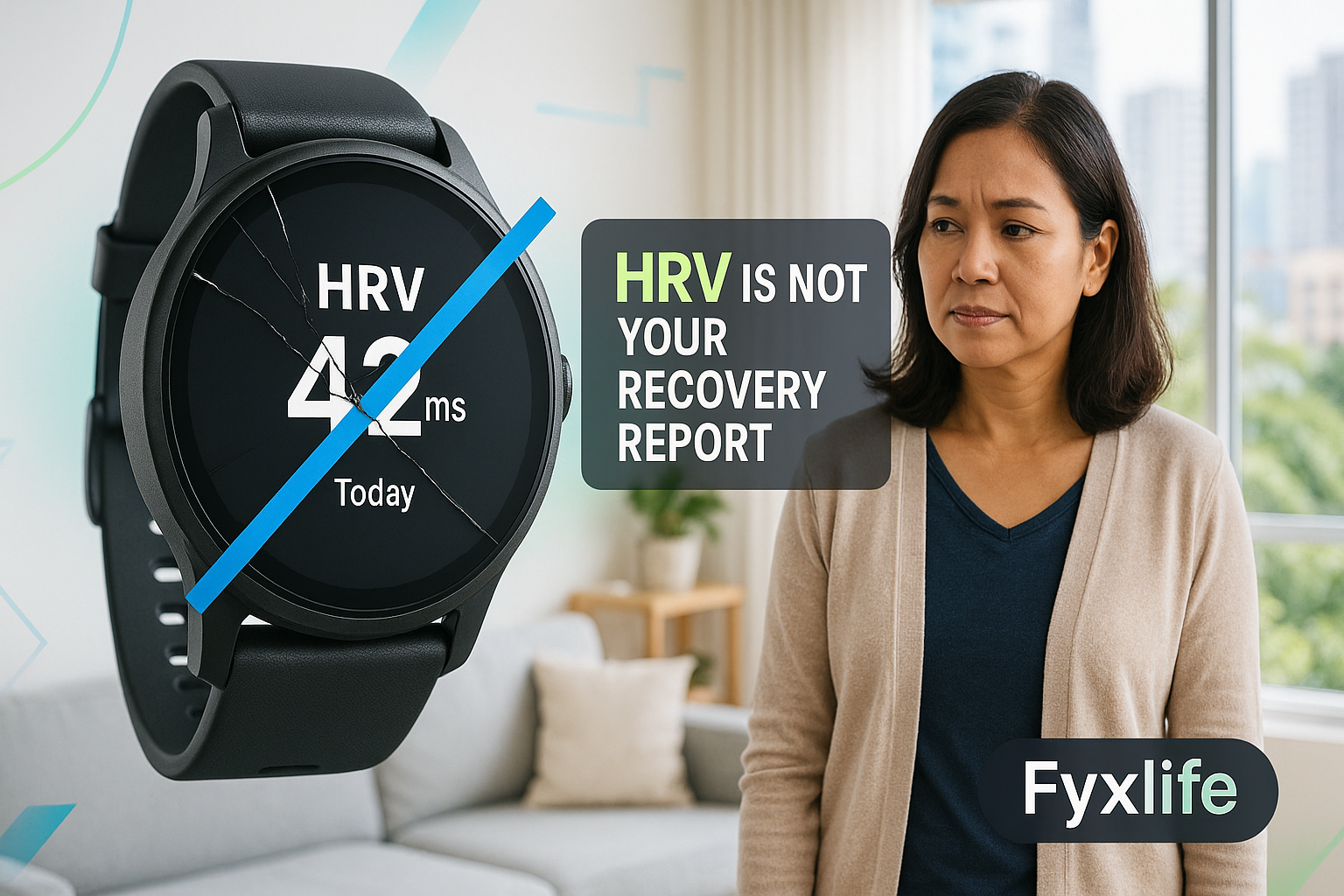
You slept eight hours, skipped the late-night whisky, and still woke up to a low HRV score. So you cancelled your workout, skipped the hard meeting, and restructured your entire day around a number on your wrist. Here’s the problem: most of what people believe about HRV is wrong — and acting on those beliefs may be making your recovery worse, not better.
This is not a niche mistake made by obsessive biohackers. It is happening every morning to busy professionals across Singapore and Southeast Asia who have done everything right — invested in a quality wearable, prioritised sleep, built a recovery routine — and are still being misled by a fundamental misreading of what the number actually means. The wearables are not lying to you. But they are not telling you what you think they are telling you, either.
The Myth — Your HRV Score Tells You Whether to Push or Rest Today
Where This Belief Comes From (and Why Wearable Marketing Made It Worse)
The idea that your morning HRV score is a daily green or red light for performance is seductive because it feels logical. High number: body is ready. Low number: stand down. Wearable companies — Whoop, Garmin, Oura, Welltory — have all, to varying degrees, leaned into this framing. The app interfaces are colour-coded. The language is readiness-first. The notifications arrive each morning with the quiet authority of a medical opinion.
The problem is that app-based HRV readings rely heavily on proprietary algorithms that require significant baseline calibration and are subject to considerable measurement noise. They are not clinically precise instruments. They are consumer-grade pattern detectors — useful over time, but poorly suited to the weight most people place on any single reading. The marketing found the aspiration (know your body, optimise your day) and built an interface around it. The science never quite caught up with the promise.
What HRV Actually Measures — Nervous System Adaptability, Not Readiness
Heart rate variability (HRV) — the variation in the time interval between consecutive heartbeats — is a proxy for something much deeper than fitness or fatigue. It reflects the balance between the two branches of your autonomic nervous system: the part that accelerates your stress response (the sympathetic branch, commonly known as “fight or flight”) and the part that promotes rest and restoration (the parasympathetic branch, sometimes called “rest and digest”). When those two systems are in dynamic balance, the intervals between your heartbeats vary more — and HRV rises as a signal of adaptability, not of energy levels or daily readiness.
Adaptability is not the same as performance capacity. It is more fundamental than that. It tells you whether your nervous system is flexible enough to respond to whatever the day demands — but it does not tell you whether today is a good day to run a personal best or close a difficult deal. That distinction matters enormously, and almost no consumer wearable communicates it clearly.
The Evidence — What the Science Actually Shows About HRV
HRV Is a Lagging Signal, Not a Live Dashboard
Think of your HRV score like the oil warning light on a car dashboard. If it flickers on once after a long drive in the heat, you note it but don’t panic. If it stays on for a week, you take it seriously. One reading tells you almost nothing. The trend tells you everything. The mistake most people make is treating every morning’s HRV like a green or red traffic light for the day — when it’s actually more like a weekly weather pattern than a daily forecast.
Recovery drives performance — sleep, HRV, and nervous system balance are what determine how well the brain and body perform the following day, not training effort alone. But the signal works across days and weeks, not hours. By the time a single low reading appears on your screen, it is already a reflection of what happened to your nervous system 24 to 48 hours ago — a delayed echo of stress already processed, not a live broadcast of current state.
A Single Low Reading Means Almost Nothing Without Trend Context
This is the part the wearable marketing most consistently obscures. A community of Welltory users discovered this the hard way: one person described their app showing constant “doom” readings — strained HRV and low health scores — despite feeling completely fine in daily life. The response from experienced users was instructive: HRV and nervous system signals can remain strained even when you feel entirely normal. The app is not showing you how you feel. It is showing you a biological signal that does not always map onto subjective experience in real time.
Separately, users tracking HRV through Garmin noted that stress readings became genuinely meaningful — but only when viewed across weeks, not days. Meaningful patterns emerged over time. Individual daily readings were noise. This is precisely how the metric was designed to be used, and precisely the opposite of how most people are using it.
Higher Is Not Always Better — Individual Baseline Is Everything
There is no universally good HRV number. A reading of 45 milliseconds might represent excellent recovery for a 55-year-old under chronic work stress, and moderate suppression for a 38-year-old endurance athlete. What matters is not the absolute number but whether your number is trending above or below your own established baseline — the average your body has settled into over several weeks of consistent measurement. Comparing your score to a friend’s, or to a population chart, is almost meaningless. The only number worth watching is deviation from your own norm, sustained across multiple days.
The Second Myth — You Can Hack Your HRV Up Quickly
What Moves HRV in a Meaningful Direction (and How Long It Actually Takes)
The internet is not short of protocols promising rapid HRV improvement — cold plunges, breathing exercises, magnesium stacks, red light therapy. Some of these interventions have real physiological mechanisms behind them. But the honest answer about timeframes is inconvenient: meaningful, sustained shifts in HRV baseline take weeks to months of consistent behaviour change, not days. Acute interventions like slow diaphragmatic breathing can temporarily elevate a single reading — by activating the parasympathetic nervous system directly — but they do not move the underlying baseline unless the practice is habitual and sustained over time.
The Three Levers That Matter Most
The three inputs that consistently move HRV in a meaningful direction are sleep quality, psychological stress load, and physical training balance — in that order of impact for most people. Sleep is the dominant driver. Not duration alone, but sleep architecture — specifically the proportion of deep, restorative sleep during which the parasympathetic nervous system actively repairs the body. Psychological stress, particularly the chronic, unresolved kind that characterises overloaded professional life, suppresses HRV over weeks in ways that no amount of cold water or breathing exercises can fully counteract while the stressor remains active. And training balance — the ratio of stress applied to recovery allowed — matters because accumulated physical load without adequate recovery suppresses HRV just as reliably as emotional stress does.
This is the kind of question that a routine annual check-up was not designed to answer — not because doctors don’t care, but because interpreting personalised trend data against an individual’s specific stress load, sleep quality, and training history requires more than a population-level reference range and a ten-minute appointment slot can accommodate.
The Verdict — What HRV Is Actually Good For
Use It as a Trend Signal, Not a Daily Verdict
Used correctly, HRV is genuinely valuable. A 14-day downward trend in HRV, combined with worsening sleep quality and increased irritability, is a meaningful signal that your nervous system is accumulating stress faster than it is recovering from it. That is worth acting on — by reducing training load, addressing the stressor directly, or improving sleep conditions. What it is not worth is cancelling a workout on the basis of a single morning reading after an otherwise normal night, or restructuring a working day around a number that may simply reflect that you measured it slightly differently than yesterday.
The One Number to Stop Obsessing Over and What to Track Instead
Stop watching the daily score. Start watching the rolling 7-day or 14-day average, and specifically whether that average is stable, rising, or declining relative to your personal baseline from the previous month. Many wearable apps already display this — it is just rarely the number presented most prominently on the home screen, because a stable trend is less emotionally engaging than a daily colour-coded verdict. The trend is the signal. The daily number is the noise.
The Belief to Drop and the One to Replace It With
Drop this: my HRV score this morning tells me what kind of day I should have. It does not. It tells you about your nervous system’s adaptability over the past several days — and only meaningfully so when placed in the context of your own baseline trend.
Replace it with this: my HRV trend over the past two weeks tells me whether my recovery is keeping pace with my load. That framing transforms HRV from a daily anxiety-generator into something genuinely useful — a slow, honest signal about the direction your physiology is moving, not a real-time report card on your readiness to face Tuesday.
This week, instead of reading your HRV each morning as a verdict, pull up the last 14 days of your HRV trend in your wearable app. Identify whether the line is stable, rising, or declining. That pattern — not today’s single number — is the only signal worth acting on. If your 14-day trend is declining alongside worsening sleep or mood, that is worth a conversation with your doctor. A single low morning reading is not.