You sleep seven hours, avoid cigarettes, and exercise three times a week — yet your last health screening left your doctor raising an eyebrow. The missing variable might be hiding in how your heart behaves while you sleep. Here is every test that connects your sleep quality to your cardiovascular risk, explained in plain English so you can walk into your next appointment asking the right questions.
You probably already have more data than you think. Millions of people in Singapore and across Southeast Asia go to bed each night with an Apple Watch or Garmin on their wrist, charging their devices during showers specifically so they do not lose a single hour of overnight tracking. The sleep scores, the resting heart rate graphs, the recovery readings — they are all there. What most people are missing is not data. It is context. This guide gives you that context, connecting the numbers on your wrist to the clinical tests that actually quantify your cardiovascular risk.
Why Your Routine Health Screen Is Missing the Sleep-Heart Picture
What happens to your heart during healthy sleep (and what breaks when sleep fails)
Think of your cardiovascular system as a factory that runs 24 hours a day. Sleep is the night-maintenance crew — the only shift that repairs equipment, resets alarm systems, and brings the boiler room pressure down to safe levels. When that crew is chronically short-staffed or interrupted, the machinery keeps running hot without repair. The tests in this guide are quality-control inspections that reveal exactly how much damage is accumulating on the night shift.
Sleep serves as a critical period of recovery and repair for the cardiovascular system — not passive rest, but active physiological maintenance. During healthy deep sleep, your heart rate slows, your nervous system shifts into its rest-and-repair mode (what clinicians call parasympathetic dominance), and inflammatory processes that accumulated during the day are wound back. The body clears cellular debris, consolidates metabolic signals, and prepares the vascular system for another day of demand. Miss enough of this, and the effects are not subtle.
Sleep disorders are now considered independent risk factors for several cardiovascular conditions — meaning they raise your heart disease risk even when every other risk factor is perfectly controlled. This is the point most standard health screenings miss entirely. You can have a healthy weight, a clean lipid panel, and normal fasting glucose and still carry a measurable sleep-driven cardiovascular burden that a single morning blood pressure reading will never reveal.
The nocturnal blood pressure drop — why your heart needs the night shift off
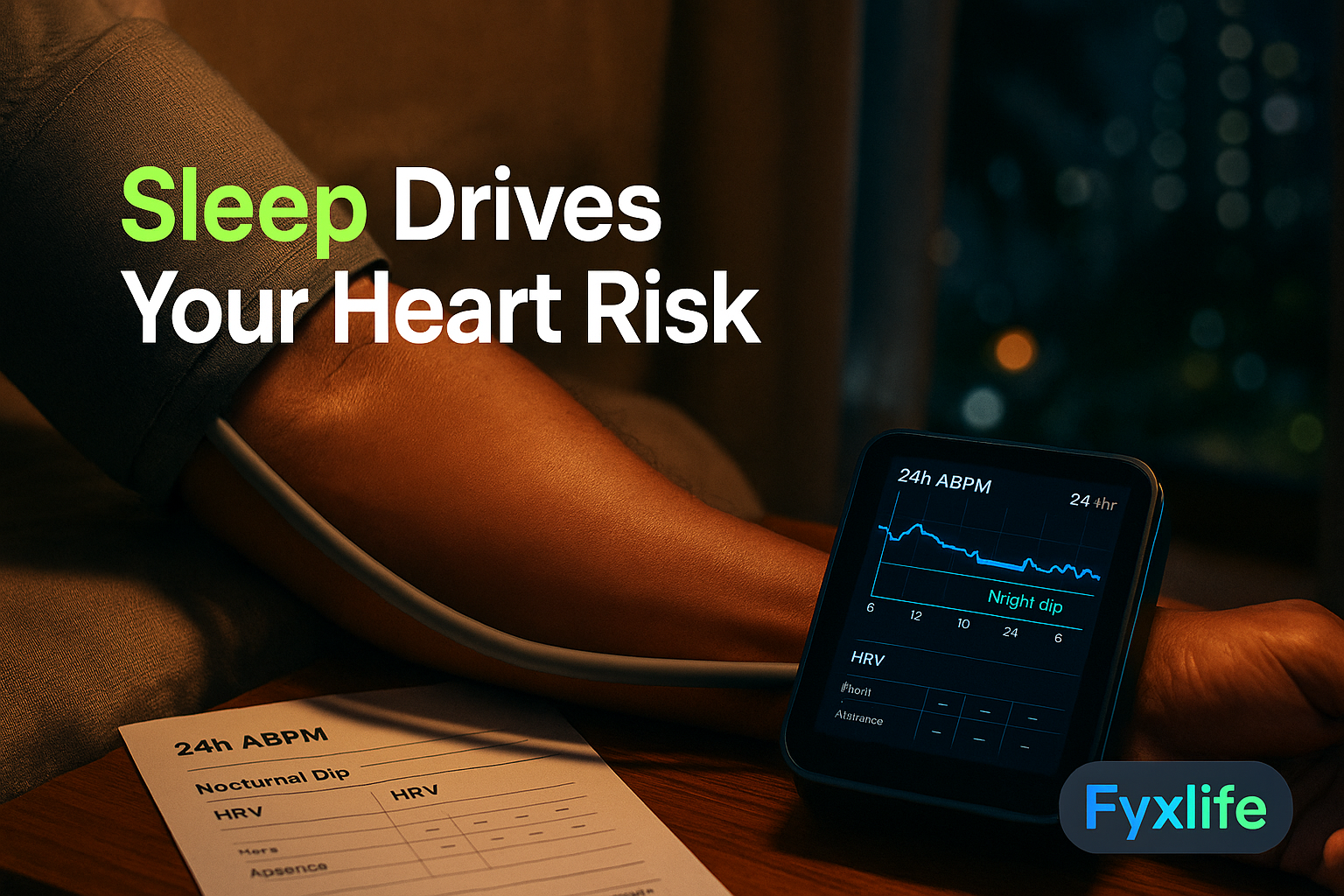
In a healthy cardiovascular system, blood pressure does not stay flat around the clock. It follows a rhythm. During sleep, it drops — typically by 10 to 20 percent compared to daytime readings. This drop is so consistent and so important that clinicians have given it a name: nocturnal dipping. The people whose blood pressure dips appropriately are called dippers. The people whose pressure stays elevated through the night are called non-dippers. That distinction matters enormously for long-term heart and stroke risk, and a standard office blood pressure reading cannot tell you which one you are.
When nocturnal blood pressure fails to drop as expected, it is a measurable cardiovascular warning signal — detectable only through the kind of extended monitoring that most annual check-ups do not include. If your sleep is fragmented, if you snore, or if you wake frequently, the maintenance crew is being interrupted before it can finish the job. The boiler room pressure never comes down.
Test 1 — Blood Pressure Monitoring (Including Ambulatory / 24-Hour)
What it measures and why daytime readings alone are not enough
A clinic blood pressure reading gives you a single snapshot — usually taken when you are slightly anxious, sitting still, and in an unfamiliar environment. It measures one moment in a 1,440-minute day. Ambulatory blood pressure monitoring (ABPM) is the 24-hour version: a small cuff worn throughout your normal day and night, taking automatic readings every 15 to 30 minutes, including while you sleep. It is the only test that tells your doctor what your cardiovascular system is actually doing when no one is watching.
For anyone with disrupted sleep, ABPM is not a specialist investigation — it is a logical next step. It catches the non-dipping pattern, identifies white coat hypertension (blood pressure that rises only in clinical settings) versus masked hypertension (normal in clinic, elevated at home and overnight), and provides the nocturnal average that daytime readings structurally cannot.
What to ask your doctor: non-dipping pattern and what it signals
When you receive your ABPM report, the key question is not just whether your average blood pressure is within range — it is whether your nocturnal readings are at least 10 percent lower than your daytime readings. If they are not, ask explicitly: “Does my result show a non-dipping pattern?” A non-dipping or reverse-dipping profile (where night readings are higher than daytime) is associated with increased risk of left ventricular hypertrophy — the thickening of the heart’s main pumping chamber — as well as stroke and kidney disease. Knowing which category you fall into changes the clinical conversation entirely.
When to test and how often
If you have borderline office blood pressure readings, report disrupted sleep, snore regularly, or have been diagnosed with any sleep disorder, ABPM is appropriate at your next screening. For those with confirmed hypertension being treated, annual ABPM helps assess whether treatment is effective overnight, not just in the morning. For sleep-disrupted adults with otherwise normal readings, once every two to three years is a reasonable baseline unless symptoms change.
Test 2 — Sleep Study (Polysomnography) and OSA Screening
Who needs a full sleep study vs. a home sleep test
A full polysomnography (PSG) — the overnight sleep study conducted in a hospital or clinic — measures brain activity, eye movements, muscle activity, heart rhythm, breathing effort, blood oxygen levels, and body position simultaneously. It is the gold standard for diagnosing obstructive sleep apnoea (OSA), the condition where the upper airway repeatedly collapses during sleep, causing the brain to jolt awake to restore breathing. These arousals are often too brief to remember but frequent enough to shred the restorative architecture of your sleep. The clinical measure of how often the brain is disrupted from restorative sleep — called arousal burden — correlates with increased mortality risk in older adults.
A home sleep test (HST) is a simplified version: a portable device that measures breathing, oxygen saturation, and heart rate during your normal sleep at home. It cannot measure brain activity, so it cannot diagnose all sleep disorders — but for straightforward OSA screening in adults with a clear clinical picture, it is an acceptable and far more accessible first step.
Why OSA risk is underdiagnosed in lean Asian adults — the Singapore context
OSA is commonly associated in the public imagination with overweight, middle-aged men who snore loudly. That picture is incomplete — and in a Southeast Asian context, dangerously so. Chinese and other Southeast Asian adults have anatomical upper airway differences, including craniofacial structure, that increase OSA risk at lower body weights than Western populations. A lean Singaporean professional with a BMI of 22 can carry significant OSA without fitting any of the stereotypes that prompt a referral. Research studying OSA screening in Chinese smart device consumers has validated questionnaire-based and device-assisted screening tools specifically in this population, precisely because Asian adults represent a distinct and systematically under-screened group.
Smart-device OSA screening tools: what they can and cannot tell you
Your Apple Watch or Garmin can detect elevated resting heart rate, irregular heart rhythm, reduced blood oxygen saturation overnight, and patterns of sleep fragmentation — all of which are indirect signals consistent with OSA. What they cannot do is measure airflow, breathing effort, or the neurological arousal events that define clinical OSA severity. They are useful as a reason to seek proper testing, not as a substitute for it. If your wearable is consistently flagging low overnight SpO2 (blood oxygen below 90 percent) or showing highly fragmented sleep despite adequate time in bed, that is a legitimate trigger to discuss a formal sleep study.
When to test and what triggers a referral
Discuss a sleep study referral if you snore regularly, wake unrefreshed despite adequate sleep duration, experience daytime sleepiness that disrupts work or driving, have been observed to stop breathing during sleep, or if your ABPM shows a non-dipping pattern. In the Singapore context, a neck circumference above 37cm in women or 40cm in men is a commonly used clinical threshold — but do not rely on that alone if you are lean and Southeast Asian.
Test 3 — Lipid Panel (Fasting Cholesterol and Triglycerides)
The sleep-cholesterol connection most doctors do not mention
Poor sleep and high cholesterol are closely connected — yet the relationship between sleep quality and cholesterol levels is an area that consistently gets overlooked in standard clinical screening. When sleep is fragmented or insufficient, the body’s lipid metabolism becomes less efficient. Cortisol — the body’s primary stress hormone, which should be low overnight and peak in the early morning — stays elevated throughout the night in chronically poor sleepers. Elevated cortisol promotes the liver to produce more LDL cholesterol (the form that contributes to plaque building up inside artery walls, a process clinicians call atherosclerosis) and depresses HDL cholesterol (the form that helps clear that plaque). The result is a lipid profile that looks like a diet and lifestyle problem — even when diet and lifestyle are genuinely good.
What numbers to focus on and what to ask about HDL
When you receive your lipid panel, look beyond total cholesterol. Ask specifically about your non-HDL cholesterol (total cholesterol minus HDL — a more complete picture of atherogenic risk than LDL alone), your triglycerides (blood fats that rise sharply with poor sleep and metabolic stress), and your HDL level. For Asian adults, an HDL below 1.0 mmol/L in men or below 1.2 mmol/L in women is a meaningful signal. High blood pressure and high cholesterol both require regular screening as part of heart disease prevention — and both are directly influenced by sleep quality.
How often to test if your sleep is disrupted
For adults over 40 with disrupted sleep, annual fasting lipid panels are appropriate — not the standard every-five-years approach used for low-risk, well-sleeping adults. If you are being treated for dyslipidaemia, six-monthly testing makes sense until sleep quality is addressed alongside medication.
Test 4 — Fasting Glucose and HbA1c (Blood Sugar Over 3 Months)
How poor sleep raises blood sugar and what that means for heart risk
Short sleep of under 7 hours per night has been linked to inefficient metabolism and is associated with cardiovascular risk — and the mechanism runs directly through blood sugar regulation. During restorative sleep, the body’s sensitivity to insulin (the hormone that allows cells to absorb glucose from the bloodstream) is maintained and reset. When sleep is cut short or fragmented, insulin sensitivity drops, glucose stays elevated for longer after meals, and the pancreas works harder to compensate. Over months and years, this progression — from insulin resistance to impaired fasting glucose to type 2 diabetes — is one of the most direct pathways through which disrupted sleep damages the cardiovascular system. HbA1c (glycated haemoglobin — a measure of average blood glucose over the past three months) is the test that captures this gradual deterioration in a way a single fasting glucose reading cannot.
Interpreting pre-diabetic ranges in an Asian risk context
Standard pre-diabetic thresholds — fasting glucose between 6.1 and 6.9 mmol/L, or HbA1c between 5.7 and 6.4 percent — were derived largely from Western population studies. Asian adults, including Singaporeans of Chinese, Malay, and Indian descent, tend to develop metabolic complications at lower body weights and sometimes at lower glucose thresholds than these population averages suggest. If your result sits in the lower half of the pre-diabetic range and your sleep is consistently disrupted, that combination warrants more attention than either factor would in isolation. This is exactly the kind of question a routine annual check-up was not designed to answer — not because clinicians do not care, but because population-level reference ranges were never built to account for your specific ethnic risk profile, sleep history, and metabolic pattern together.
Testing frequency for sleep-disrupted adults
Annual fasting glucose and HbA1c testing is appropriate for any adult over 35 with consistently disrupted sleep, regardless of weight. If your HbA1c is above 5.5 percent and your sleep quality is poor, six-monthly retesting tracks the trend more meaningfully than annual snapshots.
Test 5 — Resting Heart Rate and Heart Rate Variability (HRV)
What HRV measures and why low HRV is a recovery red flag
Your resting heart rate is how many times your heart beats per minute at rest. Your heart rate variability (HRV) is subtler and more informative: it measures the variation in time between successive heartbeats. A healthy heart does not beat with metronomic precision — it beats with slight irregularity, expanding and contracting the gap between beats in response to breathing, autonomic nervous system activity, and the moment-to-moment demands on the body. High HRV indicates that your nervous system is flexible, responsive, and recovering well. Low HRV — particularly when measured overnight — signals that your body is under chronic stress, inflamed, or failing to recover adequately from the demands of the day. In the context of sleep disruption, persistently low HRV is one of the earliest quantifiable signs that the night-maintenance crew is not completing its work.
Wearable data vs. clinical ECG — knowing which to act on
Consumer wearables measure HRV using optical sensors on the wrist — a technology called photoplethysmography (PPG), which detects volume changes in blood vessels rather than the electrical signals of the heart directly. This is less precise than a clinical electrocardiogram (ECG), which measures the heart’s electrical activity directly through chest leads. Wearable HRV data is most useful as a trend — a consistent downward drift in your overnight HRV over weeks is meaningful even if the absolute numbers are imprecise. A single low reading is not. If your wearable is showing a sustained decline in HRV alongside poor sleep scores, that is a conversation starter with your doctor, not a diagnosis.
When consumer data becomes a reason to see a doctor
Three specific wearable findings warrant a clinical conversation: resting heart rate that has risen by more than 10 beats per minute from your personal baseline and stayed elevated for more than a week; HRV that has dropped substantially from your personal average and not recovered over two weeks; or any detection of an irregular heart rhythm flagged by the device’s algorithm. The last is particularly relevant — consumer ECG features on newer smartwatches can detect atrial fibrillation (AF), a heart rhythm disorder strongly associated with sleep apnoea and poor sleep quality. An AF alert from a wearable is not a confirmed diagnosis, but it should prompt a clinical ECG promptly.
Test 6 — High-Sensitivity CRP (Inflammation Marker)
How broken sleep triggers a chain reaction of internal damage
Every night of fragmented sleep triggers a measurable increase in the body’s internal alarm signals — a chain reaction of damage throughout the body that researchers call systemic inflammation. The immune system, deprived of the overnight suppression that healthy sleep provides, produces elevated levels of inflammatory proteins. Over time, this chronic low-grade inflammation damages blood vessel walls, promotes the accumulation of plaque inside arteries (atherosclerosis), and raises the risk of heart attack and stroke through pathways that operate entirely independently of cholesterol or blood pressure. Insomnia and sleep disorders increase cardiovascular risk through multiple pathways, and systemic inflammation is one of the most direct.
What your hs-CRP result means in the context of sleep quality
High-sensitivity C-reactive protein (hs-CRP) is a blood test that measures the level of a specific inflammatory protein produced by the liver in response to inflammation anywhere in the body. It is a more sensitive version of the standard CRP test used to detect acute infection — calibrated to detect the lower, chronic levels of inflammation associated with cardiovascular risk. An hs-CRP below 1.0 mg/L is considered low cardiovascular risk. Between 1.0 and 3.0 mg/L is moderate. Above 3.0 mg/L is high — and above 10 mg/L usually indicates active infection or injury rather than chronic cardiovascular inflammation. If your hs-CRP is consistently in the moderate-to-high range and your sleep is disrupted, the connection is clinically important. Treating the inflammation without addressing the sleep is treating the symptom, not the cause.
How to Interpret Your Results as a System — Not as Separate Numbers
The cluster that signals a real sleep-heart risk pattern
None of these tests is meant to be read in isolation. The picture that should concern you — and that warrants an active clinical conversation rather than a “let’s monitor it” response — is when several of these markers move in the same direction simultaneously. A non-dipping pattern on ABPM combined with borderline fasting glucose, a declining HRV trend on your wearable, and an hs-CRP above 2.0 mg/L is not four mildly abnormal results. It is a coherent pattern pointing at a common upstream driver: chronically insufficient or fragmented sleep driving the cardiovascular system toward accelerated wear. Research from the University of Oulu found that irregular bedtimes combined with sleeping less than 8 hours may significantly increase the risk of heart attack and stroke — reinforcing that the timing and consistency of sleep matters alongside its duration.
What to bring to your doctor: a one-page conversation guide
When you attend your next appointment, bring a written summary of three things: your sleep pattern over the past month (average duration, typical bedtime, frequency of waking, any snoring reports from a partner), your wearable data if you have it (average overnight HRV, resting heart rate trend, any flagged rhythm irregularities), and the specific tests from this guide that you have not yet had. The goal is not to arrive with a self-diagnosis — it is to arrive with enough organised information that your doctor can make connections they would not have time to surface in a standard appointment. The sleep-heart link is well established in clinical literature. It simply does not always get asked about in a 10-minute consultation.
Testing Frequency Summary Table
Rather than a static table, use this as a guide to how often each test makes sense when sleep is a known concern. Ambulatory blood pressure monitoring is appropriate at your next screening if you have not had one, then every one to two years if your pattern shows non-dipping. A fasting lipid panel and fasting glucose with HbA1c are both annual tests for adults over 35 with disrupted sleep. High-sensitivity CRP can be tested annually alongside your lipid panel — it adds minimal cost and meaningful context. Resting heart rate and HRV from a wearable are continuous if you use a device, or can be assessed with a clinical resting ECG annually. A formal sleep study or home sleep test should be discussed at any appointment where snoring, unrefreshed waking, or non-dipping ABPM is identified — it is not a repeat test unless symptoms change after treatment.
One Action This Week
At your next routine health screening, ask your doctor to add a 24-hour ambulatory blood pressure test to your standard panel — and when you book the appointment, mention that your sleep has been disrupted. That single phrase changes the clinical lens, and the ambulatory result will show whether your blood pressure is actually recovering at night or running high around the clock. If your last fasting cholesterol or blood sugar result was borderline, bring it with you: those numbers look different once sleep is part of the conversation.