
QUICK ANSWER
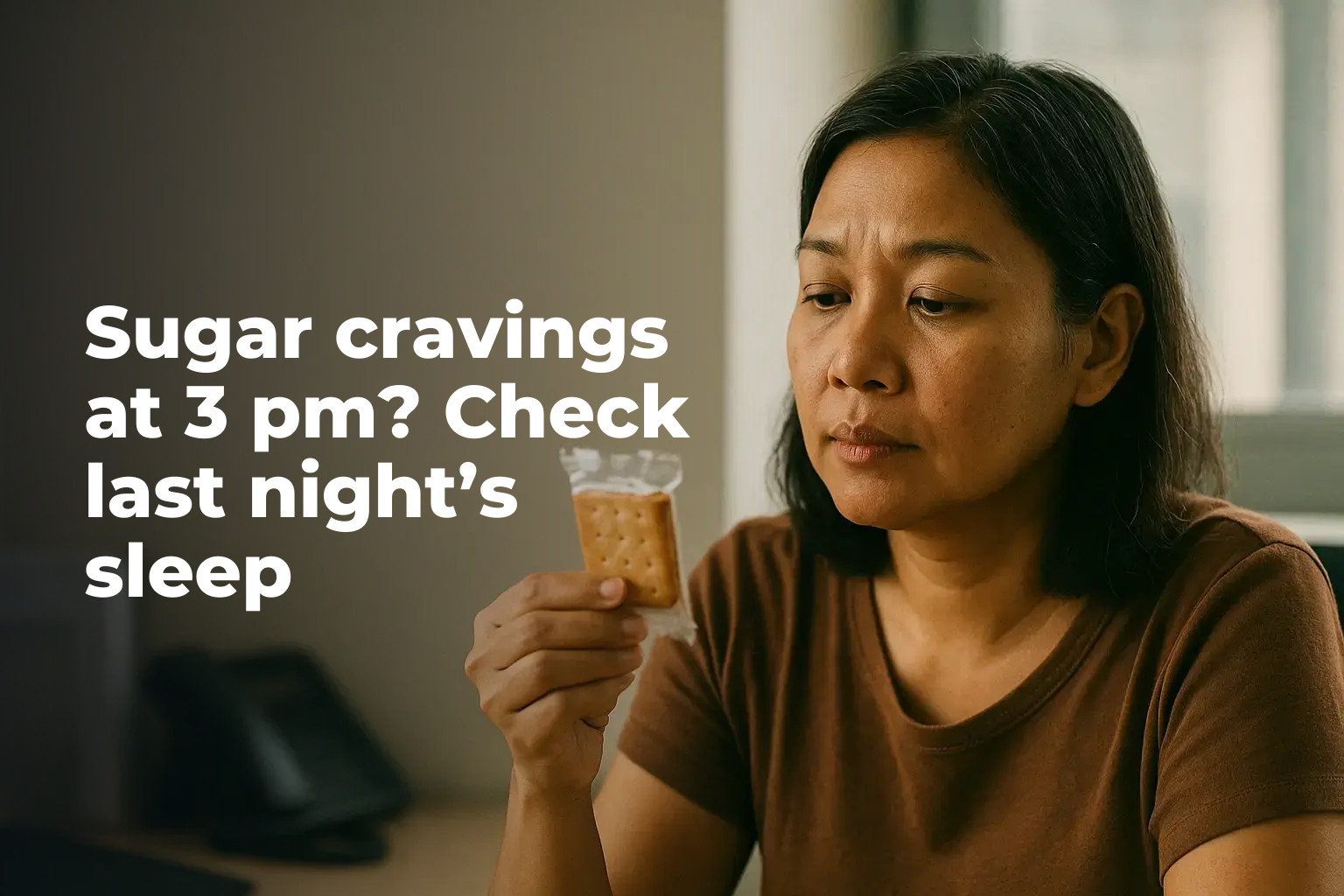
Sugar cravings are linked to poor sleep, stress and meals light on protein and fibre. Singaporeans average about 12 teaspoons of sugar a day, over half from drinks. Steadier meals, regular sleep and a two-week log may help you spot your own patterns.
Key takeaways
- Poor sleep and stress raise ghrelin, a hunger hormone, which can make sweet foods harder to resist.
- Meals with protein and fibre help keep blood sugar and cravings steadier.
- Relatively healthy people don’t need a strict sugar detox. A planned treat can fit.
- A craving alone doesn’t point to diabetes. A blood test is how you find out.
- If cravings follow a bad night or a skipped lunch, look at sleep and the plate first.
At a glance
Sugar cravings trigger chart: what drives cravings and what to try
| Trigger | What the sources say | What to try |
|---|---|---|
| Short or broken sleep | Poor sleep raises ghrelin, the hunger hormone | Keep a fixed bedtime |
| Stress | Stress hormones raise ghrelin and can feed sugar cravings | Regular meals and a short wind-down |
| Low-protein meal | Protein lowers hunger and ghrelin for a while | Add egg, fish, tofu or chicken |
| Low-fibre meal | Fibre slows digestion and gives a gentler blood sugar rise | Add vegetables, beans or wholegrains |
| Skipped meals | Regular balanced meals keep blood sugar steady and hunger down | Eat at regular times |
Sugar cravings in Singapore
Singaporeans eat about 12 teaspoons (58g) of sugar a day, according to the Health Promotion Board, and over half comes from drinks [1]. Singapore’s guidance is no more than about 10 teaspoons [2].
What causes sugar cravings?
Common triggers include:
- Poor sleep, which raises the hunger hormone ghrelin [3]
- Stress, which raises ghrelin and other hunger hormones [4] [5]
- Skipped meals, which make blood sugar less steady [6]
- For women, hormone shifts in the days before a period [6]
How do sleep and stress connect to cravings?
Sleep loss makes people crave sugar and carbs, which give a quick but uneven energy boost [6]. Ongoing stress raises cortisol and increases the pull of sugary and fatty foods [5].
That is why the 3 pm biscuit feels stronger after a late night. A good rule of thumb: after a bad night or a skipped lunch, fix the sleep and the plate first.
Why this varies from person to person
Your triggers may differ from a colleague’s. For one person it is sleep, for another it is skipped lunches. A two-week log may help you spot patterns.
Is sugar addiction real?
The evidence is partial. In people with excess weight, the brain’s reward response to food resembles what is seen with substance use [5].
That finding is about food reward in one group. It doesn’t show that sugar causes a substance-use disorder in everyone. For relatively healthy people, planning a treat is a sensible approach, and strict restriction isn’t needed [5].
How do protein and fibre at meals reduce cravings?
Protein lowers hunger and ghrelin for a while after eating [7]. Fibre slows digestion, so blood sugar rises more gently [8]. Meals with both help steady blood sugar and cravings [3].
Fat or acid in a meal also slows how fast it turns to sugar [8]. WHO suggests at least 25g of fibre a day [9].
For snacks, pair a fibre-rich carbohydrate with lean protein or healthy fat [10]. An apple with a small handful of nuts does it.
Does a sugar detox work?
Relatively healthy people don’t need a strict sugar detox or sugar cleanse [5]. WHO and Singapore’s Health Promotion Board suggest keeping free sugars under 10% of daily energy, about 50g [9] [2].
Cutting down added sugar gradually can feel kinder than all or nothing. It is a choice, not a rule. It is about knowing the trade.
Are there withdrawal-like symptoms, and how long do they last?
The sources reviewed for this article do not provide a reliable timeline. If you feel more tired or hungry after cutting back, regular meals with protein and fibre and enough sleep may help [3].
Could cravings mean diabetes, low iron or B12?
Cravings alone don’t diagnose anything. Diabetes symptoms include thirst, frequent urination, blurred vision, tiredness and unexplained weight loss, and type 2 can be mild [11]. Prediabetes has no symptoms [12].
In Singapore, a fasting glucose of 6.1 to 6.9 mmol/L counts as prediabetes [13]. A level of 7 mmol/L (126 mg/dL) or higher usually means diabetes [14]. Your lab’s range may differ. A doctor may repeat the test or add another one.
Higher sugary-drink intake has been linked with a 51% higher risk of diabetes [1]. Without lifestyle change, at least 35% of Singaporeans with prediabetes go on to type 2 diabetes within 8 years [12]. That is a window to act, and regular blood tests are the best way to catch it early [11].
Sugar cravings alone are not an established sign of low iron or B12. If you feel constantly tired, a doctor can advise which blood tests suit you.
When to ask about testing
In Singapore, BMI 23 or above is linked with higher diabetes and heart risk [2]. Ask a clinician whether your overall risk and symptoms mean you should be tested.
How do I test my craving triggers for two weeks?
A short log beats guessing. Record a normal week first, then change only one suspected trigger for the second week. It may help you spot patterns.
The steps are in the plan below.
On your plate
Nothing here is off limits. These are trades you can pick.
Swap
- Teh or kopi with sugar for kopi-O kosong or teh-C kosong
- Bubble tea for a Nutri-Grade A or B drink
- Kueh or a curry puff for fruit with nuts
- Products with a Healthier Choice ‘Lower in Sugar’ label, which have at least 25% less sugar [15]
Add
- Extra vegetables and protein to chicken rice or economic rice
- Tofu, egg or fish at breakfast
Go easy on
- Sweet drinks, since over half of Singapore’s sugar comes from beverages [1]
Fitting it into a 40-something work week
Picture a day of back-to-back calls, a skipped lunch and a pantry biscuit tin at 4 pm. The gap between meals may be playing a part, and it is not a sign of weak willpower.
It can help to keep a protein-plus-fibre snack at your desk, such as nuts with an apple [10]. Regular meals keep blood sugar and hunger steadier, even on client-dinner days [6]. On travel weeks, protecting your bedtime matters, since poor sleep raises ghrelin [3].
Fiya can fit these steadier meals around your long days and meals out, and nudge you on the hardest ones.
Two weeks to spot your sugar craving triggers
- Days 1 to 7: live normally. Each evening, note your sleep hours, meals, stress level and the time of each craving.
- Days 8 to 14: change one thing only, such as eating lunch at a regular time or keeping a fixed bedtime. Keep everything else as steady as you can.
- Day 14: compare the two weeks. Did cravings ease, and when? The log may help you spot patterns.
- To look at a second trigger, repeat for another two weeks with a different single change.
When to see a doctor
- Strong thirst, passing urine more often, blurred vision or unexplained weight loss
- Constant tiredness that doesn’t ease with better sleep
- Cravings that stay strong after you change your sleep and meals
- A fasting glucose result in the prediabetes or diabetes range
HOW FIYA HELPS
Making steadier meals stick
Knowing to add protein is easy. Doing it on tired, rushed days is harder. Fiya, Fyxlife’s personal health manager, fits steadier meals around your long days and meals out, and nudges you over WhatsApp. She also syncs sleep data from Apple Health or Google Fit, so sleep and food sit side by side.
Frequently asked questions
Start with protein and fibre at each meal, regular sleep and a way to wind down from stress. Skipping meals tends to backfire. Planning a treat, rather than fighting every urge, is fine for relatively healthy people.
It usually means cutting out added sugar for a set period. WHO and Singapore guidance instead suggests keeping free sugars below 10% of daily energy, which you can reach step by step rather than all at once.
A simple version works: protein and vegetables at each meal, such as chicken rice with extra greens or yong tau foo with more tofu and veg. Sweet drinks can become kosong versions.
Not on its own. Diabetes symptoms can include thirst, frequent urination, tiredness or weight loss, and type 2 symptoms can be mild. Prediabetes has no symptoms, so a blood test is the way to know.
In women, cravings can start about five to 10 days before a period because of hormone shifts. Preparing protein-rich snacks ahead of time can help reduce sweet cravings, so keep some ready in your bag or desk drawer.
Related reading
- HRT and Cancer: The Myth That’s Harming Women’s Health
- Chronic Inflammation Markers: 5 Myths Debunked
- Visceral Fat and Organ Health: What It Is & Why It Matters
- Hormone & Disease Risk Protocol After 40
References
- Measures for Nutri-Grade, HPB, 2026
- Dietary guidelines for adults, HealthHub, Health Promotion Board Singapore, 2024
- How To Stop Sugar Cravings, Cleveland Clinic, 2026
- Why You’re Craving Sweets, Cleveland Clinic, 2023
- Here’s the Deal With Your Junk Food Cravings, Cleveland Clinic, 2020
- Understanding Your Period Cravings, Cleveland Clinic, 2026
- Protein and appetite meta-analysis, Physiology & Behavior, 2020
- Carbohydrates and blood sugar (glycemic index and load), Harvard T.H. Chan School of Public Health, The Nutrition Source, 2025
- Healthy diet (fact sheet), World Health Organization, 2020
- Quick Snacks To Help Kick Your Sugar Craving, Cleveland Clinic, 2022
- Diabetes (fact sheet), World Health Organization, 2024
- Pre-Dicted Programme: Act now if you have pre-diabetes, HealthHub / SingHealth Duke-NUS Diabetes Centre / HPB, 2025
- Prediabetes, HealthHub, Ministry of Health Singapore, 2025
- Blood sugar test, U.S. National Library of Medicine (MedlinePlus), 2025
- Make a Healthier Choice Today!, HealthHub, 2026
Sources checked on 2026-10-16.
This article is general information, not medical advice. Talk to your doctor about your own results and before changing any medicine.


