
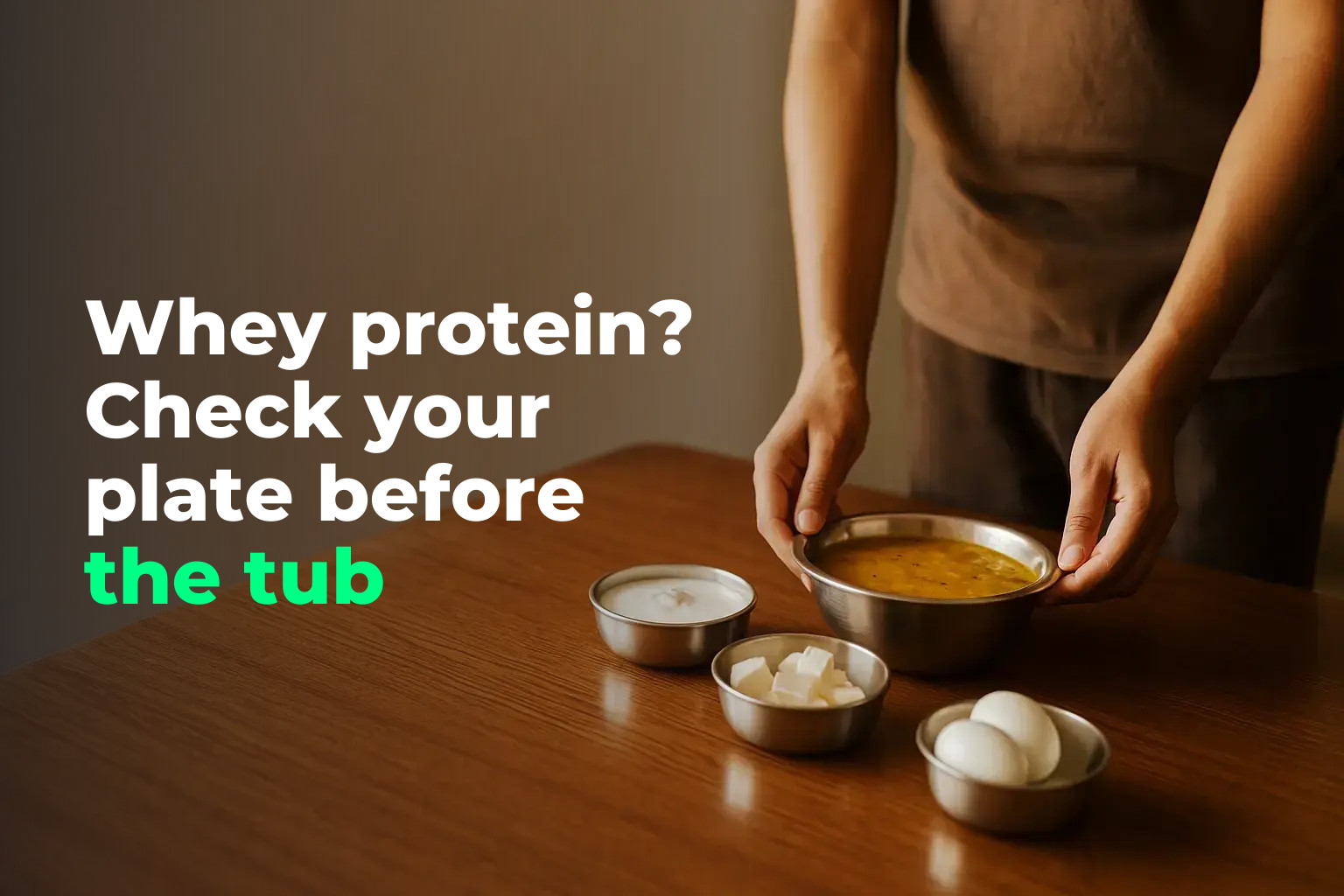
QUICK ANSWER
Many Indian diets, especially vegetarian ones built mostly on cereals, fall short on protein quality and often quantity. Start with food: pair cereals with pulses and add curd, paneer, soy, nuts or eggs. If food alone can’t meet your needs, whey (or soy or pea protein) is a practical way to close the gap. Check batch lab proof before buying.
Key takeaways
- Many vegetarian Indian diets fall short on protein quality; pairing cereals with pulses and adding curd, paneer, soy and nuts helps.
- Whey builds muscle mainly when paired with strength training, including in postmenopausal women.
- Soy gives similar strength and lean mass gains to whey when you train.
- A label alone cannot prove a tub is genuine, so look for batch-matched lab proof.
- Choose food when it is practical; use whey for convenience when your meals genuinely fall short.
At a glance
Whey protein vs food: how strong is the evidence, and what it means for you
| Claim or option | Evidence grade | Who it suits / action |
|---|---|---|
| Whey plus strength training builds muscle and strength | Strong | People who lift and fall short on food |
| Whey in postmenopausal women | Mixed: helped muscle only alongside training | Pair any powder with strength training |
| Soy vs whey for strength and lean mass | Strong: similar gains with training | Vegetarians who train |
| Plant blends vs whey | Mixed: similar muscle-building signal at a large enough serving | Choose a blend, not one plant protein |
| Whey raising long-term disease risk through amino acids | Weak: early evidence only | One reason ICMR-NIN advises against high protein from powders |
| Paying extra for a more processed whey type | Weak: no clear extra muscle benefit shown | Compare cost per gram before paying more |
| Food (dal, paneer, eggs, curd) vs shake | Limited: shakes generally have fewer nutrients than whole foods | Choose the meal when you can |
How much protein intake per day do Indian adults need?
About 60% of the protein in Indian diets comes from cereals, which are lower in quality, and once quality is counted, protein intake looks inadequate across groups, especially rural and tribal ones [13]. Diets that lean heavily on rice or roti, with little dal, milk, curd or paneer, are the most likely to fall short.
Pulses are a main protein source in Indian meals. ICMR-NIN advises pairing cereals with pulses in about a 3:1 ratio, with milk or curd, to get all the essential amino acids [1].
A commonly used figure for adults is 0.8 g of protein per kg of body weight a day [2]. Multiply your weight by 0.8. At 70 kg, that is about 56 g.
If you exercise regularly, 1.4 to 2.0 g per kg a day is enough for most people [3]. For a 70 kg person, that is roughly 98 to 140 g.
ICMR-NIN also says high protein from supplement powders is not advisable. It notes that whey is rich in amino acids that may raise the risk of some long-term diseases [4].
Why this varies from person to person
Your need is higher if you exercise regularly [3]. It can be lower if you have kidney disease, where doctors often limit protein [5]. Postmenopausal women gained muscle from whey only when they also trained [6].
Portions differ too, so treat any worked example as a starting point.
Can dal, paneer, eggs, curd and soy replace whey protein?
Usually, yes. Active people can meet their protein needs from whole foods, and powder is a practical extra, not a requirement [3].
Pairing cereals with pulses in a 3:1 ratio improves the protein quality of a meal. Vegetarians can meet needs with pulses, beans and milk or curd [4]. Soy gives muscle mass gains similar to milk protein [7].
For a 70 kg person who trains, a day aiming at about 100 g could spread across:
- Breakfast: egg bhurji or paneer bhurji with roti.
- Lunch: dal with roti or rice, and a bowl of curd. Pairing cereals with pulses improves protein quality [4].
- Snack: roasted chana, sprouts chaat or soya chunks.
- Dinner: dal, paneer or eggs with sabzi.
Check the protein per serving on packs, since brands and portions differ. Shakes tend to have fewer nutrients than whole foods [8]. That is one reason to start with the plate.
What is whey protein, and how is it made from milk?
Whey is the liquid left when enzymes curdle milk to make cheese. It is then pasteurised and dried into powder [9].
Milk protein is about 80% casein and 20% whey [5].
Whey concentrate, isolate and hydrolysate: does the type matter?
The three types differ in how much they are processed and how they sit in your stomach.
| Type | What it is | Lactose | Who might value it |
|---|---|---|---|
| Concentrate | Standard whey powder; protein per serving varies, so read the label | Not stated in these studies | Budget-minded buyers |
| Isolate | Higher in protein, lower in fat and lactose [9] | Almost lactose-free [2] | People who are lactose intolerant, but not those with a milk allergy [9] |
| Hydrolysate | Pre-broken into small pieces, easiest to digest [9] | Not stated in these studies | People who find other types hard to digest |
There is no good evidence that a more processed type builds more muscle. Compare the price per gram of protein before paying extra.
For most people the type matters less than whether you need powder at all.
When does whey protein help?
Whey helps when you lift weights and your food falls short. Milk proteins, including whey, improved muscle mass and strength alongside resistance training [10].
In postmenopausal women, whey helped muscle only when combined with resistance training [6].
If you prefer plant protein, soy gives similar strength and lean mass gains to whey with training [11]. Well-formulated plant blends can stimulate muscle building similarly to whey when the serving supplies enough protein [12].
Picture a long train day with only a canteen lunch of rice and a thin dal. A shake is a fair stopgap that day. The better habit is to fix the meals around it.
A dietitian or qualified coach can set any serving size for your body and training.
Who should avoid whey protein?
People with a milk allergy should avoid all types of whey [9]. People with kidney disease can’t handle a lot of protein at once and should check with their doctor or dietitian before any powder [8] [5].
If whey repeatedly causes digestive symptoms, stop it and discuss the cause with a clinician. If lactose intolerance is already known, isolate may be easier to tolerate [2].
Different advice applies in pregnancy and for children, so ask a clinician first.
How can you tell a fake whey protein in India?
A label alone can’t tell you if a tub is genuine. Supplements can contain fillers or heavy metals that are not listed on the label [9]. Third-party testing is usually a sign of a higher-quality product [5].
Try these checks before you buy:
- Label basics: protein per serving, full ingredients, manufacturer name and address, batch number and expiry date.
- Licence number: look for an FSSAI licence number and check it on FSSAI’s official website. A number on the pack is a start, not proof.
- Batch-matched lab report: ask the brand for a certificate of analysis that names the same batch number as your tub.
- Proprietary blends: it can help to avoid them, because they hide what is inside [2].
- Seller: buy from the brand’s own store or an authorised seller, and be wary of prices far below others.
What does a lab test prove? A protein assay shows how much protein a sample of that batch contained. It cannot show that your tub came from that batch, and it does not guarantee the product is free of other contaminants. A seal or lab logo on the tub is not proof either.
Is protein coffee or a daily shake worth the cost?
Work out cost per gram of protein. Divide the price you paid by the total grams of protein in the pack. Do the same for each food and compare.
| Item | Price you paid (₹) | Total protein in pack (g) | Cost per gram (₹) |
|---|---|---|---|
| Whey concentrate tub | your price | label total | price ÷ grams |
| Whey isolate tub | your price | label total | price ÷ grams |
| Eggs, paneer, dal, soya chunks | your price | grams per pack from label | price ÷ grams |
| Protein coffee sachet or can | your price | label total | price ÷ grams |
For a tub, total protein is the grams per serving times the number of servings. Prices change often, so use today’s price.
Food also brings more nutrients than a shake [8]. The same goes for protein coffee.
Rule of thumb: choose food when it is practical; use whey for convenience when your meals genuinely fall short.
When to see a doctor
- Hives, swelling of the lips or face, wheeze or vomiting after whey: possible milk allergy. Stop and seek urgent care.
- Known kidney disease or reduced kidney function: see your doctor or dietitian before any protein powder.
- Digestive symptoms that keep coming back after shakes: stop the powder and discuss the cause with a clinician.
- Pregnancy, or giving powder to a child: different advice applies, so ask a clinician first.
HOW FIYA HELPS
Sticking with food first
Knowing your protein number is the easy part. Hitting it through canteen lunches and long train days is harder. Fiya, Fyxlife’s personal health manager, works over WhatsApp and shapes your meals around the week you actually have. Fyxlife sells no supplements, tests or devices, and your data is never sold.
Frequently asked questions
It depends on the price, the protein it gives and what it replaces. Protein coffee is a shake in a cup, and shakes tend to have fewer nutrients than whole foods. If you enjoy it, treat it as an occasional extra and compare its price per gram of protein with your usual food.
Whey is not necessary every day. If food does not meet your protein needs, a powder can be a practical option. People with kidney disease or a milk allergy need individual advice from a clinician.
Whey is good for building muscle when you also lift weights. It is not a health food in itself, and it gives fewer nutrients than a meal. It suits people whose meals cannot reach their protein needs, which is common on cereal-heavy vegetarian diets.
It depends on your weight and training. For a 70 kg person who exercises, 1.4 to 2.0 g per kg works out to roughly 98 to 140 g, so 100 g is near the low end. Without exercise, it is above the 56 g general figure.
The commonly used adult figure of 0.8 g per kg gives about 56 g a day. With regular exercise, 1.4 to 2.0 g per kg gives roughly 98 to 140 g. A dietitian can tailor this to you.
Brand rankings that call a tub No. 1 are marketing, not evidence. A better question is which one has a clear label, a batch number and independent lab proof, at a price per gram you accept.
Whey comes from milk, so it suits people who eat dairy but not vegans. Soy protein is an option if you avoid dairy, and it gave similar strength and lean mass gains to whey in people who trained.
Related reading
- Zinc Deficiency Cascade: How It Breaks Immunity
- CoQ10 Depletion: The Energy-to-Inflammation Cascade
- Creatine Monohydrate Review: Worth It or Hype?
- Hyperbaric Oxygen Therapy: How It Works & Who Needs It
References
- Dietary Guidelines for Indians (Revised Edition 2024), ICMR-National Institute of Nutrition, 2024
- When You Should Drink a Protein Shake, Cleveland Clinic, 2022
- International Society of Sports Nutrition Position Stand: protein and exercise, International Society of Sports Nutrition, JISSN, 2017
- Dietary Guidelines for Indians (Revised Edition 2024), ICMR-National Institute of Nutrition, 2024
- Casein Uses and Benefits, Cleveland Clinic, 2023
- Whey Protein Supplementation in Postmenopausal Women, Nutrients, 2022
- Plant Versus Animal Protein on Muscle Mass: Meta-analysis, Nutrition Reviews, 2025
- What You Need To Know About Protein Powder, Cleveland Clinic, 2026
- Is Whey Protein Good for You?, Cleveland Clinic, 2021
- Timing and Types of Protein Supplementation: Network Meta-Analysis, Int J Sport Nutr Exerc Metab, 2024
- Soy vs animal protein on muscle gains, Int J Sport Nutr Exerc Metab, 2018
- Plant-Based Proteins on Recovery from Resistance Exercise, Nutrients, 2025
- Protein intakes in India (Swaminathan, Vaz and Kurpad), British Journal of Nutrition, 2012
Sources checked on 2026-10-17.
This article is general information, not medical advice. Talk to your doctor about your own results and before changing any medicine.


