
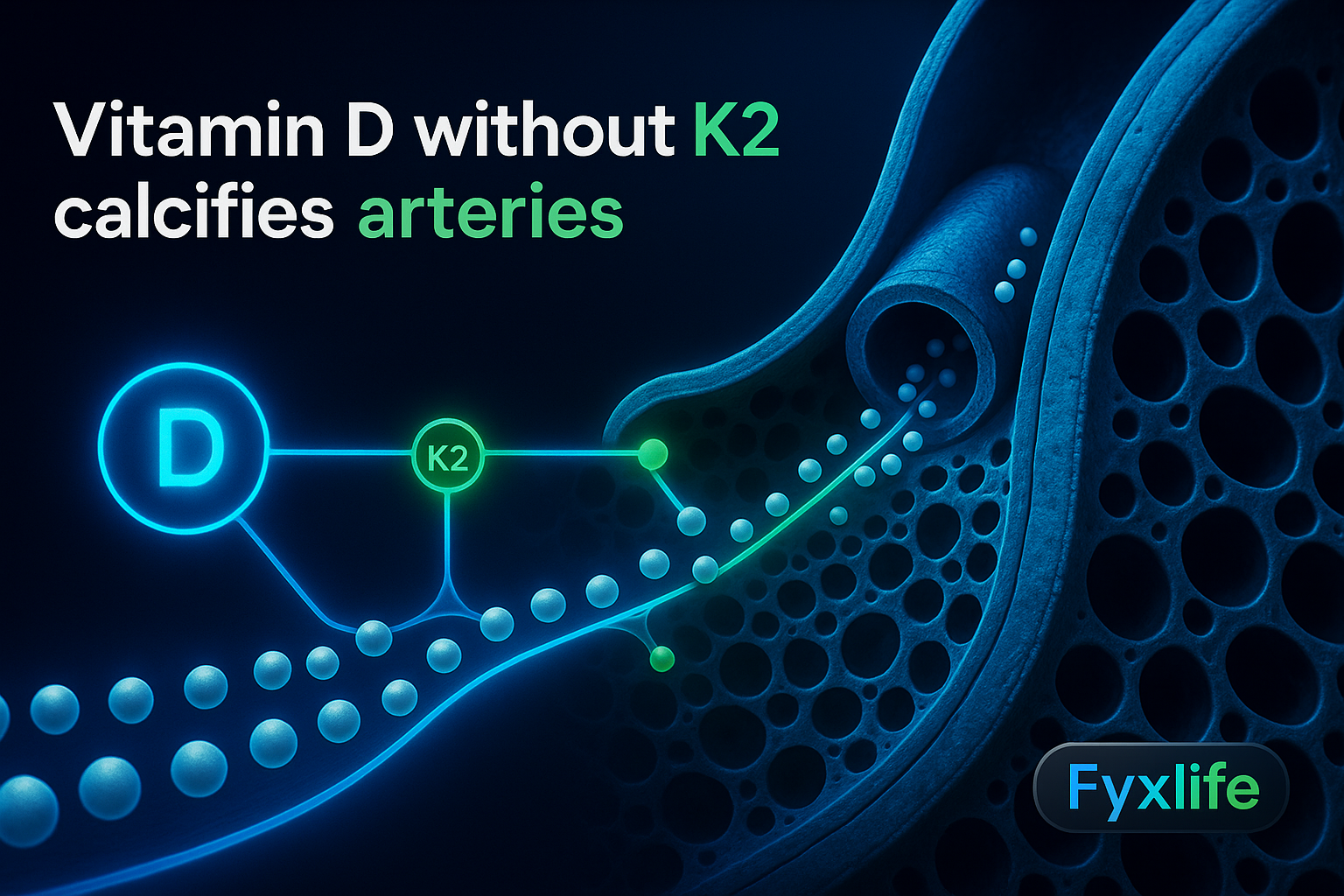
You started taking Vitamin D because your doctor said your levels were low — a smart move. But if you’re taking it without K2, you may be solving one problem while quietly creating another. Here’s the chain reaction that happens inside your body when calcium gets absorbed but has nowhere safe to go.
This isn’t a wellness scare story. The mechanism is real, the evidence is peer-reviewed, and the fix is straightforward. What’s missing from most Vitamin D conversations — including the one you probably had with your GP — is the second half of the equation. Vitamin D handles absorption. K2 handles routing. And when the routing system is missing, calcium doesn’t just disappear. It goes somewhere. The question is where.
The Setup — Why Millions Are Taking Vitamin D Alone (And Why That’s Half the Story)
Why Vitamin D deficiency is common in Singapore and across Southeast Asia despite year-round sun exposure
The assumption most people make is that living near the equator means you’re covered. It doesn’t. Sunscreen use, air-conditioned offices, long commutes in covered vehicles, and the reality that most working adults in Singapore spend the majority of daylight hours indoors mean that meaningful UVB exposure — the kind that actually triggers Vitamin D synthesis in your skin — is rarer than you’d think. Darker skin tones also require more sun exposure to produce the same amount of Vitamin D, which puts much of Southeast Asia’s population at a structural disadvantage that geography alone can’t fix.
What Vitamin D actually does — it increases calcium absorption from your gut, not calcium placement in the right tissues
This is the part that most Vitamin D conversations skip entirely. Vitamin D doesn’t build bone. It doesn’t protect your arteries. What it does — its primary mechanical job — is dramatically increase how much calcium your intestines absorb from the food you eat. That’s it. Absorption is step one. What happens to that calcium after it enters your bloodstream is an entirely different process, governed by an entirely different set of proteins. And those proteins require K2 to function.
Step 1 of the Cascade — Vitamin D Pulls Calcium Into Your Blood
The mechanism: Vitamin D upregulates calcium absorption in the intestine
When Vitamin D is active in your body, it signals the cells lining your small intestine to increase production of a calcium-binding protein called calbindin. This protein is essentially a calcium ferry — it grabs calcium from digested food and carries it across the gut wall into your bloodstream. Without adequate Vitamin D, you absorb roughly 10 to 15 percent of the calcium you eat. With it, that figure rises to 30 to 40 percent. That’s a meaningful difference, and it’s why low Vitamin D genuinely matters for bone health.
The problem: absorbed calcium is now circulating — it needs routing instructions
Here’s where the story gets more complicated than the standard supplement advice covers. Once calcium is in your bloodstream, it’s mobile. It needs to go somewhere. In a well-functioning system, it goes to bone. In a system missing a critical co-factor, it doesn’t. Think of Vitamin D as the delivery driver that picks up calcium from your gut and drops it into your bloodstream. K2 is the dispatcher who tells the driver exactly where to deliver it — bone gets the order, artery walls get cleared. Without the dispatcher, the driver just leaves packages wherever there’s space. Some end up in the right place. But over time, the wrong deliveries pile up in your arteries — and that’s when the real damage starts.
Step 2 of the Cascade — Without K2, the Routing System Fails
K2’s job: activating osteocalcin (sends calcium to bone) and Matrix Gla Protein (removes calcium from artery walls)
K2 — specifically the form known as menaquinone — activates two proteins that are central to calcium’s journey. The first is osteocalcin, a protein produced by bone cells that, once activated by K2, acts as a molecular anchor for calcium inside bone tissue. The second is Matrix Gla Protein, or MGP, which does something equally important: it actively prevents calcium from depositing inside artery walls. Research on these molecular pathways confirms that K2 is the required activator for both proteins — without it, osteocalcin can’t bind calcium to bone, and MGP can’t clear calcium from vascular tissue.
Without K2, both proteins remain inactive — calcium becomes a free agent in your bloodstream
This is the critical point. These proteins don’t activate themselves. They sit in an inactive, uncarboxylated form — chemically incomplete, unable to do their job — until K2 supplies the activation signal. If you’re supplementing Vitamin D without K2, you’re increasing the amount of calcium in circulation while simultaneously leaving the proteins that route it switched off. The calcium is there. The instructions aren’t. Taking Vitamin D and K2 together appears to enhance bone mineralisation while simultaneously reducing the risk of vascular calcification — an effect that neither achieves as effectively alone.
Plain English analogy: the calcium traffic controller
If Vitamin D is what floods the system with calcium, K2 is the traffic control system that decides where it flows. Remove the traffic controller and you don’t get an orderly slowdown — you get calcium moving through the bloodstream looking for somewhere to settle. Arteries, with their complex inner surfaces, are unfortunately good at providing that somewhere.
Step 3 of the Cascade — Calcium Ends Up Where It Doesn’t Belong
Vascular calcification: plaque hardening in arteries — the cardiovascular downstream consequence
The clinical term for calcium depositing inside artery walls is vascular calcification — and it’s not a minor inconvenience. Calcified plaques are harder, less elastic, and more likely to rupture than soft plaques. They are a recognised independent risk factor for cardiovascular events. This is not a theoretical concern. Observational studies indicate that K2 is associated with a reduced risk of vascular calcification, suggesting a protective cardiovascular role when taken alongside Vitamin D. The D-without-K2 pattern, maintained over months and years at meaningful doses, creates exactly the conditions where this calcification risk can quietly accumulate.
Bone loss despite supplementation: the paradox of taking D without K2 and still losing bone density
Here’s the paradox that most people never encounter: you can take Vitamin D faithfully, absorb calcium reliably, and still lose bone density — because the osteocalcin that should be locking calcium into your bones isn’t being activated. The calcium came in through the front door and left through a different one. Combined Vitamin D and K2 supplementation has been shown to improve bone mineral density more than either vitamin alone in clinical trials involving postmenopausal women — which means that taking one without the other is measurably less effective for bones, not just theoretically incomplete.
The Extended Cascade — Immune and Hormonal Downstream Effects
Toll-Like Receptor pathways: how D and K2 together modulate immune signalling
The story doesn’t end at bone and arteries. Both Vitamin D and K2 have documented effects on immune regulation through pathways involving Toll-Like Receptors — the cellular sensors that detect pathogens and trigger inflammatory responses. When these receptors are chronically over-activated, the result is a pattern of low-grade systemic inflammation that underlies everything from autoimmune conditions to metabolic disease. Vitamin D and K2 have documented synergistic effects, and dual supplementation may provide added benefit across multiple studied outcomes, including immune signalling. This is an area where the research is still developing, but the mechanism is plausible and the direction of effect is consistent.
Fat-soluble vitamin competition: why how and when you take these matters
Vitamin D and K2 are both fat-soluble vitamins, meaning their absorption depends on co-ingestion with dietary fat — and they share overlapping metabolic pathways. This matters practically. Taking either vitamin on an empty stomach, or with a low-fat meal, can substantially reduce how much your body actually absorbs. There’s also a signal from real-world supplementers that high-dose Vitamin D can accelerate magnesium depletion — because magnesium is required at multiple points in Vitamin D’s metabolic conversion. The fat-soluble vitamin system has more moving parts than the single-supplement conversation suggests.
What the Evidence Actually Shows — And Where It Stops
What is well-supported: synergistic bone benefit, reduced vascular calcification risk in observational data
The evidence that D and K2 together outperform either alone for bone mineral density is solid, particularly in postmenopausal women. The observational association between K2 and reduced vascular calcification is consistent across multiple studies. The mechanism — K2 activating MGP to clear arterial calcium — is well-characterised at a molecular level. This is not fringe science. It’s increasingly part of the mainstream conversation about cardiovascular risk and bone health.
What remains uncertain: optimal dosing ratios, long-term RCT data in Asian populations
What the evidence does not yet firmly establish is the optimal ratio of D to K2, or whether the findings from European and North American populations translate cleanly to Southeast Asian populations with different dietary patterns, sun exposure histories, and genetic backgrounds. Formal clinical trials on Vitamin D3 and K2 co-supplementation, including a 2021 study at the Medical University of Bialystok, are studying fracture healing outcomes — but large-scale, long-term randomised controlled trial data specific to Asian populations remains limited. The mechanism is clear. The precise numbers are still being worked out.
The Vitamin D toxicity angle — when high-dose D supplementation without K2 carries real risk
Vitamin D toxicity — technically called hypervitaminosis D — is rare but real, and its primary danger is excessive calcium in the blood (the condition known as hypercalcaemia). K2 supplementation has been identified as a mitigation factor against several side effects associated with Vitamin D toxicity, including this calcium dysregulation. Separately, high single doses of Vitamin D taken at intervals carry identified health risks — a pattern some people adopt thinking it’s equivalent to daily dosing. It isn’t, and the risk is compounded without adequate K2 and magnesium as co-factors.
This is also the kind of nuanced risk calculation that a standard 10-minute GP appointment wasn’t designed to work through. The advice to “take Vitamin D” is medically reasonable. The follow-up question — at what dose, with what co-factors, and against what individual cardiovascular baseline — is where population-level guidance and personal application start to diverge. That gap is real, and it’s worth naming.
Who This Matters Most To — Identifying Your Position in the Cascade
Already supplementing D alone at high doses
If you’re taking 2,000 IU or more of Vitamin D daily without K2, and have been for three months or longer, you are actively running the cascade described in this article. The calcium absorption effect is real. The routing proteins are inactive. This doesn’t mean damage has already occurred — but the conditions for it are present, and the longer the pattern continues, the more relevant it becomes.
Postmenopausal women and older men with bone density concerns
If bone density is your primary concern, the evidence is particularly direct: you are leaving measurable benefit on the table by taking D without K2. The osteocalcin activation that K2 provides is not a marginal addition — it’s the mechanism by which calcium actually integrates into bone matrix rather than circulating unused.
Anyone with cardiovascular risk factors or family history of arterial disease
If you have elevated LDL, a history of hypertension, a family history of heart disease, or have already been told you have arterial stiffness or early plaque, the vascular calcification angle of this cascade is directly relevant to you. Continuing high-dose D supplementation without K2 in this context is a risk worth taking seriously.
The Practical Fix — What to Take, With What, and When
K2 form matters: MK-7 (longer half-life) vs MK-4
Not all K2 is equivalent. The two main forms are MK-4 (menaquinone-4) and MK-7 (menaquinone-7). MK-7 has a significantly longer half-life in the body — roughly three days compared to MK-4’s few hours — which means a single daily dose keeps Matrix Gla Protein and osteocalcin activated throughout the day. MK-7 is the form used in most of the relevant clinical research and is what you should look for on a supplement label. Doses in studies typically range from 90 to 200 micrograms per day, though optimal dosing relative to your Vitamin D intake remains an open question.
Take both with a meal containing fat — why this is non-negotiable for fat-soluble vitamins
Because both Vitamin D and K2 are fat-soluble, they require dietary fat to be properly absorbed across the gut wall. Taking them on an empty stomach, or with a low-fat meal, means a meaningful proportion of what you swallow doesn’t make it into circulation. A meal containing avocado, eggs, olive oil, nuts, or any reasonable fat source is sufficient. This is not a minor optimisation — it’s the difference between the supplement working and not.
Get your 25(OH)D level tested before escalating doses
The blood test that measures your actual Vitamin D status is called a 25-hydroxyvitamin D test — written as 25(OH)D on a lab form. Most GPs can order this. Without it, you’re guessing at your dose relative to your baseline, and more isn’t always better. Levels above 100 nmol/L are generally considered adequate; levels above 150 nmol/L without monitoring start to carry meaningful risk. Know your number before you increase your dose.
Check the label of whatever Vitamin D supplement you are currently taking. If it does not contain K2 (listed as MK-7 or menaquinone-7), note your current daily dose. If you are taking 2,000 IU or more daily and have been doing so for more than three months without K2, bring this up at your next GP visit and ask for a 25(OH)D blood test alongside a conversation about whether K2 co-supplementation is appropriate for your cardiovascular risk profile.