
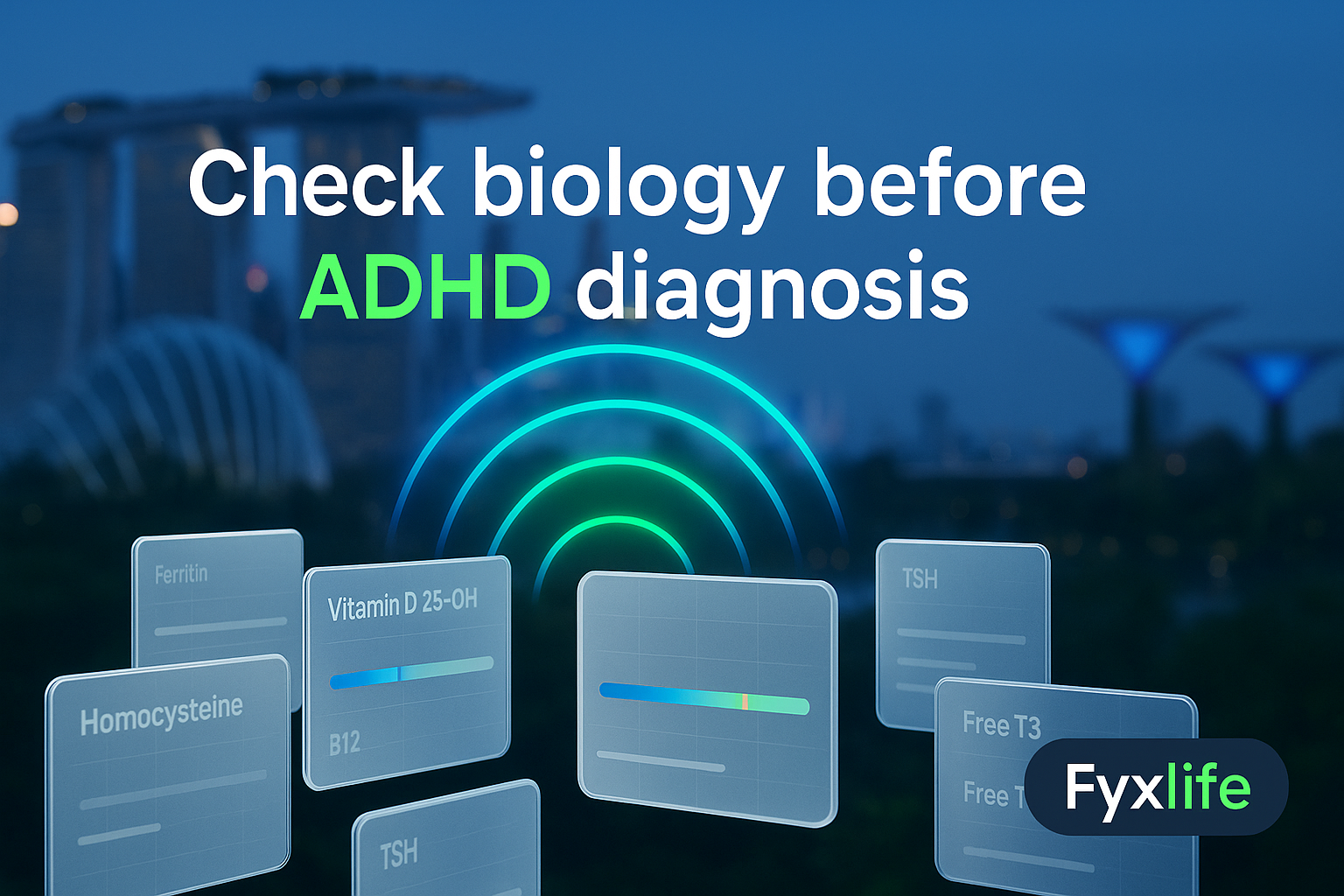
You’re 45, sharp enough to run a team, but you can’t finish a report without losing the thread six times. You’ve wondered — quietly — whether this is just stress, or something more structural in your brain. Before you assume it’s ADHD, or dismiss the idea entirely, there’s a logical testing sequence that separates biology from lifestyle, and both from a genuine attention disorder.
The frustration is real. You’re not imagining the brain fog, the half-finished tasks, the conversations where you’ve nodded along while your mind has already left the room. But reaching straight for an ADHD diagnosis — or a prescription — without first working through a structured testing process is the cognitive equivalent of calling an electrician when the problem is an unpaid power bill. The cause matters enormously. And in adults, the causes of attention failure are rarely simple.
Why Testing for ADHD as an Adult Is More Complicated Than You Think
The diagnostic reality — no single test, no brain scan, no blood marker that confirms it
Here is the first thing to understand, and it will save you both money and frustration: there is no blood test, no brain scan, and no app that definitively diagnoses ADHD. ADHD diagnosis is based on a clinical assessment determining whether you meet the criteria described in the Diagnostic and Statistical Manual of Mental Disorders — not on a single biomarker. That’s not a failure of medical science. It reflects the genuine complexity of a condition that manifests differently across individuals, life stages, and contexts.
The research community is working hard to change this. An optimal ADHD biomarker must meet strict criteria — high diagnostic sensitivity and specificity, non-invasiveness, and reliability — and no single currently available biomarker fully satisfies all of these for clinical use. So while the science is advancing, you are currently working in a space where clinical judgment remains central. That makes the quality of your testing process — and the questions you ask at each stage — more important, not less.
Why adults in Singapore often reach 40 before anyone considers the diagnosis
ADHD was, for decades, considered a childhood condition that you either grew out of or never had. Singaporean high-achievers — people who succeeded through sheer effort, structured schooling, and the social pressure to perform — often masked their symptoms for years. The system rewarded the compensation strategies, not the underlying struggle. By the time the masking stops working — usually when professional complexity increases, or when life demands genuine sustained self-direction — the person sitting in a doctor’s office is in their 40s, and neither they nor their GP has ever seriously considered that attention might be structurally compromised.
This is also where the standard system shows its limits. A 10-minute GP consultation is not designed to untangle the difference between adult ADHD, chronic sleep debt, iron deficiency, and the accumulated cognitive load of two decades of career pressure. The gap between what you need — a structured, sequential investigation — and what a routine appointment delivers is real. Naming that gap honestly is the first step toward navigating it well.
Step 1 — Rule Out the Biological Mimics First (Blood Tests to Request)
Think of diagnosing adult ADHD like investigating why a Wi-Fi connection keeps dropping. Before you assume the router is broken, you check whether the cable is plugged in, whether there’s interference from a neighbouring network, and whether the ISP is having an outage. Only after ruling out those external causes do you open up the router itself. Blood tests and sleep assessment are your cable checks. Neuropsychological evaluation is opening the router. Skipping straight to the hardware diagnosis wastes time and often reaches the wrong conclusion.
Iron and ferritin — low iron directly impairs dopamine production
Dopamine — the brain’s primary attention and motivation signal — requires iron to be synthesised. When your stored iron (the technical term is serum ferritin) is low, your brain’s capacity to produce adequate dopamine is compromised. The result feels almost identical to ADHD: difficulty sustaining attention, low drive, mental fatigue that coffee doesn’t fix. Research has identified serum ferritin and iron among the biomarkers relevant to ADHD evaluation, suggesting these should be measured as part of the diagnostic workup. The critical detail: ferritin can sit within the laboratory “normal” range while still being functionally suboptimal. Ask for the number, not just the verdict.
Vitamin D deficiency and its link to attention and mood dysregulation
In Singapore, where most professionals spend their days in air-conditioned offices rather than sunlight, vitamin D deficiency is surprisingly common despite the equatorial geography. Low vitamin D affects both mood regulation and cognitive function in ways that can look like inattention, low motivation, and emotional reactivity. These are also three of the core presentations of adult ADHD. You need the 25-OH vitamin D result — the storage form that reflects your actual tissue levels — not a binary positive/negative reading.
Vitamin B12 and homocysteine — when these are off, so is your cognitive clarity
Vitamin B12 is essential for the protective coating around nerve fibres (the technical term is myelin) and for the production of neurotransmitters involved in focus and mood. When B12 is low, or when its metabolic by-product — an amino acid called homocysteine — builds up in the bloodstream, cognitive clarity suffers noticeably. Elevated homocysteine in particular has been linked in the research literature to impaired attention and mental processing. Homocysteine and vitamin B12 are among the serum markers identified as relevant to ADHD evaluation, and they are frequently omitted from standard panels because doctors don’t think to request them unless there’s a specific neurological concern. Request both explicitly.
Thyroid function — an underactive thyroid looks almost identical to inattentive ADHD
An underactive thyroid — the butterfly-shaped gland in your neck that regulates your body’s metabolic rate — produces a symptom profile that overlaps almost completely with inattentive ADHD: slow thinking, difficulty concentrating, low energy, poor memory, and emotional flatness. The difference matters enormously because the treatment is completely different. A full thyroid panel means TSH (the signal hormone), free T3 (the active form), and free T4 (the storage form). TSH alone — which is all many standard panels include — can appear normal even when T3 and T4 tell a different story.
How to read your results and what ‘normal range’ may miss for optimisers
Laboratory reference ranges are built on population averages, not on optimal function. A ferritin result of 15 µg/L sits within the “normal” range at most Singapore labs. It is not optimal. Similarly, a vitamin D level of 52 nmol/L clears the deficiency threshold while remaining well below the 75–100 nmol/L range associated with better cognitive and immune function. When you receive results, look at the actual numbers relative to the optimal ranges in the literature — not just whether you’ve cleared the flagging threshold. A series of biomarkers in the literature are identified as promising objective parameters to more accurately diagnose ADHD, especially where clinical presentation is ambiguous — and “borderline normal” is exactly the kind of ambiguity that deserves attention.
Step 2 — Assess Sleep Architecture Before Assuming Attention Disorder
Why sleep deprivation and ADHD produce nearly identical symptom profiles
Six hours of fragmented sleep produces cognitive impairment — specifically in working memory, sustained attention, and impulse control — that is functionally indistinguishable from ADHD on a symptom checklist. The underlying mechanism is different, but the day-to-day experience is not. If you are sleeping fewer than seven hours consistently, or if your sleep is regularly disturbed, ruling out sleep as the primary driver is not optional. It is Step 2. A lifestyle factor — and an honest one shared in ADHD communities online — captures this precisely: an unhealthy lifestyle doesn’t directly cause ADHD, but it reliably makes attention symptoms dramatically worse. Poor sleep is the most powerful lifestyle confounder in adult attention assessment.
What to track and when to consider a sleep study
Start with two weeks of consistent sleep tracking using a wearable that measures heart rate variability and sleep stages. Look for patterns: Are you getting adequate deep sleep, the restorative phase that consolidates memory and clears metabolic waste from the brain? Are you waking repeatedly without remembering it? If tracking suggests fragmented sleep, or if your partner reports loud snoring and breathing pauses, a sleep study (the clinical term is polysomnography) to rule out a breathing disorder during sleep (obstructive sleep apnoea) becomes genuinely important. Untreated sleep apnoea is one of the most commonly missed causes of adult-onset attention failure in men over 40.
Step 3 — Neuropsychological and Digital Assessment Tools
What a formal neuropsychological evaluation actually tests
If blood work and sleep assessment come back clean — or correcting deficiencies doesn’t resolve your symptoms — this is when you open the router. A formal neuropsychological evaluation is a structured battery of cognitive tests administered by a trained psychologist. It measures working memory (your brain’s short-term processing space), processing speed, sustained attention, and executive function (your capacity to plan, sequence, and self-regulate). The result is a cognitive profile, not just a diagnosis. That profile tells you where your attention system is genuinely underperforming relative to your own intellectual baseline — not relative to a population average.
Digital and app-based tools — useful screening, not diagnosis
A narrative review of ADHD diagnostic tools found that both traditional clinical methods and emerging digital approaches are in use, with digital tools expanding the screening toolkit without replacing clinical judgment. Apps and online cognitive assessments can give you useful preliminary data — and they’re worth using before a formal evaluation to arrive better informed. But a positive result on a digital screening tool is a prompt to investigate further, not a diagnosis. Treat it as signal, not conclusion.
How to find an adult ADHD specialist in Singapore and what to expect
Adult ADHD assessment in Singapore is conducted primarily by psychiatrists and clinical psychologists with specific experience in neurodevelopmental conditions. The Institute of Mental Health (IMH) offers adult ADHD assessment, as do several private psychiatric practices. Expect an initial consultation covering detailed developmental history, current symptom presentation across multiple life domains, and structured rating scales completed by you and ideally someone who knows you well. A thorough evaluation takes time — multiple sessions is the norm for a rigorous assessment. Be wary of any process that reaches a diagnosis in a single short appointment without ruling out the mimics described above.
Step 4 — If You’re Already Treated, These Are the Biomarkers Worth Tracking
Treatment response biomarkers — what may indicate whether an intervention is working
Whether your treatment is pharmacological or lifestyle-based, tracking biological markers over time adds objectivity to what can otherwise be a purely subjective assessment of “is this working?” Treatment biomarkers for ADHD are an active area of research that may enhance personalised medicine and guide novel treatment development, suggesting that ongoing monitoring has real clinical value — not just at diagnosis, but across the treatment journey. The markers most worth retesting include ferritin, vitamin D, homocysteine, and thyroid function. If you’ve corrected a deficiency and your attention has improved, retesting at three to six months confirms the correction is holding. If symptoms return, the labs often tell you why before your memory does.
There is also emerging — though still largely research-phase — work on metabolic markers (what scientists call metabolomic profiling) that may eventually allow more precise biological characterisation of ADHD subtypes. Metabolomic research is revealing biological mechanisms underlying ADHD with potential diagnostic applications, though this remains largely in the research phase rather than clinical practice. Watch this space. The science is moving faster than the clinical guidelines.
How often to retest and what changes in results mean
For nutritional markers — ferritin, vitamin D, B12, homocysteine — retest every three to six months while actively correcting a deficiency, then annually once levels stabilise. For thyroid markers, annually is appropriate unless symptoms change. If a marker improves and your attention symptoms improve in parallel, that’s meaningful data. If the marker improves and symptoms don’t shift, the marker wasn’t the driver — and that pushes you further along the diagnostic pathway toward a formal neuropsychological evaluation. Recent progress in biomarker science has shed light on the neurobiological underpinnings of ADHD, giving rise to the hypothesis that objective biological parameters could more accurately support diagnosis — and while that future isn’t fully here yet, the markers available today are already clinically useful when tracked systematically.
What to Ask Your Doctor at Each Stage
The five questions that move a GP consultation from generic to productive
- “Can you run a panel that includes serum ferritin, 25-OH vitamin D, vitamin B12, homocysteine, and a full thyroid function test — TSH, free T3, and free T4?”
- “If any of these results are in the lower quarter of the normal range rather than optimal, could that level be contributing to my attention symptoms?”
- “Before we consider a formal ADHD referral, is there a structured process to rule out nutritional, thyroid, and sleep-related causes first?”
- “What would you want to see corrected — and for how long — before we could say with confidence these weren’t the primary drivers?”
- “If we do pursue a formal assessment, which specialist or service in Singapore would you recommend for adult ADHD specifically, and what does their evaluation process involve?”
When to ask for a referral to a psychiatrist or neuropsychologist
Ask for a referral when blood work is optimised, sleep is adequate, and attention symptoms persist across multiple life domains — at work, at home, in low-stimulation environments — for at least six months. Also ask for a referral if there is a strong family history of ADHD or learning differences, or if your symptoms are significantly impairing your professional or personal functioning and lifestyle correction alone has not moved the needle. Because no single biomarker fully satisfies the criteria for clinical ADHD diagnosis, the clinical evaluation remains the definitive step — and getting there having already ruled out the mimics makes that evaluation considerably more meaningful.
The Single Next Step
Before your next GP appointment, request a panel that includes serum ferritin, vitamin D (25-OH), vitamin B12, homocysteine, and a full thyroid function test (TSH, free T3, free T4). Print your results and, if any value sits at the low end of the normal range rather than optimal, ask your doctor: “Could this level be contributing to my attention and focus symptoms, and is it worth correcting before we consider a formal ADHD evaluation?” That single question shifts the consultation from a quick referral to a genuinely diagnostic conversation.