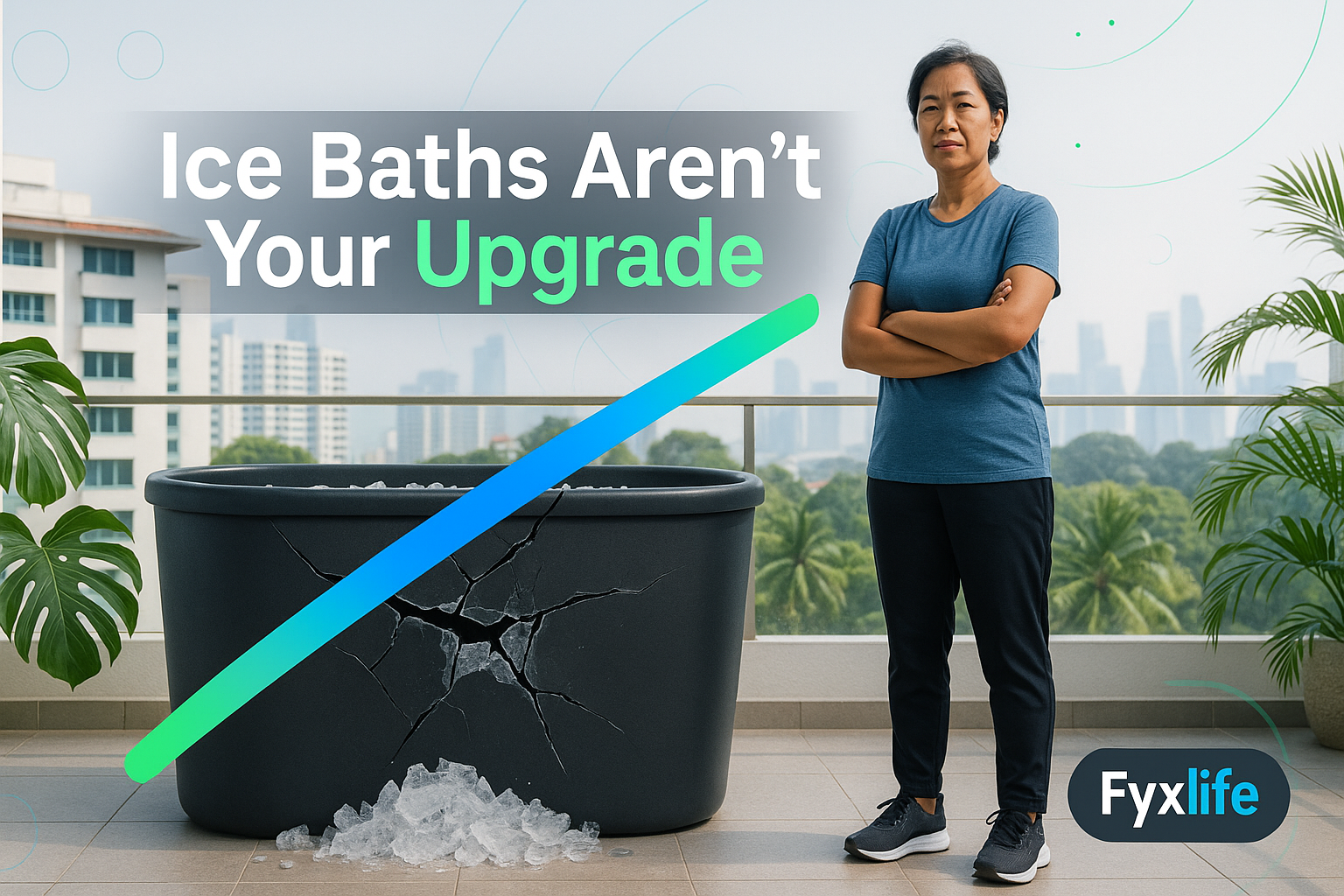
You’ve seen the videos — executives plunging into ice baths at 5am, swearing it’s why they perform better, sleep deeper, and never get sick. But when you look at the actual research, the story is messier, more nuanced, and in some places, completely backwards from what’s being claimed online. The felt experience is real. The physiology behind the popular claims is a different matter entirely.
Cold exposure has gone from niche athletic recovery tool to mainstream biohacking ritual in the space of a few years. If you’re a busy professional already doing the right things — sleeping reasonably well, training when you can, managing stress — the promise of a practice that turbocharges your immune system, speeds up recovery, and sharpens your mind is exactly the kind of offer you’d want to believe. The problem is that what people are claiming cold does and what cold actually does are only partially the same thing.
The Myth — Ice Baths Are a Recovery Superweapon Backed by Science
Where the claim comes from and why it spread so fast
The modern cold exposure movement has genuine scientific roots. Researchers have studied cold water immersion in athletes for decades, and there are real physiological responses worth knowing about. The problem is what happened next: a handful of compelling findings got amplified through podcasts, social media, and the biohacking community into a much broader set of claims than the evidence supports. When influential figures describe cold exposure as feeling “comparable to cocaine except, for most people, no side effects,” you understand immediately why it spread. It feels extraordinary. And feelings, when they’re that strong, tend to generate beliefs that outrun data.
What the popular narrative promises vs. what the research actually tested
The popular narrative promises a package deal: boosted immunity, faster muscle recovery, sharper mental performance, metabolic improvement, and longevity enhancement — all from regular cold immersion. What the research actually tested is far more specific: particular populations, particular temperatures, particular durations, particular outcomes. Cold showering and cold water immersion, for instance, have been studied separately and produce different physiological responses — collapsing them into a single claim about “cold exposure” already misrepresents what each actually does. The gap between what was studied and what is claimed is where most of the mythology lives.
Myth #1 — Cold Exposure Boosts Your Immune System
The proposed mechanism and why it sounds plausible
The immune-boosting claim has a logical surface appeal. Cold is a stressor. The body responds to stressors by activating protective systems. Hormesis — the idea that mild stress produces adaptive strengthening (the technical term for this is hormesis) — is a real and well-documented phenomenon. So the leap to “cold stress trains your immune system” feels reasonable. It’s the kind of reasoning that’s right often enough in biology that it earns credibility.
What the evidence actually shows: thermogenesis vs. immune activation
Think of your body’s response to cold like a circuit breaker box. When you hit the cold, your body throws almost all its available power into keeping your core temperature stable. That’s thermogenesis — the process of generating heat — and it’s a genuine, powerful, and metabolically expensive response. The popular claim is that while the circuit breaker is flipping, it’s also upgrading the whole electrical system. The evidence doesn’t support that. What you get is a powerful but narrow response, not a whole-body tune-up. Specifically, cold exposure may actually constrain immune response rather than boost it, because thermogenesis and immune activation appear to compete for the body’s resources. The two systems trade off against each other, rather than running in parallel.
Verdict: Plausible but unproven — and possibly backwards
The immune benefit claim is not supported by the current evidence base. It may be that the mechanism runs in the opposite direction from what’s being claimed. The published literature frames immune improvement from cold bathing as a claim requiring further investigation — not an established fact. Stop treating this one as settled.
Myth #2 — Ice Baths Accelerate Physical Recovery After Exercise
The inflammation argument — and why blunting it may backfire
The recovery argument goes like this: exercise creates acute inflammation — localised swelling and tissue damage in the muscles you’ve trained — and cold reduces inflammation, therefore cold accelerates recovery. The first two parts of that sentence are true. The third part is where it gets complicated. Acute post-exercise inflammation is not purely a problem to be solved. It is part of the adaptation signal. When your muscles are briefly inflamed after a hard session, that discomfort is your body beginning the process of getting stronger. Blunting that signal has consequences.
What cold water immersion actually reduces (and what it doesn’t)
Cold water immersion does reduce the perception of soreness — what researchers call delayed onset muscle soreness (DOMS) — in the short term. If you need to feel less wrecked the morning after a hard training session, cold immersion has a genuine role to play. But feeling better and adapting better are not the same thing. Cold water therapy presents a potential lifestyle strategy for enhancing physical and mental well-being and promoting healthy aging, but researchers describe it as having “untapped potential” — meaning the evidence base is still being built, not settled. For athletes chasing long-term strength or hypertrophy gains, regular cold immersion after training sessions may actually reduce the adaptation signal they’re working to generate.
Verdict: Useful for soreness, potentially counterproductive for adaptation
If you’re a competitive athlete in a high-volume training block, routine ice baths after sessions may not be your friend. If you’re a busy professional who exercises to feel good and wants to recover enough to function well through the week, occasional cold immersion has a legitimate place. Context matters enormously, and the cold exposure discourse almost never provides it.
What Cold Exposure Actually Does Well
Mood, affect, and mental recovery — the most consistent signal in the data
Here is where the evidence is clearest and most consistent. Short-term cold water immersion is supported by an emerging body of evidence for facilitating positive affect and reducing negative affect — meaning measurable improvement in mood, not just subjective reports of feeling good. For stressed, time-poor adults who feel tired despite doing the right things, this is actually a meaningful finding. The acute physiological jolt of cold immersion — the spike in noradrenaline, the forced presence required to stay in the water — appears to produce a real and measurable shift in how you feel. That is the most robust signal in the data, and it is conspicuously underplayed relative to the recovery and immune claims.
Blood sugar regulation via brown fat activation — real but limited
Cold exposure does activate brown adipose tissue — a specialised type of fat that generates heat by burning calories, which is sometimes called “brown fat.” This process has metabolic consequences. Intermittent cold exposure causes transient, meaningful improvements in blood sugar regulation, linked to this brown fat activation. This is a real effect worth knowing about, particularly if metabolic health is a priority. But — and this matters — these effects show no synergy when combined with other common interventions. They are real, but bounded. They do not compound indefinitely.
Specific benefits for women: anxiety and menstrual symptoms
One finding that consistently gets buried in the generic “cold plunge” discourse is specific to women. Women who cold water swim reported reduced menstrual-related anxiety in 46.7% of respondents, and reduced mood swings in 37.7% — a specific, measurable psychological benefit that deserves far more attention than it receives. If you’re a woman dealing with cyclical anxiety or mood disruption, this is a more compelling evidence-based reason to explore cold water swimming than anything in the recovery or immune literature.
The Risk Nobody Talks About
Autonomic conflict and cardiac arrhythmia risk in cold water immersion
The optimisation community talks about the benefits constantly. It almost never talks about this. Cold water submersion can induce a high incidence of cardiac arrhythmias — abnormal heart rhythms — even in healthy volunteers. The mechanism is called autonomic conflict: when you submerge your face in cold water, one nervous system response is triggered (the dive reflex, which slows your heart). Simultaneously, cold shock triggers another response (the fight-or-flight response, which speeds your heart up). These two signals compete, and in some people the competing electrical signals produce arrhythmias. This is not a fringe theoretical risk. It has been measured in controlled studies in healthy people.
Who should be especially cautious
If you have any history of cardiac arrhythmia, known structural heart disease, uncontrolled hypertension, or a family history of sudden cardiac events, cold water immersion warrants a direct conversation with someone who knows your cardiovascular history in detail. The challenge is that this is exactly the kind of question a routine annual check-up was not designed to answer — not because doctors don’t care, but because population-level safety guidance was never built to account for your specific cardiac risk profile. The risk is real, it is measurable, and it is almost never mentioned in the content that is driving people toward ice baths.
The Verdict — Drop This Belief, Keep This Practice
What to stop claiming cold exposure does
Stop claiming it reliably boosts your immune system. The mechanism runs in a direction that may be the opposite of the claim, and the evidence base is largely observational and mechanistic rather than from large randomised trials. Stop claiming it universally accelerates recovery from exercise — for people trying to build strength or fitness, it may do the opposite by blunting the adaptation signal. And stop treating “cold exposure” as a single unified practice with a single unified effect. A cold shower is not an ice bath. A lake swim is not a cryotherapy chamber. These are different stimuli with different physiological profiles.
What it genuinely appears to offer for busy, stressed adults
The most honest summary is this: cold exposure is a genuine mood and mental recovery tool with real but narrow physiological effects. For stressed professionals who feel tired despite doing the right things, the consistent mood benefit is not nothing — it may actually be the most relevant benefit the practice offers. The brown fat metabolic effect is real. The women’s anxiety and menstrual symptom data is real and underappreciated. These are worth knowing about and worth acting on. They just aren’t the story that’s being told.
How to use it intelligently if you choose to
If you want to use cold exposure, use it for the right reasons and with appropriate caution. Cold immersion after hard training sessions is probably not the tool for you if long-term adaptation is the goal — save it for recovery weeks or high-stress periods when mood and mental reset matter more than training adaptation. Start with shorter exposures and cooler rather than ice-cold temperatures while your body acclimatises. Do not submerge your face if you have any cardiac concerns. And understand that the dose, the method, and your individual physiology all shape what you actually get from it.
Drop the belief that cold exposure is a broad-spectrum health upgrade and replace it with the evidence-based version: it is a genuine mood and mental recovery tool with real but narrow physiological effects. The next time you make a decision about whether to add cold exposure to your routine — or justify the one you already have — anchor it to the one consistent signal the research supports: stress and mood regulation, not immune boosting or accelerated physical recovery.