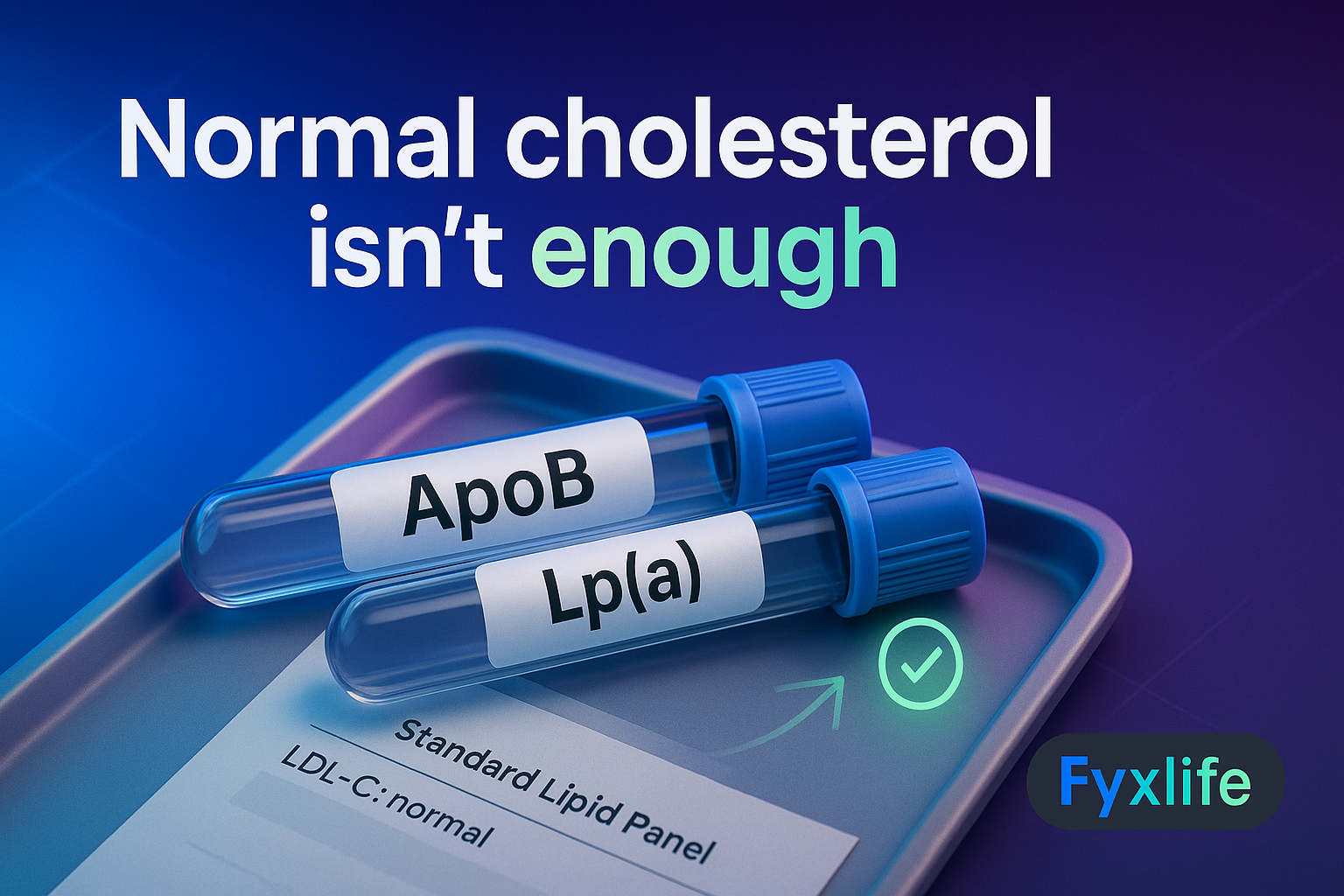
You did everything right: got your annual blood test, your LDL came back normal, your doctor said “looks good.” But something still feels off — or worse, someone in your family had a heart attack with “normal” cholesterol. The standard lipid panel is a starting point, not a finish line. Here’s the exact protocol for upgrading your cardiovascular picture with two tests most doctors won’t order unless you ask.
That feeling of something missing is not paranoia. It reflects a genuine gap between what the standard cholesterol test was designed to measure and what modern cardiovascular science now understands about how heart disease actually starts. The good news: the additional tests exist, they are not exotic, and you can request them at your next blood draw. The frustrating part is knowing which ones to ask for, and why — which is exactly what this article will walk you through.
What the Standard Lipid Panel Actually Measures (And What It Leaves Out)
The four numbers on your standard panel — and the question each one cannot answer
When your doctor orders a standard lipid panel, you get four numbers: total cholesterol, HDL (the so-called “good” cholesterol), LDL-C (the so-called “bad” cholesterol), and triglycerides. Each of these is a measure of cholesterol volume — the total amount of fatty molecules circulating in a given lipoprotein category. What none of them tell you is how many individual particles are carrying that cholesterol. And that distinction, it turns out, is critical.
A full lipid profile including total cholesterol, HDL, LDL, and triglycerides remains the essential baseline for cardiovascular risk assessment. No one is arguing you should skip it. But treating it as the complete picture is where the problem begins.
The cholesterol volume problem: why a ‘normal’ LDL-C can still mean dozens of dangerous particles
Think of your standard lipid panel like a traffic report that only tells you how many cars are on the road by weight. It can miss a highway packed with small, aggressive vehicles all looking for a gap in your artery walls. The total weight looks manageable. But the number of vehicles — and their size — is what determines how much damage they can do.
This is the core limitation of LDL-C (low-density lipoprotein cholesterol, the measure of cholesterol carried inside LDL particles). Two people can have an identical LDL-C of 2.5 mmol/L. One of them might have that cholesterol distributed across a moderate number of large, relatively buoyant particles. The other might have it packed into dozens of small, dense particles — each one fully capable of penetrating artery walls and contributing to the slow buildup of plaque inside artery walls (the technical term for this process is atherosclerosis), a process that begins decades before any symptoms appear. Standard testing cannot tell the difference between these two people. The standard panel measures cholesterol volume, not the number of dangerous particles actually causing damage in your arteries.
ApoB — The Particle Count That Changes the Picture
What ApoB measures in plain English
Back to the traffic analogy. If LDL-C tells you the total weight of vehicles on the road, ApoB (apolipoprotein B) counts every single vehicle — regardless of size. Every atherogenic lipoprotein particle — every particle with the potential to build plaque — carries exactly one ApoB protein on its surface. One particle, one ApoB. So the ApoB number is a direct count of total particle traffic.
ApoB is the primary structural protein carried by every atherogenic lipoprotein particle — including LDL, VLDL, IDL, and chylomicron remnants — meaning one ApoB number captures the total traffic of particles that can build plaque in arteries. VLDL and IDL are other lipoprotein types that your standard panel does not directly count. ApoB counts them all in a single number.
Why ApoB is more clinically useful than LDL-C for assessing residual risk
Residual cardiovascular risk — the risk that remains even after standard markers look normal — is where ApoB earns its importance. Someone with a normal LDL-C but a high particle count will have an elevated ApoB. Without testing it, that risk is invisible on paper.
ApoB is considered simpler, more widely available, less expensive, and more clinically actionable than LDL particle number testing, making it the preferred advanced marker in clinical practice. It doesn’t require specialist equipment or a specialist referral. Your standard lab can run it. The 2026 ACC/AHA guidelines reflect this shift: ApoB testing is now considered useful for improving risk assessment and guiding therapy, particularly once LDL-C and non-HDL-C goals have been met, and especially in people with cardiovascular-kidney-metabolic conditions.
What your ApoB number means: how to interpret results
General interpretation thresholds for ApoB sit around these levels: below 65 mg/dL is considered optimal for high-risk individuals; below 80 mg/dL is a reasonable target for those at moderate risk; and above 100 mg/dL warrants a serious conversation about both lifestyle and, in some cases, medication. But context matters — your ApoB number should always be read alongside your triglycerides, your HDL, and your overall cardiovascular risk profile. A number in isolation is incomplete intelligence.
Lp(a) — The Genetic Risk Factor Almost Nobody Checks
What Lp(a) is and why it behaves differently from LDL
Returning to the traffic analogy one final time: if ApoB counts every vehicle on the road, Lp(a) (lipoprotein(a), pronounced “LP little a”) identifies a specific type of vehicle that is stickier, harder to remove, and largely determined by the blueprint you were born with. It is not simply another LDL particle. Lp(a) carries an additional protein called apolipoprotein(a) that makes it particularly prone to promoting both plaque formation and blood clotting — a combination that makes it independently dangerous.
The critical word there is “independently.” Lp(a) is not just a variation of your LDL risk. Elevated Lp(a) is an independent cardiovascular risk factor — it can coexist with a normal ApoB and a perfectly normal standard lipid panel, making both tests necessary rather than interchangeable. You need all three reports to know what is actually happening on the road.
Why elevated Lp(a) can hide behind a perfectly normal lipid panel
This is the part that surprises most people. You can receive entirely normal lipid panel results and still have elevated Lp(a). The standard panel does not measure it. It is not captured in your LDL-C, not reflected in your total cholesterol, not visible in your triglycerides. If your doctor never orders it, you will never know — and given that elevated Lp(a) affects roughly one in five people globally, that is a significant blind spot.
The challenge is that this is exactly the kind of question a routine annual check-up was not designed to answer — not because doctors don’t care, but because population-level reference ranges were never built to account for individual genetic risk factors like this one. A GP working within a 10-minute appointment slot, using a standard requisition form, is unlikely to add a test that requires a separate clinical rationale unless you ask specifically.
What your Lp(a) number means and why you only need to test it once
Unlike LDL-C or ApoB, Lp(a) levels are largely set by your genetics and remain relatively stable throughout adult life. Diet, exercise, and most lipid-lowering medications have minimal effect on it. This is why the 2026 ACC/AHA guidelines now recommend a one-time Lp(a) screening for all adults, noting that it can independently increase cardiovascular disease risk. You test it once to establish your baseline. Then you know. Values above 50 mg/dL (or 125 nmol/L, depending on the unit your lab uses) are generally considered elevated and warrant closer attention to other modifiable cardiovascular risk factors — because if you cannot change the Lp(a) itself, you work harder on everything else.
The Protocol — When to Test, What to Ask, and In What Order
Step 1 — Start with a complete standard lipid panel (fasting or non-fasting)
The standard panel is the foundation. Without it, you have no baseline and no context for interpreting what comes next. The good news: current guidelines now allow either fasting or non-fasting lipid panels, removing the previous requirement to fast before a standard cholesterol test. This removes one of the most common excuses people use to delay getting tested. Book the blood draw. Get the four baseline numbers.
Step 2 — Add ApoB if LDL-C is borderline, if you have metabolic risk factors, or once LDL-C goals are met
ApoB is most valuable in three situations: when your LDL-C sits in an ambiguous range and you want clarity on actual particle burden; when you have metabolic risk factors like elevated triglycerides, low HDL, insulin resistance, or abdominal obesity that make LDL-C a less reliable indicator; or when you are already treating your LDL-C and want to confirm that particle count is actually coming down alongside cholesterol volume. The lipid profile feeds into cardiovascular risk assessment, with ApoB contributing meaningfully to the overall picture when standard markers are insufficient or ambiguous.
Step 3 — Add Lp(a) as a one-time baseline test regardless of your other results
This is the test that requires the least ongoing attention and carries the most permanently useful information. Test it once. The 2026 ACC/AHA guideline reflects a clear shift toward earlier and more comprehensive cardiovascular risk profiling across the lifetime — and Lp(a) is now explicitly part of that picture. Do not wait until a cardiac event prompts it.
Step 4 — Interpret the combination, not each number in isolation
Adding Lp(a) and ApoB measurements to traditional cardiovascular risk factors improves risk prediction accuracy — but the operative word is “adding.” These markers gain their meaning in context. A high ApoB with a normal LDL-C tells one story. A high Lp(a) with an otherwise clean panel tells a different one. Both elevated together with a borderline standard panel tells a third. The protocol is designed to be read as a complete report, not three separate documents.
What NOT to Do
Do not skip the standard panel and jump straight to advanced markers
Chasing ApoB or Lp(a) without first completing a standard lipid panel and basic cardiovascular risk assessment creates noise, not signal. Advanced markers exist to refine and extend the picture — not to replace the baseline. If you arrive at a consultation with only an ApoB number and no standard panel, any clinician worth their training will send you back for the foundation first.
Do not treat Lp(a) like LDL — lifestyle changes have minimal impact on it
This is important enough to say plainly. The habits that bring down your LDL-C — reducing saturated fat, increasing fibre, losing weight, exercising more — have very little effect on Lp(a). It is genetically set. Knowing your Lp(a) is elevated does not mean you need to work harder on your diet. It means you need to be more precise about managing every other cardiovascular risk factor you can influence: blood pressure, LDL-C, ApoB, smoking, insulin resistance. Specific Lp(a)-targeted therapies are in late-stage clinical trials, but they are not yet widely available. Until they are, the strategy is risk factor optimisation across the board.
Do not interpret ApoB in isolation without knowing your triglycerides and HDL
ApoB captures all atherogenic particles — but the distribution of what is driving a high ApoB matters for deciding what to do about it. High triglycerides push VLDL particles up, which pushes ApoB up, which requires a different conversation than an ApoB driven purely by small dense LDL. Your HDL level provides additional context about how efficiently your body is clearing particles from the bloodstream. Read ApoB alongside those numbers, not instead of them.
How to Talk to Your Doctor — The Exact Ask
The script: how to request ApoB and Lp(a) without being dismissed
The most effective approach is to be specific, calm, and brief. You do not need to give a lecture. You need to name two tests and provide a single sentence of justification. Something like: “I’d like to add ApoB and Lp(a) to my next lipid panel. The 2026 ACC/AHA guidelines now recommend a one-time Lp(a) test for all adults, and I want a baseline ApoB to understand my particle count alongside my cholesterol volume.” That framing — citing a current guideline, using clinical language, and being clear about what you want — is usually enough. Both ApoB and Lp(a) are widely available through standard laboratory requisitions and do not require specialist referral in most healthcare systems.
What to do if your doctor says the tests are unnecessary
Ask one follow-up question: “Can you help me understand which specific part of my risk profile makes you confident that particle count and Lp(a) aren’t relevant for me?” A good clinician will either answer it with your specific clinical context — which is genuinely useful — or will recognise that the question is reasonable and reconsider. If the answer is simply that it is not standard practice or not covered, that is a different conversation about access rather than clinical relevance. In Singapore and much of Southeast Asia, both tests can be run privately through laboratories for a modest out-of-pocket cost if your standard pathway does not cover them.
Your Next Step
At your next routine blood test or GP visit, ask specifically: “Can you add ApoB and Lp(a) to my lipid panel?” If your doctor asks why, say: “The 2026 ACC/AHA guidelines now recommend a one-time Lp(a) test for all adults, and I want a baseline ApoB to understand my particle count, not just my cholesterol volume.” Write these two test names down before the appointment so you do not leave without asking.