Your doctor says your blood pressure is ‘fine’ — but fine by whose standard, and fine compared to what outcome? The number on the cuff means nothing without knowing the target you’re being measured against, and right now those targets are actively being debated at the highest levels of cardiovascular medicine. If you have a family history of heart disease, diabetes, or stroke, this debate is not academic. It is directly about you.
The discomfort many health-aware adults feel after a routine check-up is not paranoia. It is pattern recognition. You sense that ‘your blood pressure looks fine’ and ‘your blood pressure is optimised for your risk profile’ are not the same statement — and you are right. They are not.
What Does Your Blood Pressure Number Actually Mean?
Systolic vs. diastolic — what each number is measuring inside your vessels
When a blood pressure reading shows 128/82, those two numbers are measuring two different moments in a single heartbeat. The top number — systolic pressure — is the force your blood exerts against artery walls when your heart contracts and pushes blood out. The bottom number — diastolic pressure — is the residual pressure that remains while your heart is at rest between beats. Together they describe the full mechanical load your vascular system carries through every cycle, roughly 100,000 times per day.
There is a third value worth knowing: the gap between the two numbers, called pulse pressure. A widening pulse pressure — say, systolic rising while diastolic stays flat or drops — can signal that your arteries are stiffening, which is itself a cardiovascular risk factor independent of either number alone. Most clinic conversations never reach this level of nuance.
Why a single clinic reading can mislead you (and what ambulatory monitoring captures instead)
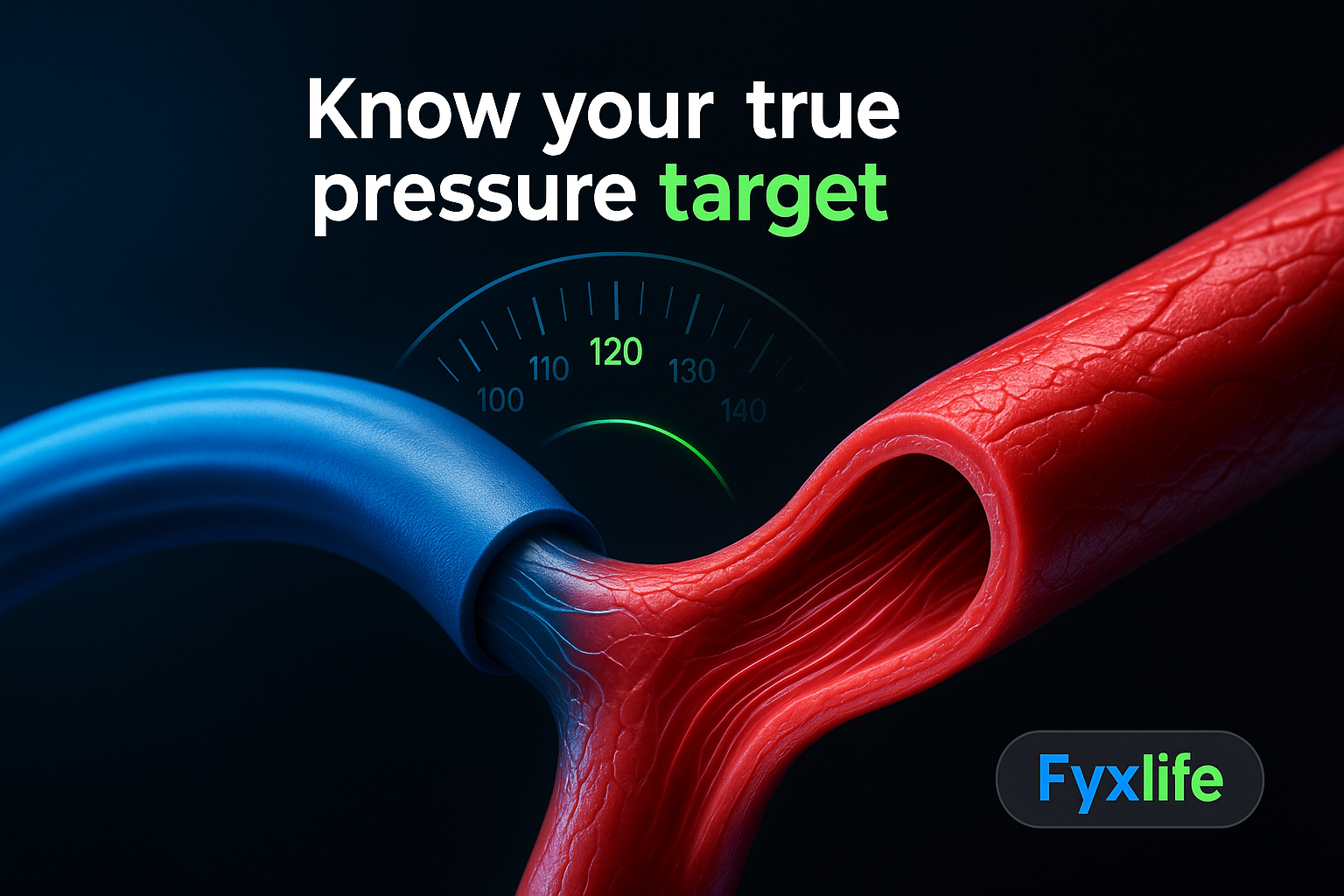
Think of your blood vessels like a garden hose. When the water pressure inside is consistently too high, the hose doesn’t burst immediately — it slowly stiffens, cracks at the joints, and starts leaking at the weak points. Your arteries do the same thing under sustained pressure: they harden, narrow, and become vulnerable at exactly the places you least want failure — the heart, the kidneys, and the brain. The target number is essentially the safe operating pressure that keeps the hose intact for decades, not just today.
The problem with a clinic reading is that it captures one moment. It misses what your pressure is doing at 3am, during your commute, or after a stressful meeting. Research comparing clinic measurements with continuous monitoring shows that different clinic blood pressure targets can produce meaningfully different treatment decisions — meaning the number your doctor sees may not reflect the true mechanical load your arteries experience across the day. A technique called ambulatory blood pressure monitoring — a wearable cuff that takes readings every 20 to 30 minutes over 24 hours — captures this fuller picture. If you have borderline readings or symptoms that don’t add up, it is worth asking for one.
Where the ‘Normal’ Target Comes From — and Why It Keeps Changing
The SPRINT trial and the case for targeting below 120 mmHg systolic
The 120/80 figure most people have internalised did not emerge from a single definitive study. It evolved through decades of epidemiological observation and clinical trial data, and it continues to shift as better evidence accumulates. The most significant recent contribution came from a large randomised controlled trial called the Systolic Blood Pressure Intervention Trial (SPRINT). SPRINT demonstrated that lowering systolic blood pressure targets below 120 mmHg in adults with hypertension significantly reduced cardiovascular events — heart attacks, heart failure, and cardiovascular death — compared with the then-standard target of below 140 mmHg.
That finding was striking. It suggested that the comfortable zone many clinicians had been aiming for — 130s, low 140s — was leaving meaningful cardiovascular risk on the table. But the caveats matter. SPRINT excluded people with diabetes and prior stroke, used a specific method of unattended blood pressure measurement that tends to read lower than a standard clinic cuff, and enrolled a selected population. Applying its conclusions universally requires care.
The 2025 AHA/ACC guideline update — what shifted and why
Cardiology guidelines are not scripture. They are living documents, revised as evidence accumulates. The American Family Physician clinical practice guideline on blood pressure targets is now cited as a foundational document in current discussions of how to select targets mathematically and clinically — but even among guideline authors, consensus is not complete. There is significant ongoing controversy over appropriate blood pressure targets even in the general population, a controversy that extends further still when kidney disease or other complicating factors are present. The 2025 updates from the American Heart Association and American College of Cardiology have pushed toward more intensive targets for higher-risk individuals — but the phrase ‘higher-risk’ is doing a lot of work in that sentence, and whether you fall inside or outside that category is not always obvious from a standard annual check-up.
Your Target Is Not My Target: How Risk Profile Changes the Number
If you have diabetes or impaired fasting glucose
If you have type 2 diabetes — or even impaired fasting glucose, the earlier warning state before a formal diabetes diagnosis — your blood pressure risk profile is categorically different from someone with identical readings but normal glucose metabolism. Research evaluating blood pressure targets in people with type 2 diabetes and impaired fasting glucose finds that this population requires specific target considerations distinct from the general hypertension population. The combination of elevated glucose and elevated pressure accelerates damage to small blood vessels — the ones supplying your kidneys, your retinas, and your peripheral nerves — in ways that neither condition produces alone. The appropriate systolic target for someone with diabetes is an active clinical question, not a settled one, but ‘below 140’ is almost certainly not the right answer for someone who is also optimising for longevity.
If you have kidney disease
The kidneys are both a victim and a driver of high blood pressure. Sustained high pressure damages the tiny filtering structures inside each kidney, called glomeruli, progressively reducing their function. As kidney function declines, the kidneys become less able to regulate fluid balance and vessel tone — which can push blood pressure higher still. Breaking this cycle requires tighter targets, but the evidence on exactly how tight is genuinely contested. What is clear is that a blanket population target applied without accounting for kidney function is inadequate.
If you are over 65 — the overtreating problem
Hypertension management guidelines from the American College of Physicians emphasise individualised targets for older adults, reflecting something important: aggressive blood pressure lowering in people over 65 is not always better. Evidence from landmark trials shows that while lower targets can reduce cardiovascular events in carefully selected older adults, the same guidelines raise concern about overtreating frail patients — because blood pressure that drops too low in someone with stiff, ageing vessels can reduce blood flow to the brain, increasing the risk of falls, fractures, and paradoxically, cognitive decline. Frailty changes the calculus entirely. A target that is protective at 55 may be harmful at 75 in a different physiological context.
The Brain-Pressure Connection Most People Don’t Know About
How chronically high blood pressure damages blood vessels supplying the brain
The brain is exquisitely sensitive to sustained high pressure. Over years and decades, the small arteries that supply brain tissue — called cerebral small vessels — undergo exactly the kind of slow structural damage the garden hose analogy describes: they stiffen, their walls thicken, and their inner diameter narrows. The result is reduced blood flow to white matter — the brain’s wiring — and an accumulation of tiny, often silent injuries called white matter hyperintensities or lacunar infarcts. These do not announce themselves with dramatic symptoms. They accumulate quietly over years, and their effect on memory, processing speed, and executive function becomes apparent only later — often much later than anyone anticipated.
What post-stroke blood pressure control means for long-term cognitive outcomes
The brain-pressure link becomes even more clinically urgent after a stroke. Research shows that changes in blood pressure from baseline to one year post-stroke are directly associated with the risk of cognitive decline — meaning blood pressure control in that window is one of the most powerful modifiable levers available for protecting brain function. This is not a niche finding. It is one of the clearest demonstrations that blood pressure is a brain health issue, not just a heart health issue. If anyone in your immediate family has had a stroke, this connection belongs in your thinking about your own targets.
What ‘Optimal’ Actually Looks Like for a Prevention-Focused Adult in Their 40s and 50s
The numbers worth aiming for — and the lifestyle levers that move them
In evidence-based longevity frameworks, optimal blood pressure is now discussed alongside LDL cholesterol, ApoB, and triglycerides as part of a multi-marker cardiovascular prevention strategy — not as a standalone metric. For a prevention-focused adult in their 40s and 50s without complicating factors, the emerging consensus among longevity-oriented clinicians points toward a systolic closer to 110-120 mmHg as genuinely optimal — not just ‘below 140.’ The lifestyle levers that move it meaningfully are not surprising, but their magnitude often is. Consistent aerobic exercise, specifically the kind that elevates your heart rate for sustained periods, can reduce systolic pressure by 5 to 8 mmHg on its own. Sodium reduction matters, but the effect size varies enormously by individual salt sensitivity. Excess alcohol is often underestimated as a pressure driver. And chronic psychological stress — the kind that comes from sustained vigilance, not acute spikes — maintains a background sympathetic activation that keeps vessel tone elevated in ways that are difficult to medicate around.
How to read your own results and know when to push back on reassurance
The challenge with blood pressure management is that the standard health system was designed for acute care, not for answering ‘what does this evidence mean for my specific risk profile?’ A GP working within a ten-minute appointment, applying population-level reference ranges, cannot give you the same answer that a clinician reviewing your family history, metabolic markers, kidney function, and ambulatory readings over time can provide. That is not a criticism — it is an accurate description of what different types of clinical encounters are built to do. Newer research confirms that treatment goals should be based on periodic discussion of both the benefits and harms of specific targets — which is a very different conversation from receiving a blanket number and a repeat prescription.
If your systolic is consistently in the 130s and your doctor says you’re fine, the right question is not whether you’re above the threshold for diagnosis — it’s whether your personal risk profile justifies a more intensive target. Those are genuinely different questions.
One Conversation Starter for Your Next Doctor Visit
At your next blood pressure check — whether at a clinic, pharmacy, or home monitor — write down your systolic number and then ask one specific question: ‘Given my age, family history of heart disease, and any metabolic risk factors, what is the evidence-based target you are aiming for me, and why?’ If the answer is simply ‘below 140,’ use this article as the basis to ask whether a target closer to 120 mmHg systolic has been considered for your risk profile. That one question will tell you whether your current management is personalised or default.